“Poems on the Telegraph Poles” is an initiative of Art & Talking, Chipping Norton started in MMXXVI that aims to expose all the inhabitants of the UK to poetry in their daily life through democratic publication on Telegraph Poles. We are open to any and all cooperation and collaboration that can further this goal. We acknowledge our debt to Poems on the Underground.

Proud member of the The Telegraph Pole Appreciation Society.
click for answer.
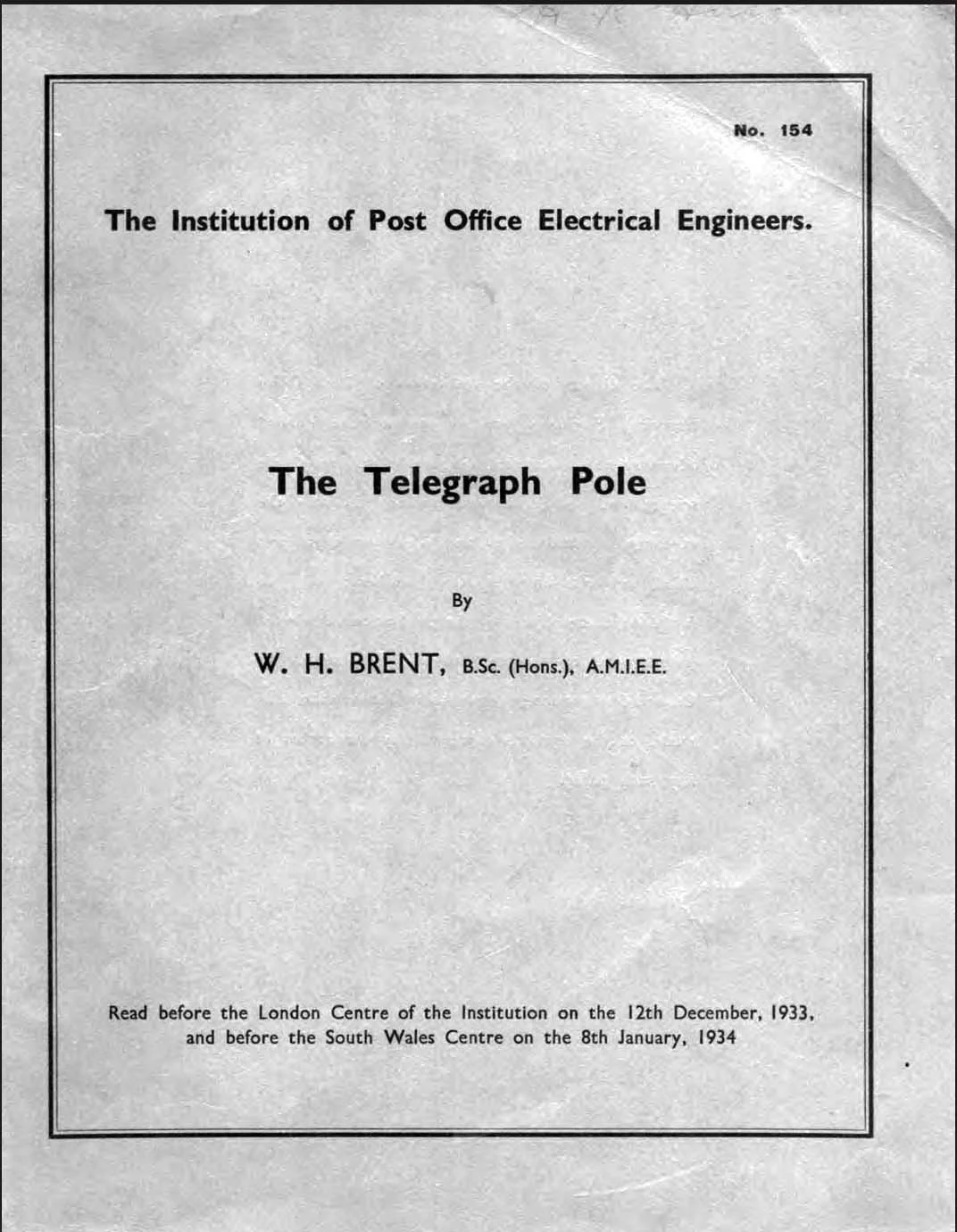
Click above for answer.
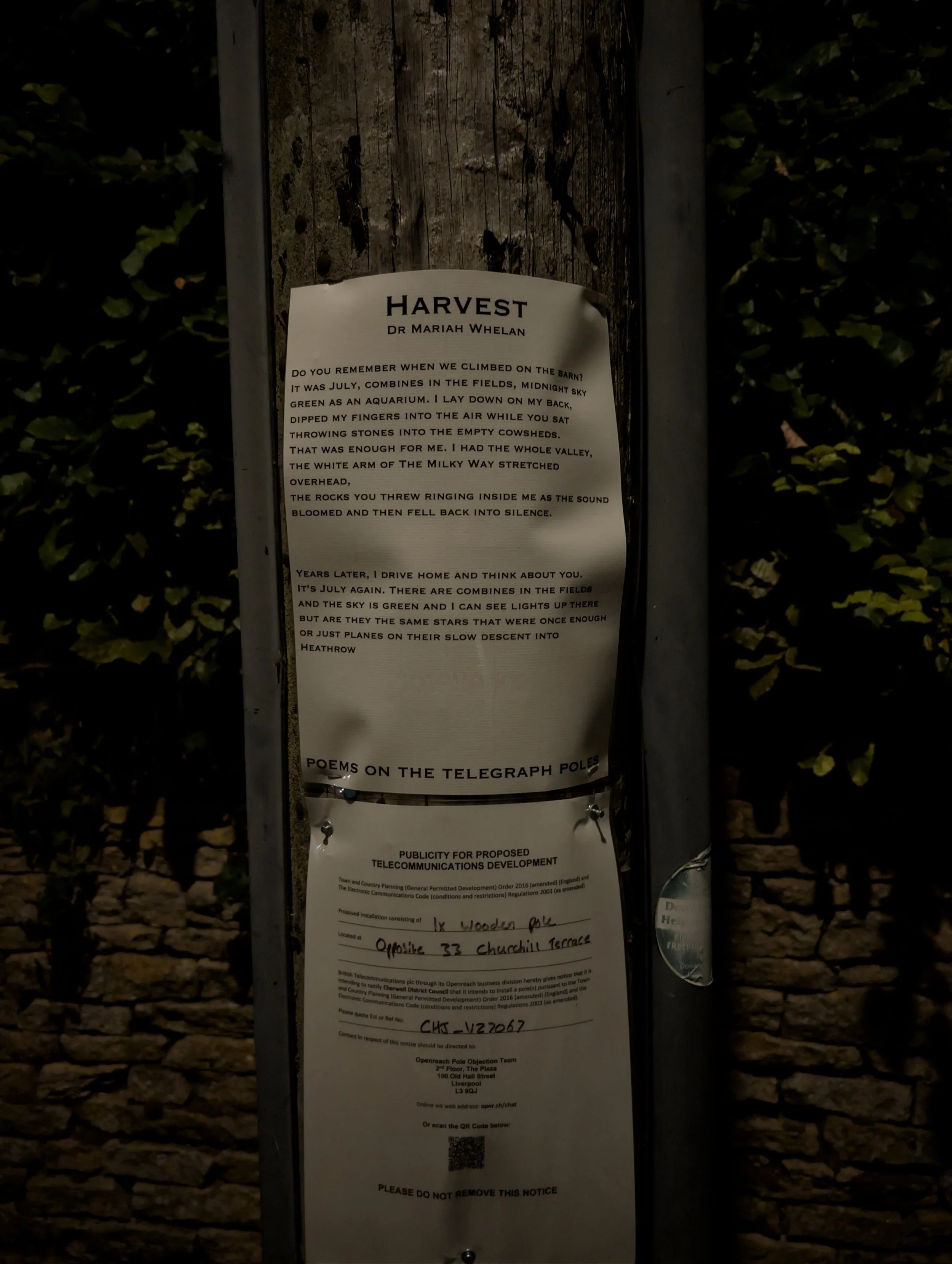
Harvest
Do you remember when we climbed on the barn?
I was July, combines in the fields, midnight sky
green as an aquarium. I lay down on my back,
dipped my fingers into the air while you sat
dipped my fingers into the air while you sat
throwing stones into the empty cowsheds.
That was enough for me. I had the whole valley,
the white arm of The Milky Way stretched
overhead,
the rocks you threw ringing inside me as the sound
bloomed and then fell back into silence.
Years later, I drive home and think about you.
It’s July again. There are combines in the fields
and the sky is green and I can see lights up there
but are they the same stars that were once enough
or just planes on their slow descent into
Heathrow

Imposter Syndrome
Maybe I'll feel gay enough after I / sleep with a
woman / sleep with two women / learn all the
acronyms / shave half all of my head / find a
girlfriend / buy a vest / marry a woman / write
a book about sapphic yearning / pretend that
I've never slept with a man / tattoo HARD DYKE
across my knuckle bones / die of old age holding
my wife's hand / donate my organs to eight young
gays / choose a bell hooks quote for my gravestone
/ or maybe just have them write-in big, capital
letters / HERE LIES HALF A GAY
L. MANTIS
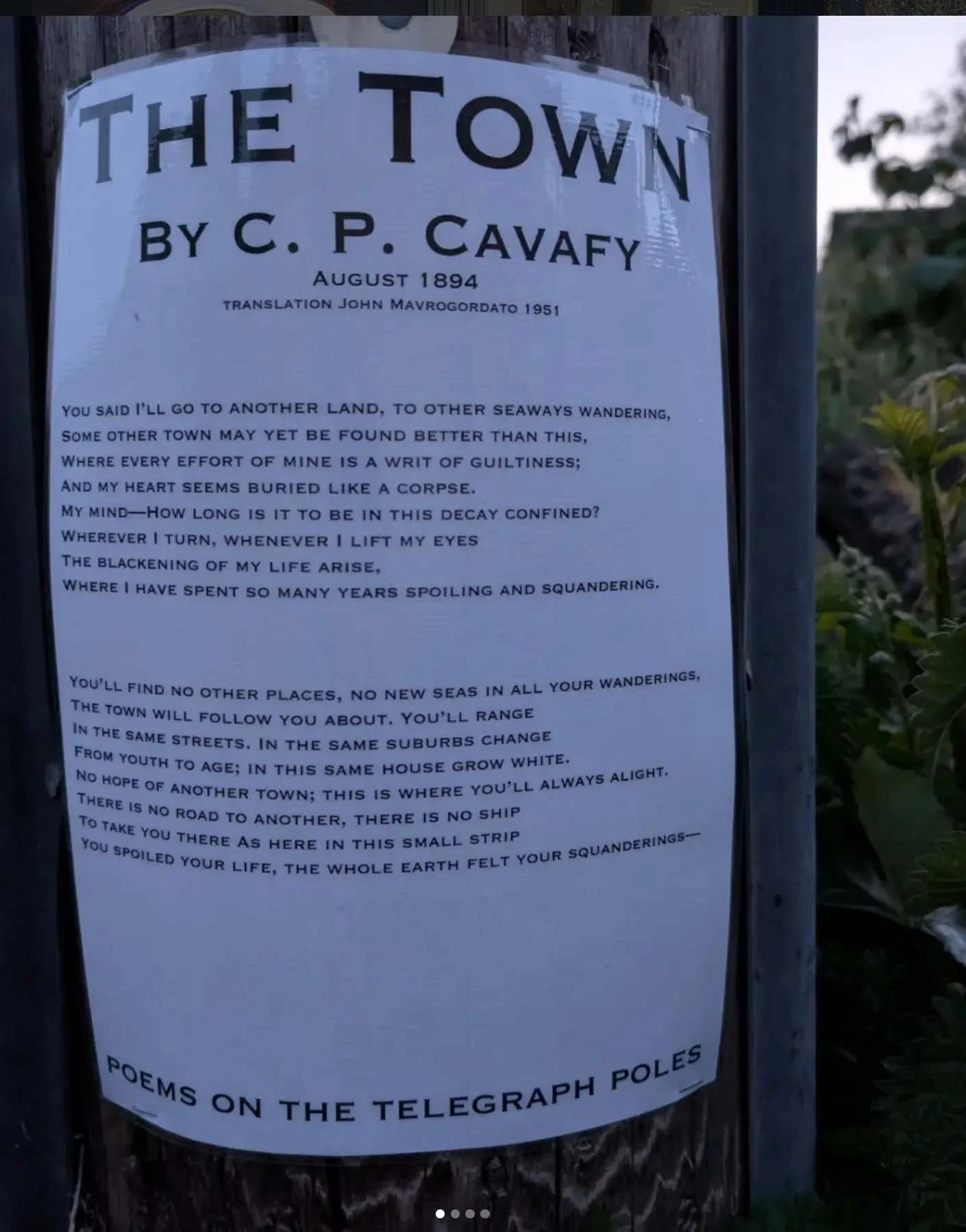
The City
By C. P. Cavafy
You said: “I’ll go to another country, go to another shore,
find another city better than this one.
Whatever I try to do is fated to turn out wrong
and my heart lies buried like something dead.
How long can I let my mind moulder in this place?
Wherever I turn, wherever I look,
I see the black ruins of my life, here,
where I’ve spent so many years, wasted them, destroyed them totally.”
You won’t find a new country, won’t find another shore.
This city will always pursue you.
You’ll walk the same streets, grow old
in the same neighborhoods, turn gray in these same houses.
You’ll always end up in this city. Don’t hope for things elsewhere:
there’s no ship for you, there’s no road.
Now that you’ve wasted your life here, in this small corner,
you’ve destroyed it everywhere in the world.
Copyright Credit: C. P. Cavafy, "The City" from C.P. Cavafy: Collected Poems. Translated by Edmund Keeley and Philip Sherrard. Translation Copyright © 1975, 1992 by Edmund Keeley and Philip Sherrard.
Source: C.P. Cavafy: Collected Poems (Princeton University Press, 1975)
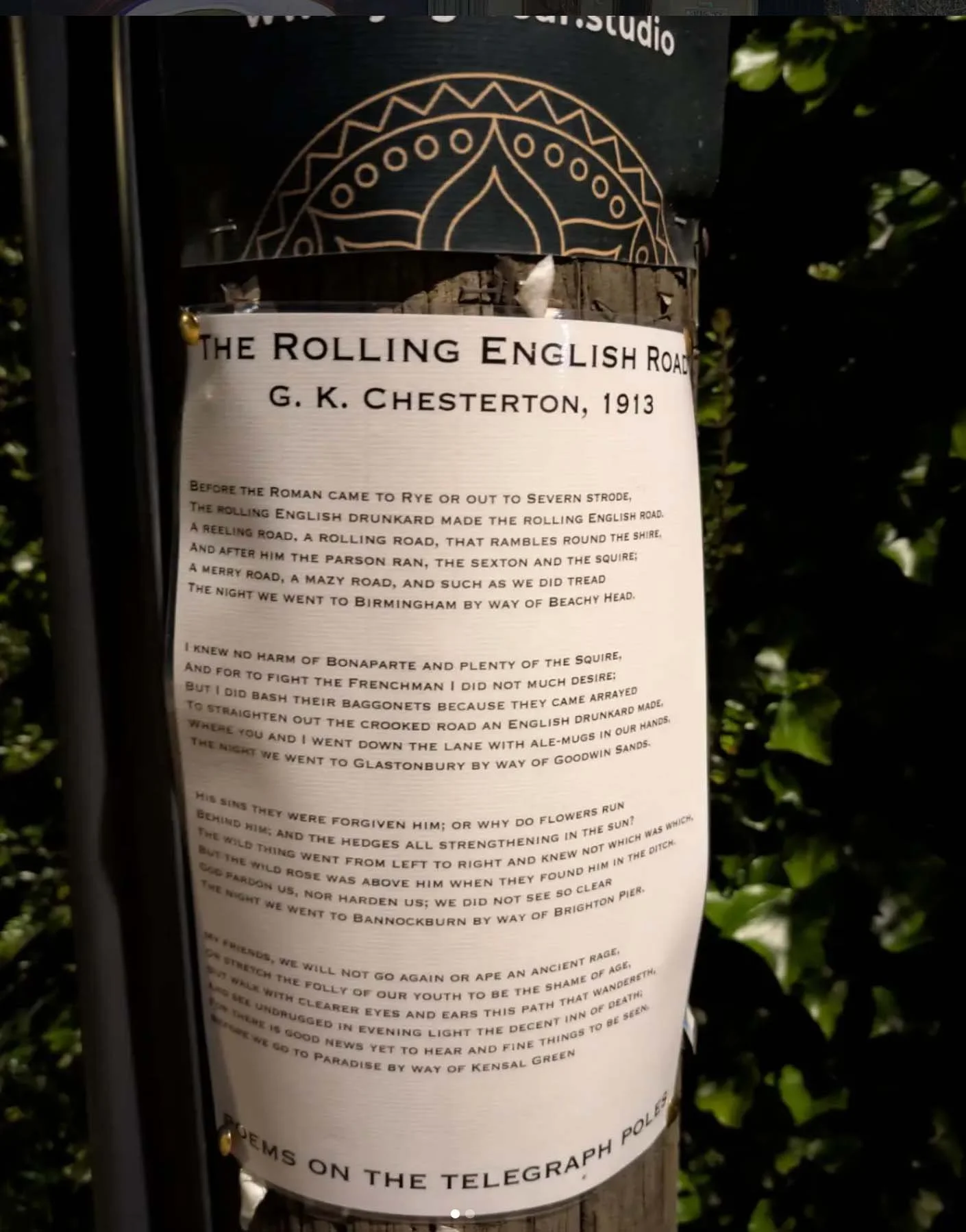
The Rolling English Road
By G. K. Chesterton, 1913
Before the Roman came to Rye or out to Severn strode,
The rolling English drunkard made the rolling English road.
A reeling road, a rolling road, that rambles round the shire,
And after him the parson ran, the sexton and the squire;
A merry road, a mazy road, and such as we did tread
The night we went to Birmingham by way of Beachy Head.
I knew no harm of Bonaparte and plenty of the Squire,
And for to fight the Frenchman I did not much desire;
But I did bash their baggonets because they came arrayed
To straighten out the crooked road an English drunkard made,
Where you and I went down the lane with ale-mugs in our hands,
The night we went to Glastonbury by way of Goodwin Sands.
His sins they were forgiven him; or why do flowers run
Behind him; and the hedges all strengthening in the sun?
The wild thing went from left to right and knew not which was which,
But the wild rose was above him when they found him in the ditch.
God pardon us, nor harden us; we did not see so clear
The night we went to Bannockburn by way of Brighton Pier.
My friends, we will not go again or ape an ancient rage,
Or stretch the folly of our youth to be the shame of age,
But walk with clearer eyes and ears this path that wandereth,
And see undrugged in evening light the decent inn of death;
For there is good news yet to hear and fine things to be seen,
Before we go to Paradise by way of Kensal Green
Would you like to get involved with Poems on the Telegraph Poles, submit poems, or receive our pole-ready files & news? Please fill in the form below
Poems on the Underground (POTU) is a project, started in 1986, to bring poetry to a wider audience by displaying various poems on the London Undergroundrapid transit network and participating websites. Poems on the Underground displays poems by contemporary and classic poets three times a year. POTU also produces booklets free of charge to the public and publishes anthologies.[1]
History
Launched in 1986 with support from the Stefan Zweig programme of the British Library,[2] the Poems on the Underground programme was the idea of three writers, Judith Chernaik, Gerard Benson, and Cicely Herbert, whose aim was to bring poetry to a wider audience. Judith Chernaik, Cicely Herbert, Imtiaz Dharker, and George Szirtes now select poems for inclusion in the programme. London Underground provides space on its fleet of trains, and they and POTU's partners also display the poems on their websites during the duration of the print display. The posters are designed by Tom Davidson.[1]
The first book containing all the featured poems was not published until much later, having been initially rejected by Faber as unlikely to prove commercially viable. In the end, towards the end of the decade, a young Publisher's Representative (salesman) persuaded his employers – Cassell Publishing – to publish the tome when, having failed in his attempt to buy the as-yet non-existent publication as a birthday present for his mother, he felt sufficiently confident of making it a bestseller. He was set a target by the publishing house of selling 5,000 copies by the Christmas following publication, or risk losing his job. But the book – which is still very much in print 27 years later and must rank as one of the best-selling poetry books of all time – immediately sold out and went straight to reprint prior to publication.
Partners for Poems on the Underground include London Underground, which supports the programme, and the Arts Council of England, the British Council, London Arts and the Poetry Society.
The programme
A series of different poems are displayed at any given time, ranging from classical and historical works by such well-loved poets as Blake, Shakespeare and Shelley, to contemporary and emerging poets from around the world. The works are displayed three times a year and have proved extremely popular with the travelling public.
Recent booklets, distributed free to the public, include Young Poets on the Underground, London Poems on the Underground, Irish Poems on the Underground, and World Poems on the Underground. Poems on the Underground also publishes anthologies of Poems on the Underground and the most recent edition is Poems on the Underground, A New Edition, Penguin, 2012.
"The Rolling English Road" is one of the best-known poems by G. K. Chesterton. It was first published under the title "A Song of Temperance Reform" in the New Witness in 1913.[2] It was also included in the novel by Chesterton, The Flying Inn, in 1914.
The poem is written in heptameters. Alliteration is plentiful and "a particularly useful device in the last line of each stanza, playfully yoking the far-flung places together (Birmingham/Beachy Head, etc) and reminding us that, like a pub comic, our narrator is, supposedly, improvising his tall story. When he drops the alliterative yoke in the last stanza ("Paradise ... Kensal Green") you know he's being serious."[3]
In the final line of the poem, Kensal Green refers to Kensal Green Cemetery in London.
A restaurant in the local area, on Chamberlayne road, uses most of the last line, "Paradise by way of Kensal Green" as its name
"The City" (Greek: Ἡ Πόλις) is a famous Greek philosophical poem by Constantine Cavafy. It was written in August 1894, originally entitled “Once More in the Same City.” It was then published in April 1910.
Story
In this poem we witness the poet's futile attempt to leave his past, in which he is trapped, because everywhere he looks he sees "black ruins" of his life.[1] He expresses the desire he had for a trip, which would make him escape from the trivial and bleak reality that is his life. It is not just a fleeting thought, as he emphasizes that he made many attempts to put into practice what he was feeling, however every effort proved useless and his desire ended up as a past reverie.[1]
As this is a philosophical poem, Cavafy wants to educate as well as warn his readers about the values of life.[1] The poet concludes his poem by commenting that if a person has ruined their life in one place, then they have ruined it all over the planet.[1][2] He believed that, if a person does not try to change themselves, they will not succeed in changing anything around them. Happiness is something that comes from within us and remains constant no matter where we are.[3]
Excerpt
Original GreekTransliterationEnglish TranslationΚαινούριους τόπους δεν θα βρεις, δεν θάβρεις άλλες θάλασσες. Η πόλις θα σε ακολουθεί. Στους δρόμους θα γυρνάς τους ίδιους. Και στες γειτονιές τες ίδιες θα γερνάς, και μες στα ίδια σπίτια αυτά θ’ασπρίζεις. Πάντα στην πόλι αυτή θα φθάνεις. Για τα αλλού - μη ελπίζεις - δεν έχει πλοίο για σε, δεν έχει οδό. Έτσι που τη ζωή σου ρημάξες εδώ στην κώχη τούτη την μικρή, σ’όλην την γή την χάλασες.Kainoúrios tópous den tha vreis, den thávreis álles thálasses. I pólis tha se akoloutheí. Stous drómous tha gyrnás tous ídious. Kai stes geitoniés tes ídies tha gernás: kai mes sta ídia spítia aftá th’asprízeis. Pánta stin póli aftí tha ftháneis. Gia ta alloú - mi elpízeis - den échei ploío gia se, den échei odó. Étsi pou it zoí sou rímaxes edó; stin kóchi toúti tin mikrí, s’ólin tin gí tin chálases.There are no new places you’ll find, you’ll catch no other tide. This city will always follow you. The streets you tread will be the same, it’s in these same houses your head will turn grey, in the same neighbourhoods that you’ll age. Always you’ll end up in this city. Don’t hope to turn the page to an Elsewhere for which there’s no ship for you, no road shows clear. Just as you destroyed your life back here in this tiny retreat, so you ruined it world-wide.
Structure
The City features aspects predominantly focused on despair, pessimism and sadness.[4]
Both stanzas have an almost identical metrical pattern: 16-14-14-11-15-12 or 10-12-16 syllables.[5]
The rhymes, mostly homophonous, are abbccdda and effggdde (rhymes a and e are almost identical).[5]
The poem is written in second person singular as the poet wants his readers to relate and empathise with his feelings.[5]
The first stanza captures the feelings of a person with hopelessness who wants to improve as well as build new foundations for their life.[2] Specifically, it refers to someone who wishes to leave their home but feel as though they cannot fix their life in the process, no matter how hard they try.[3] In the quote, "through the heart buried as if he were dead" emphasises the depair and desperation one feels. Unfortunately, the poet sees that the years are passing by without him having achieved anything worthwhile and important in his life.[3] He feels like his life is slipping right through his fingers.[3]
In the second stanza of the poem, Cavafy mentions that "you will not find new places, you will not catch another tide."[3] In this way, the poet wants to emphasize a person's inability to escape from themselves and their choices.[2][3] The most notable line "the city will follow you" implies that the past can haunt a person as wherever they go they will not be able to escape from their own truth, their own reality and their own failures.[3]
Symbolism
Alexandria plays a key role as a symbol in several of Cavafy's poems.
In this poem, Alexandria is the symbol of the past that follows the protagonist everywhere. It is presented as the sign of failures, troubles and mistakes that people experience in their lives, whether they brought upon themselves or not.[6]
Translations
There are several translations of the poem, the most popular one being Keeley and Sherrard (1992). However, several translators have noted that some nuances of Greek have been surrendered for the sake of a 'poetic' translation.[7]Rae Dalven, best known for her translations of Cavafy, focused on the tone of voice and accuracy of language in her translation.[8] John Mavrogordato, an Anglo-Greek academic, titled his translation "The Town".[9] Diane L. Durante, a student of Greek and Latin has translated the poem more literally.[7] André Aciman wrote a short article on the role of the translator through the comparison of different translations of "The City".[10]
Cultural impact
An English translation of the poem appears in the appendix of the Lawrence Durrell novel Justine; Cavafy is a character in the work. The narrator of Justine refers to his translation of this poem as "by no means literal".[11]
The poem is also featured at the end of the 2007 film Japan Japan, as the protagonist Imri is coming to terms with his failure to leave Tel Aviv and emigrate to East Asia. The poem is interwoven with a sequence documenting the Israeli West Bank barrier and the Qalandia checkpoint.
UC-NRLF B 3 110 2bT mmn WHAT IS POETRY? In preparation, uniform with this volume and with The Silence of Love, a new volume of Poems, by the same author, entitled Without and Within. WHAT fS POETRY? BY Eib^OND HOLMES AUTHOR OF THE SILENCE OF LOVE. Of THE VERSITY OF rifi, I WHAT IS POETRY? " Poetic creation, what is this but seeing the thing sufficiently ? The word that will describe the thing follows of itself from such intense clear sight of it. T. Carlyle. 0^ -\\* '•i\^ WHAT IS POETRY? PART I. FEELING. What is poetry ? There are as many answers to this question as there are minds that take an interest in it ; for in the attempt to answer it each of us is perforce thrown back upon that unformulated philosophy which is an essential aspect of his inmost self, a philosophy which emancipates him from the control of all schools and sects, and in expounding which (so far as it admits of exposition) he tells the story of his heart and makes confession of his faith. When I ask myself, What is poetry ? I amsetting myself a task which far " exceeds man's might." I am inviting myself to solve, by implication, all the master problems of human thought. And if I take my own answer seriously, I do so not because I think that the question can be answered, but because I knowwell that it cannot ; not because I flatter myself that I have succeeded where others have failed, but because I see in the failure which awaits us all, convincing proof that the problem is worthy of our highest endeavours, and that each answer in turn is as real and true as the individual life which it summarizes and the personality which it expresses and reflects. Cardinal Newman has somewhere said that without assumptions no one can prove anything about anything. To prove that poetry is what I believe it to be is beyond mypower and beyond my aim. But the scope of Newman's aphorism may surely be extended. Without assumptions no one can begin to think about anything. For every enterprise of thought one needs what soldiers call a base of operations. I am about to set out on one of the most desperate of all enterprises ; and in order to provide myself with a base, I must ask to be allowed to make two initial assumptions : (i) that poetry is the expression of strong and deep feeling ; (2) that wherever there is feeling, there is something to be felt. Let us consider each assumption in turn. Poetry is the expression of strong and deep feeling. By strong feeling I mean feeling that is vehement, passionate, intense; feeling that burns rather than broods. By deep feeling I mean feeling that is subtle, delicate, mystical ; feeling that broods rather than burns. Is it possible for feeling to be strong without being deep, or deep without being strong ? Yes and No. Strength can exist apart from depth ; and depth can exist apart from strength. But neither can develop itself freely or fully ex- cept it be modified by the other. Feeling that is strong without being deep is violent ; in other words, it is not really strong. Feeling that is deep without being strong is dreamy and fantastic ; in other words, it is not really deep. It needs the red light of passion ta pierce the darkness of the inner life ; but if the fire of passion burns too furiously, it will speedily burn itself away. It must be understood then that in poetic emotion, as I conceive of it, strength is inseparable from depth ; and, therefore, that whenever I apply the term passionate to poetry or the poet's heart, I take for granted that the passion is not all flame and fury, but is strong enough to control itself. That poetry is the expression of strong and deep emotion, that, in Wordsworth's well- known words, it is the "spontaneous overflow o{ powerful feelings,'' will, I think, be generally- admitted. When I use the word poelry, I am of course thinking of the higher kinds of poetry. I am thinking of the plus vales, the inspired bard. In ordinary parlance the word poetry is used as loosely as the word music. But just as there is an impassable abyss between the music-hall song of the hour and the symphony of a great master, so there are many kinds of verse which are not in the slightest degree poetical. To try to prove an assumption is to undermine the very foundations of one's thought ; but if proof were needed of the truth of my thesis that poetry is the expression of strong and deep feeling, it would surely be found in the indisputable fact that whenever one of the lower kinds of poetic composition rises for a while to the level of true poetry, it is lifted above itself by a passing wave of genuine emotion. Satire, for example, becomes poetical when, and only when, it is inspired by saeva indignalio ; and even vers de sociele, as they are called, become worthy of the sacred name of poetry when, but only when, they are pervaded by that subtle humourwhich is near of kin to one of the deepest and most delicate of all feelings, pathos. There is one significant point of view from which it may be profitable for us to consider the connection between poetry and feefing. The poet is commonly regarded as the typical embodiment of genius, as the representative of those who owe their best work to a constrain- ing power which they cannot control. In ancient days he was supposed to be divinely inspired ; and we still speak, not wholly in jest, of the divine afflatus, of seasons of inspiration, of the presence of the Muse, and so forth. Now when we say that true poetry is the outcome of genius, we imply that the true poet has an essentially passionate nature. For one of the leading characteristics of genius, and the one which more than any other has led men to regard it as divinely inspired, is its tyranny, the irresistible nature of its influence, the inevitable character of its work. On this point the evidence of those who have felt the storm and stress of genius must carry special weight. " I do but sing because I must " is the cry—the boast shall I call it, or the apology ?—of every true poet. And there is no true poet who has not again and again been mastered by that strange feeling of helplessness in the hands of an inward and spiritual power, to which the Hebrew prophet gave memorable expression : " Then I said, I will not makemention of Him, nor speak any more in His Name. But His Word was in mine heart as a burning fire shut up in my bones, and I was weary with forbearing and I could not stay." The belief in inspiration has not wholly died out ; and I, for one, see no reason why it should ever die. The doctrine needs but a change of notation to become entirely true to fact. The poet is indeed stirred and swayed by a power which is so far not his own, that he cannot control its movements or consciously realize either its origin or its goal. But that power, though certainly supernormal, is not supernatural. Nay it is Nature herself, to use a word whose very comprehensiveness enables one to use it in safety, it is Nature herself that inspires the poet, moving him to her own ends and for her own purposes through the medium of an inborn bent of his inner being, a persistent pressure which she never relaxes until he has yielded himself to her will and begun to follow her guidance. Not that his submission, however complete it may be, can bring him lasting relief. For one of the most vital characteristics of poetic genius is that its claims upon its victim are infinite ; that as it punishes his rebellion by blasting his life with the curse of a clinging sense of failure, the curse of having missed his destiny and been treasonably false to his higher self, so it rewards his obedience, not with peace of mind, but with new unrest, by filling his heart with new desires, and showing him from each new height that he wins a higher sky-line and a wider world. Thepressure put upon the poet by this bent of his nature—a pressure which is now strong and steady, now sudden and violent—is realized by him as feeling, so deep and so intense as to deserve the name of passion. Passion meanssuffering. The passionate heart is one that suffers much. What the poet suffers is not trouble or sorrow, though even to these he is perhaps more than ordinarily sensitive, but the stress of Nature's influence, the despotic might of his own inborn genius. In fine, the poet's is a " passionate heart " for this, if for no other reason, that it is his doom to be constrained and mastered by forces which are not his own, as being for ever beyond the control of his consciousness, and yet again intimately his own, as coming from his inner nature, as being in fact part of his buried self. Perhaps I am dwelling too much on the emotional side of poetry. Even Wordsworth, who almost revered passion, remembered that the poet must think as well as feel. Havingtold us that " all good poetry is the spontane- ous overflow of powerful feelings," he goes onto say, "though this be true, Poems to whichany value can be attached were never producedon any variety of subjects but by a man who,being possessed of more than usual organicsensibility, had also thought long and deeply.For our continued influxes of feeling aremodified and directed by our thoughts, whichare indeed the representatives of all our pastfeelings." I admit that the poet must have areflective as well as a passionate nature, andthat, if he is to do good work, his thought mustinterpret and co-ordinate his feelings, and sodeepen, widen, and finally exalt and intensifythem. But I hold that in the poet's mindthought must operate continuously and half-unconsciously, and that at the time of inspiration, though its influence must be apparent, it must itself be in the background ; just as inthe work of poetic composition artistic studyand experience must make themselves felt, butmust not betray their presence. MoreoVer,thouo;-h it is doubtless true that " our thouofhtsare the representatives of all our past feelings,"it is not less true that our feelings, which arebeing continually ' modified and directed byour thoughts," are at any given moment repre-sentative of all our past thoughts ; and per-haps it is even more essential for the poet's8 thoughts to be "steeped in feeHng " than for his feehngs to be controlled by thought. Thenagain, the end and aim of thought is to lead us, by more or less circuitous routes, to truth. But the moments of exalted feeling are also moments of " passionate intuition," and, therefore, of clear and unerring insight ; moments in which we seek truth no longer, but embrace it and make it our own. Toquote Wordsworth once more, " the adamantine holds of truth" are built, not merely by "reason," but also by " passion, which itself Is highest reason in a soul sublime." Even brooding, which may be defined as the reverie of passion, and which is the kind of reflection that is most congenial to the poetic temperament, is, I think, a higher form of meditation than thinking (in the strict and narrow sense of the word) ; for in the former state the mind lies open to the profound and subtle influences of Nature, whereas in the latter consciousness, that transparent mtdiumwhich is opaque to the higher rays of spiritual light, interposes itself between the soul andtruth ; and whereas the brooding mind, in the course of its aimless wanderings, may sometimes come in contact with hidden truth, the mind of the systematic thinker is led astray byits very desire for accurate knowledge, and fails in proportion to the completeness of its success. In any case, it must, I think, be admitted that the reflective side of the poet's nature is always subordinated to the emotional, and that it is the latter, not the former, which differentiates him from other men. To what extent, we must now ask ourselves, is the poet differentiated from othermen ? When we say that he differs from themin having a stronger and subtler sensibility, do we mean that the feelings which it is his mission to express, are peculiarly his own.' Do we mean, in other words, that poetic genius is an accidental departure from what is real and central in the nature of man ? Surelynot. If poetic genius were a mere freak ofNature, the poet would sing to himself alone, in other words, he would not sing at all. Language always expresses a common measure of experience. Were the poet's feelings exclusively his own, he could not possibly communicate them to others, for there would be nocommon ground on which he could meet his fellow-men. To give expression to monstrousor eccentric feelings is not the function of thepoet. The feelings that inspire him belong to ''the general heart of man." Nay, they are oflO the Inmost essence of human nature. Thedifference between the feeHngs of the poet and those of ordinary men is, to use the most pregnant and suggestive of antitheses, the difference between what is actual and what is potential. FeeHngs which are actual in the poet, in the sense of being vividly realized and brougrht near to the lig"ht of consciousness, have but a potential existence in the hearts of ordinary men. But they are there, in the darkness of the " buried life," waiting to be actualized ; and it is because they are there that the message of the poet goes home to the hearts of his listeners. When we are movedby poetry there is no transfusion of feeling. What happens is, that expression is given to emotions which are ours and which we know to be ours, though we had not actually experienced them till we listened to the poet's words. The terms potential and actual are of course always used comparatively. What is actual from one point of view is potential from another. 1 sometimes think that every feeling is the embryo of another and a deeper feeling, and this of another, and so on ad injinituin. Thus the sense of outward beauty is implicit in the sense of sight : the sense of inward andspiritual beauty is implicit in the sense of outward beauty ; and in the sense of inward II and spiritual beauty there is endless gradation, depth beneath depth, dream within dream, glory beyond glory. It follows from this con- ception that, in the act of consciously realizing a given feeling, we are unconsciously cominginto contact with another and a deeper feeling ; and, further, that the more clearly conscious we are of what goes on in the more accessible part of our inner life, the deeper we are able to go into its darker mysteries. It is in this respect, I think, that the poet differs most from ordinary men. The profounder side of humannature is nearer to the light of consciousness in him than in them ; and so he is always con- versant with deeper feelings than they are, conscious of feelings of which they are but dimly conscious, dimly conscious of feelings of which they are wholly unconscious. Themovement from consciousness to unconsciousness is, I need hardly say, as continuous as the chanee in our northern latitudes from licrht to darkness ; but to express the contmuity of Nature's processes is, unhappily, beyond the power of human speech. It would seem, then, that the deep andstrong feelings which poetry expresses are potentially common to all men, and that they belong to that deeper side of human nature which is for most of us an unknown land. 12 This unknown land is at last beginning to interest human thought We hear muchnowadays of the self that lies below the level of consciousness, the "subliminal self " of the psychical inquirer, the " buried life " of Matthew Arnold's beautiful poem, the " vie profonde,'' the '' dmey' the '' contree lointaine'' of the Belgian mystic. Systematic attempts are being made to explore this shadowy region, in the hope of discovering what I may perhaps venture to call the magnetic pole of existence. Whatever may be the remoter issue of these daring enterprises, there is one thing at least which the explorers will not fail to report to us, namely, that the "buried life " is the home of those inward and spiritual feelings which it is the mission of poetry to express and reveal. Let us now consider the second of myinitial assumptions. Wherever there is feeling, there is some- thing to be felt. This proposition is, I think, "as true as truth's simplicity." Feeling must have its object, for it is always the product, direct or indirect, of experience ; and experience meanscontact with fact. We may, if we please, define feeling as the line or surface of contact between one's self and one's environment. It is 13 only through the medium of our feelings that ' things," as we call them, are revealed to us : and though we find it convenient to assumethat things exist apart from the feelings that they generate, this distinction always breaks down when onr thought leans heavily on it ; and in the last resort we find ourselves compelled to confess that feelings and things are inseparable- The apparent exceptions to the rule that I have formulated, the cases of (so- called) illusion, need not detain us long. For, in the first place, there may well be more in the phenomenon of mental illusion than is dreamedof in our philosophy ; and, in the second place, the rule which these abnormal occurrences seem to violate does not pretend to be, and for my purpose need not be, more than approximately correct. Feelings then are generated by experience of things ; and as there are different kinds of feelings, so we may assume that, corresponding to these, there are different orders of things, different aspects of existence, different strata of reality. In some respects the different feelings are incommensurable with one another ; but there is at least one point of view from which it seems to be possible to classify them, to arrange them, one might almost say, in order of merit. Some feelings announce themselves 14 to us as being higher, purer and nobler than others, and also (the one announcement being implicit in the other) els having been generated by higher realities. For example, the sense of beauty announces itself to us as being a higher sense than the sense of sight ; and in and through this announcement it tells us that beauty is a more real property of things than either colour or form. So, again, the pleasure which we derive from hearing one of Beethoven's symphonies announces itself to us as being far higher and purer than the pleasure which we derive from eating a well-seasoned dish ; and we feel instinctively that the things, whatever they may be, which generate the former kind of pleasure are immeasurably higher in the scale of reality than the things which gratify the sense of taste. Here, then, we seem to be provided with an inward criterion and standard of reality, a scale of dignity in our feelings which corresponds with a scale of reality in the things that surround us. Are we to accept this criterion, this standard of worth with which Nature has equipped us ? Well, in the first place, we must accept it ; for, speaking generally, it may be said that each feeling in turn constrains us to take it at its own valuation. And, in the second place, it may fairly be urged that apart from this inward 15 standard we have no criterion of reality. It is indeed sometimes contended that the objects of our bodily senses are real things, and that the objects of all our other senses are illusions and dreams. But surely to say that this little animal which calls itself Man, crawling- about on the surface of one of the lesser satellites of one of the least of the innumerable stars, is able by means of his bodily senses, the senses which he shares with other animals, to see the Universe as it really is, is to make the mostaudacious and arrogant of all anthropocentric assumptions. Dismissing this hypothesis as gratuitous and absurd, we must either sav that there is no standard of reality, or accept the inward standard and allow it to control our notions of what is real and true, and through this to determine our ideals and regulate our lives. Now the strong and deep feelings whichpoetry expresses unquestionably belong to that higher side of one's being which has reality, in the deeper sense of the word, for its objective counterpart. Once the validity of the inwardstandard has been established, it becomes clear that the objects of the poet's feelings are as much more real than the superficial aspects of Nature and of life, as the feelings themselvesare deeper and stronger than the surface feel- i6 Ing of the average man ; for all who have ever experienced poetic emotion, whether in its creative or its responsive mood, will acknowledge that it sets a high value on itself, that it is imperiously self-assertive, that its very- presence is a summons to us to accept its valuation not of itself alone but of all the feelings that sway us, and through these of all the things that we seek or shun. As there is a buried or subliminal self behind and be- yond the ordinary self, so there is (we must believe) a buried world behind and beyond the ordinary world, —an order of things which far transcends in grandeur and reality that ap- parent order of things which, for the average man in his average moods, is the all-in-all of existence. To discern this buried world through the medium of his abnormal sensibility, and to reveal it to other men through the medium of kindled emotion, is the true function of the poet. In opposing the real to the ap- parent order of things I am using dualistic language, which I cannot justify except by pleading that human speech is unable to measure the infinite subtlety of Nature. I knowwell that there are not two orders of things only, but many orders, and that the movement from the pole of appearance to the pole of reality is as continuous as any other natural t; movement ; and I can even amuse myself byimagining that, as we have feeling behindfeeUng, carrying us deeper and deeper into the darkness of the buried self, so we haveworld behind world, carrying us deeper anddeeper into the vie profonde of the Universe.Nevertheless, the exigencies of speech beingwhat they are, I must continue to oppose thereal to the apparent order, trusting that myreaders will interpret the words in the sensein which I use them. The poet then sees the real order of things^ and his vision kindles profound emotion in hisheart. That this view of poetry, thoughseldom consciously taken, is in substantialagreement with what I may call the acceptedview, seems to be proved by two significant facts. In the first place it has ever been heldthat in the poet's nature passion has its counterpart in vision. In bygone days men believedthat the poet was divinely inspired, in otherwords that hidden truth was supernaturallyrevealed to him ; and this belief has its modernequivalent in the idea that insight, the power of* This thought is not wholly fantastic. It means no more than this, that Reality—the inmost soul of things—reveals itself under different aspects to the different orders of our perceptive faculties, from the simplest and most sensuous to the obscurest and most spiritual, and that each aspect in turn constitutes a new " world." i8 seeing into the heart of a thing and discerning its hidden properties, is of the very essence of the poetic faculty. In the second place, it is a commonplace of criticism that in the higher forms of poetic creation, such as the Drama, fidelity to Nature is the first thing needful, and its absence the worst of defects. We are apt to talk about the poet as if he were a mere dreamer of idle dreams ; but we know in our hearts that he is a seer and revealer of hidden truth. Even the worldling's earnest conviction that poetry is all moonshine is but a back eddy on the surface of an irresistible stream. We must now ask ourselves, where is the real order of things to be found } Is it in our hearts or in the Universe that lies around us } The poet is no metaphysician, but (perhaps for that very reason) he is the best of philosophers. He resolutely refuses to separate the inward from the outward, the subjective from the objective aspects of existence. The real order of things is in Nature, and Nature is a living and indivisible -whole. That is the whole of his philosophy, and it has the twofold merit of being a simple and comprehensive conception. He may never have heard of what metaphysical writers call the ''ego" but if you were to talk to him about it, he, or rather his "subliminal self," would probably tell you 19 that the ego belongs to the outward worldquite as much as the outward world belongsto the ego; or, again, that mind volatilizesmatter in the act of perception quite as muchby diffusing itself through material things andentering into quasi-chemical combination withthem as by absorbing them into itself. Thedualism of the common-sense philosopher is profoundly repugnant to the poet : so is theone-sided monism of the materialist or the'V^i? "-maniac. Hence it is that, when he dealswith outward nature, he is no mere wordpainter. He leaves it to the second-ratenovelist to describe scenery, as we call it, forits own sake. It is the spiritual significance ofoutward things which appeals to him, and towhich he strives to give expression in his verse.The intense sympathy which he feels foroutward things is thrown back, like reflectedlight, upon the inner life of man ; and the all- pervading unity of Nature makes the outwardorder symbolical at every turn of the inward.More than that, the feelings which outwardthings awake in him are ever transformingthemselves into feelings about inward things.Thus for him the violence of the autumnaltempest sweeps through the voids of thehuman heart ; and when he watches the "longmoon-silvered roll " of the sea, the " peace that20 passeth all understanding "—a peace which is half passion, half repose—seems to shed apathway of light on the mystic depths of the"buried life." And if he spiritualizes theoutward world, he gives form and substance to the inward. The soul for him is no abstraction, but a reality whose life is inextricablybound up with that of " inanimate Nature,"expresses itself in outward action and can bedepicted only by the aid of material images. An illustration will help me to explainwhat I mean. The summer dawn is, I think, one of the most beautiful of all physicalphenomena. The purity and freshness of theair, the speaking stillness, the ever-changingcolours and ever-growing glories of the easternsky, all minister to our senses and fill us withdelight. But for some of us this deep emotiontransforms itself into a larger and profounderfeeling. The triumph of day over night hasever been symbolical of the triumph in theUniverse of spiritual light over darkness ; butwhen we witness the dawn and receive its message into our hearts, we are not contentmerely to recognize the fitness of this simile. In and through the feelings that the beautyand wonder of the dawn have generated,another feeling, at once more subtle and moreintense, begins to live and work in our hearts ; 21 a feeling of inexpugnable certitude ; a sense ofpartnership in a world-wide and eternal victory ; an overmastering conviction that the problemswhich baffle us, the riddles which mock us, have no real existence, the whole course of Nature being in very truth as sure, as clear, and as glorious as the dawn of day. And as this feeling takes possession of us, we seem at last to become one with the " pure eternal course of things," to share in its transcendent serenity, in its absolute immunity from fear andbewilderment and doubt. It is the function ofthe poet who describes the dawn to experience this incommunicable feeling and awake it in us. He can do this by so painting the dawn as to ravish our bodily senses through the medium of memory and imagination, and then leaving it to us to discover, behind and beyond the moresensuous feeling, that deeper emotion which I have vainly tried to describe. We are all familiar with Shakspeare's two immortal couplets : " Night's candles are burnt out, and jocund day Stands tiptoe on the misty mountain-tops '' and " But, look, the morn, in russet mantle clad, Walks o'er the dew of yon high eastern hill. For me all the magic of the dawn is in these 22 lines. All my past experiences of the early summer morning live again as I repeat to myself their simple words, and once more, in and through my half-sensuous delight, I read for a moment the innermost secret of the Universe. But sometimes the poet leads us nearer to the spiritual feeling and half suggests it to us. When Tennyson tells us that the breeze which heralds the dawn " died away ; ' And East and West, without a breath, Mixt their dim lights, like life and death, To broaden into boundless day." he reveals the feeling of triumphant conviction even to those who had never been conscious of its existence, he shows them that it belongs to them and has ever belonged to them, and he makes it live and work in their hearts.I am trying to prove that in the poet's philosophy the inward and outward aspects ofexistence are ever tending to lose themselvesin a higher unity. In the lines from " In Memoriam," which I have just quoted, wesurely find an apt illustration of this tendency. The dawn of hope in the poet's heart after along night of sorrow, sends him for sympathyto earth and sky at the mystic hour of their dawn ; and then and there, in the very heart of23 inanimate Nature, he finds himself face to facewith the most inward and spiritual of all experiences. His individual hope loses itself in a mighty hope for the whole Universe : nay,hope itself passes beyond itself into an all- embracing and all-conquering certitude, asbefore his gazing eyes the " dim lights " of" East and West," of " life and death " " broaden into boundless day." It has been well said that the poet always seesthe universal in the particular. The reason ofthis is that he goes so deep into himself (and, therefore, into outward things) by the force ofhis emotion and insight, that he at last reachesa level of existence below that (perhaps I ought to say above that) at which Natureseems, for the individual consciousness, to bifurcate into the subjective and objectiveworlds ; a level which is, comparatively speaking, near to that universal, world-deep life in which all things—inward and outward, animateand inanimate—live and move and have their being. He is thus able to free the individualego from the bonds of subjectivity, and to sendit forth into the outward world, whence, after diffusing itself through all material things, it returns to him as the universal eo-o, —from onepoint of view the inner life of the Cosmos,24 from another his own true self. In other words, he both spiritualizes the outward and visible world, and universalizes the inward andspiritual life. I sometimes think that the very- mainspring of poetry is a desire—a dim andinstinctive, but profound and passionate desire —to escape from self (in the narrow sense of the word), to expand the soul till it shall transcend all wonted limits, and at once lose and find itself in the larger life of the living Whole. If this be so, then the old-world ideas of poetic ecstasy, rapture, inspiration, of the poet being carried out of himself, transported beyond himself, may after all have somefoundation in sober fact. The desire to escape from self may be in some sort its own cause and its own fulfilment. We shall do well, then, to follow the guidance of the poet, and say that the hidden realities which kindle poetic emotion belongneither to the inward nor to the outward order, but to the cosmic order, to Nature as such, the buried life of the poet's heart being strangely akin to, and perhaps in the last resort identical with, the buried life of the world that lies around him. Reality, such reality as Man is competent to discover, reality, whereveror whatever it may be, is the object of the poet's vision, and the source of those large and25 E exalted feelings to which he seeks to giveexpression. That I may the more clearly explain myconception of poetry, I will now try by its. aidto solve certain insoluble problems, with whichevery lover of poetry is fated to tormenthimself. In what relation does poetry stand to science ? The question is often asked, seldomanswered. Both poetry and science "find thereal in the unapparent." Both go below thesurface of things. Both go behind and beyondwhat is palpable. The difference betweenthem is that from the same starting point theygo off in diametrically opposite directions,* It will be asked. How can poetry and science both gobelow the surface of things and yet go off in diametrically opposite directions ? In answer to this question, I can but say that it is never wise to lean heavily on a metaphor. I havesaid much about the buried life, the deeper feelings, the life below the surface of consciousness and so forth ; but I havenever allowed my thought to become enslaved to this metaphor, for such it is, of depth. We all know from experience that wehave two kinds of sub-conscious life, one material and the other spiritual. Nearly all the processes of our animal life—processes of digestion, secretion, disintegration, re- integration of tissue, &c. —go on without our being in the least aware of what is happening. But this sub-conscious life of the body has nothing in common with the inner life of the soul. If the former life may fitly be spoken of as sub-conscious, the term super-conscious ought in strictness to be applied to the latter, conscious- ness itself being likened to the surface of the sea, which is also 26 science in the direction of analysis, poetry of higher synthesis. I have tried to show howpoetry deals with the phenomenon of the dawn. We speak of the dawn as a physical phenomenon. It is really a synthesis of an infinite number of physical phenomena. Science is ready, if we ask it, to take each of these and analyse it into its constituent elements and underlying laws. In this way it carries us beyond and behind the apparent, but in doing so it disintegrates the objects of our the surface of the atmosphere, and which is balanced, as it were, between the two infinities of water and air. This simile may serve to throw light on the antithetical relation in which poetry stands to science. If the conscious life of body and soul, which seems to us in our ordinary moods to be the whole of life, has as its objective counterpart that superficial aspect of existence which seems to us in our ordinary moods to be the whole world, may it not be that the sub-conscious life of the body has as its objective counterpart that material base of existence towards which science is ever tending to work its way by analysing things into their parts and elements, while the sub-conscious life of the soul has as its objective counterpart that supreme synthesis towards which poetry is ever tend- ing to work its way by building things up, in and through the act of perception, into indivisible wholes. (It is worthy of note that both in the sub-conscious and in the super-conscious life the distinction between subject and object, which is clearly marked in the light of consciousness, is ever tending to vanish). But though this simile is useful and suggestive, I propose, when dealing with the sub-conscious life of the soul, to adhere to the time-honoured metaphor of depth : I propose to say, in accordance with established usage, that poetry expresses dfep emotions which have their home in the buritd life. 27 emotions and disenchants our hearts. Onebyone, the various quaHties of things, from themost spiritual down to the most material,vanish at the probing touch of science, untilat last we begin to see looming in the dimbackground, the phantom shadows, the paleabstractions of Mathematics, the science thatunderlies all other sciences, the Goddess of thedead, " Who gathers all things mortal With cold immortal hands." We are not deeply moved when the physicisttalks to us about the rotation of the earth onits axis, the declination of the sun below thehorizon, and the reflection of its light by theair and the clouds and vapour suspended in it : but we are deeply moved when the poet tells us (the words are so beautiful that I must askpermission to repeat them once more) that " East and West, without a breath, Mixt their dim lights, like life and death. To broaden into boundless day." The physicist disintegrates the various pheno-mena of the dawn. The poet fuses them bythe force of his emotion into the crlorious andwonderful whole which generates his emotion,poetic emotion being essentially a synopticfaculty, whose very receptivity makes it crea-28 tive and whose fire is both lit and reflected by the objects of its vision. And as theemotion deepens, even this synthesis no longercontents him. The whole panorama of thedawn becomes a transient aspect of a higherand yet more spiritual synthesis, and he seemsat last to be feeling his way towards thehighest of all syntheses, the One in the Many," the only source of all our life and light." It is true that science too seeks for unity in multiplicity ; but it is unity of relation that it seeks, not unity of substance—the unity of anall-controlling law, not the unity of an all- sustaining life. The difference between themmay be looked at from another point of view.Both aim at knowledge ; but whereas sciencedesires to know all about things, poetry desiresto know them as one knows the heart of afamiliar friend. The physicist entirely detacheshimself from the objects of his investigation : the poet identifies himself as closely as possiblewith the objects of his emotion. If we couldimagine a physicist, pure and simple, and apoet, pure and simple, standing side by sideand watching a glorious sunset, the one wouldbe wondering how the given colours got into the sky and trying to solve the correspondingproblem or problems, whereas the other wouldbe striving to lift the veil that hangs between29 what he feels and what he sees, to merge hisbeing in the splendour of the western sky,to absorb its life into his own. Science andpoetry may be said to derive their respectivetitles to existence from charters which Natureherself has conferred upon them. Science is bound by its charter to be cold, impersonal,unemotional. Poetry is bound by its charterto be warm, personal, passionate. If we wouldrealize how far apart from one another thetwo can be carried in the pursuit of their re-spective ideals, let us first read, or try toread, a scientific masterpiece —a profoundmathematical treatise, let us say—and thenturn from it to a poetical masterpiece, to the"Agamemnon," let us say, or to " King Lear."I can well believe that, just as "too far Eastis West," so poetry and science starting fromthe actual and going off in opposite directionswill meet at last. I can well believe that whatis ultimate in analysis will be found in the lastresort to coincide with what is ultimate insynthesis, matter resolving itself into force, andforce, which after all is the expression of aninward experience, being traced up to the onlyfountains of force of which we have personalexperience, namely, will and love. Meanwhile, however, we must face the fact that,though poetry and science both seek for the30 real in the apparent, their search for reah'ty carries them in diametrically opposite directions, that they are therefore antithetical though not really antagonistic to one another, and that they have widely different functions to fulfil. • What is imagination, and what part does it play in poetry ? It is commonly regarded as the most poetic of poetic gifts ; and yet for many persons, including some who profess to admire poetry, it is a mendacious faculty, a faculty by means of which we amuse ourselves with delusions and dreams. If this were so, the poet would be a mere weaver of fantastic fairy tales, and we should be at a loss to account for his authority and influence, and for the high honour which has ever been paid to him. If we would know what imagination really is, let us first study it in its more homelyand familiar forms. Its work may be said to begin where that of perception and memoryends. Perception deals with what one sees. Memory with what one has seen. Imaginationis the power of picturing the unseen : or, to bemore precise, of realizing familiar things in newcombinations, in combinations which go beyondthe limits of our actual experience. Such apower evidently depends for its effective 31 existence on a just and true perception of whatis within our experience. For example, it is by means of imagination that we can in somemeasure reaHze scenes in other countries andother ages. But it would be impossible for usto realize such scenes if we had no feeling foror insight into the scenes with which we arefamiliar. You are told one or two facts aboutthe meeting of two persons whom you know,and then left to imamne the whole scene. Youwill be able to imagine it, to realize whatactually happened, just so far as you reallyknow the persons, or in other words havea sympathetic insight into their characters and,therefore, an instinctive appreciation of whatthey would say and do in the given circumstances. This is imagination in its moreeveryday form. Yet even here one sees howgreat is its power and how vast are its capacities. And even here one sees thatreality is its object, and sympathy its proximatesource.What makes imagination possible is theunity and self-identity of Nature. Nature is one with itself, in spite of its infinite variety,from pole to pole of its being ; and, therefore,to know any given portion of it is to haveapartial or rather a potential knowledge of therest. But in order to go far beyond the32 horizon of experience, we must have somethingmore than a superficial knowledge of Nature : we must have a knowledge of it so true anddeep as to enable us to penetrate to the heart of the universe, to that centre of things whichmay be reached from all parts, and is the samefor all parts, of the ensphering surface. We^must have, as it were, a clue to Nature as a whole, a clue which is vouchsafed only to those who have got to what is vital and essential in their own experience, if we are to go boldly, as the greatest of us have done, into every winding of its labyrinth. In other words, imagination of a high order implies insight which is unusually penetrative and clear. It is this high order of imagination which is characteristic of the poet. If it requires imagination to make mental pictures of scenes which are presented to us in words, it requires imagination of a far higher order to call such scenes into being. The imagination of the poet is active where ours is passive. It creates new combinations of things where ours does but attempt to realize them. Now in such creations truth to Nature is the first thing demanded. The poet must haveanalysed the objects of his experience into their essential parts before attempting to reconstruct them, or his structures will fall to pieces at the 33 first probing touch. It is in virtue of highimagination that the Drama is possible ; andit is a truism to say that in the Drama to departfrom Nature is to go far astray. Whenadramatist depicts things as they ought not tobe, when he combines in the same person in-compatible powers and purposes, when hecarries out tendencies into inappropriate action,we say at once that his work is bad ; and weaccount for this by attributing to him either adefective imagination or an imperfect insightinto character. This ag-ain shows that imagination is the other self of insight, and that realityis the object of both. That daring form of imagination in which,after a faultlessly correct analysis, the essentialelements of things are re-combined into wholeswhich are not only beyond actual but evenbeyond possible experience, is very rare andisa mark of exceptional genius. It might indeedseem as if here, at its highest point, imaginationdeliberately departed from Nature. But no: even here the great poet is true to essentialreality. No one was ever more daringlyimaginative than the creator of the " Tempest"and the " Midsummer's Night's Dream," andit is of him that Lamb says, in language whichisas true as it is paradoxical, " Where he seemsmost to recede from humanity he will be found34 the truest to it. From beyond the scope of Nature if he summon possible existences, hesubjugates them to the law of her consistency. He is beautifully loyal to that sovereign direct- ness even when he seems most to betray anddesert her. Caliban, the Witches are as true to the laws of their own nature (ours with adifference) as Othello, Hamlet, Macbeth." These examples show that the essence of imagination is perception of hidden truth. That its source is vivid emotion seems to begenerally allowed and is certainly in keepingwith the conception which we have formed of it. We have seen that the one thing neededto generate imagination is this, to know one's own sample of Nature so truly and so well, that one gets as it were the key to the whole and so can picture and even construct the rest. Nowthere is one sample of Nature which is intimately and for all time one's own, and that is one's own self Know your own self well, and you will be able to imagine how others think and feel, to anticipate their desires andimpulses, to forecast their aims and purposes, and so to construct in any given case their probable courses of action. But self-knowledge depends not upon introspection, not uponpsychological study, but upon the vividness of one's own inner life. You are yourself at once JO subject and object. Your very existence is potential self-knowledge. Realize yourself live strongly and vividly—and your self-know-ledge will become actual, and through it youwill gain that insight into human nature, thatwide and subtle sympathy which is imagination's other self. Not that even this is the whole of imagination. That Protean faculty has anotherand a yet wider self. The poet's imagination does more than give him insight intohuman nature. It gives him insight into theheart of cosmic nature, into the very "soul ofthings." The subtle and indefinable atmosphere of beauty with which he invests hiscreations, and which we rightly regard as oneof the highest products of his imagination, is nomere mirage of an overheated brain. Experience, as genuine as it is obscure, has generatedit ; and reality, as profound as it is impalpable,is its counterpart. The ether waves of spiritualcharm that vibrate through the poet's work,vibrate eternally through all the realms ofexistence. When poetry enchants us, theyflash, for a fleeting instant, on our sight. " The light that never was on sea or land," a light which ever was, and is, and shall be,though most eyes are blind to it, is seen by36 the poet, seen with that " inward eye " which is the true organ of imagination, and revealed tous through the medium of the emotion whichhis voice kindles in our hearts. And it is because he is intensely emotional and, therefore, abnormally sensitive and impressionable,that he is able to perceive rays of light to whichthe rest of us are blind. In other words, theimagination that enables him to discover andreproduce Nature's obscurer aspects, is the out-come of the sensibility that enables him to re-spond to Nature's more occult influences. Infine, the very qualities of his work which we aremost ready to attribute to his perfervid imagination, the rarer and more volatile essences towhich his poetry owes its special charm, havebeen distilled by his passionate sympathy, notfrom the dreams of a disordered mind, but fromsome of the most real, though doubtless leastpalpable, of Nature's environing realities. Onno other hypothesis can we account for theirpresence and their attractive force. Perhaps the highest achievement of whichimagination is capable is that of realizing thatthe true order of things in the universe is inthe last resort unimaginable. Ordinary menin their ordinary moods are disposed to rest in theevidence of their bodily senses, and regard it asadequate and conclusive; and so, when they17 "exercise themselves in great matters" they arecontent to think, or rather to have their thinkingfdone for them, in signs and symbols, in picturesand images. But the poet, born artist thoughhe be, is also a born iconoclast. When we saythat he is emotional along the whole range ofhis nature, we imply that his sub-conscious andsupersensual perceptive faculties are abnormallydeveloped ; and, thanks to these faculties, he is able to feel his way through those unimaginable regions which for most men are a landof dreams and shadows, but for him are alonesubstantial and real. Moreover, though he is keenly sensitive to the charm of outward form,he never, even for a passing moment, mistakesthe symbol for the thing symbolized. Nay,it is because beauty, the beauty of outwardform, has a special fascination for him, becauseit inflames his thirst even while it seems to quench it, that he is ever tending to passbeyond it in quest of that ideal beauty whichis veiled from his eyes by the very symbolsthat profess to reveal it. His quest, as heknows well, is endless. " For though his soul sail leagues and leagues beyond, Still leagues beyond those leagues there is more sea." The poet climbs the " hills of Time," notin order that he may rest on their summits or38 look down from them into the "vale of Time,"but in order that he may discover from their watch-towers the cloudlike outlines of the"mountains of Eternity." As the unattainableis the only adequate object of his heart's desire, so it is only in the sphere of the unimaginablethat his imagination can find its appointedhome. Nor is this negative form of imagination, this faith in and thirst for the unimaginable, as barren and inoperative as it mightseem to be to the careless observer. On thecontrary, it is active and even creative on thelargest scale and in the highest degree. For it is within the illimitable limits which it assignsto man's latent capacity for desire and wonder,that all the more familiar forms of imagination,fostered by freedom and quickened by the stimulus of an unattainable ideal, live and move andhave their being. Deep feeling, then, is the source of imagination. Insight into the heart of Nature is ofits essence. Reality is its end and aim. Wesometimes speak of it as if it were one amongmany faculties ; or rather as if it were thepeculiar endowment of a few exceptional men.It is not. It is the true life of each of us. Ifit does not initiate all or even many of us intoNature's diviner mysteries, it does one workin which, and in the fruition of which, even the39 least of us may share; it "makes the whole world kin." To be entirely without it is to be less than a man. In its highest form it Is but another name for absolute power And clearest insight, amplitude of mind, And Reason in her most exalted mood. I have said that the imagination of the poet is active and creative where ours is passive and receptive. Creation and imitation have often been contrasted, and it is still in dispute which of the two elements ought to pre- dominate in art. I know little of any art but poetry, but I feel sure that there the creative and imitative tendencies are neither enemies nor rivals, but fellow-labourers and friends. Poetry is creative just so far as it is truly imitative, and it is truly imitative just so far as it is creative. To create without imitating is to weave tissues of gossamer. To imitate without creating is to twist ropes of sand. The poet does not invent a new order of thinofs. He sees the real order. The world is what it is. To see it as it really is, to interpret it and represent it to us who cannot see so clearly or so well,—this is the highest aim of poetry, and fidelity to Nature is its crowning triumph. So far the poet is imitative. On the other hand, his interpretation of Nature is deeply different from that of the botanist or 40 the geologist. He is not faithful to Nature as these would conceive of fidelity. His sense is for general effects, which exist only for those who are able to see them. Astronomy knows nothing of "the silence that is in the starry skies." Geology knows nothing of " the sleep that is among the lonely hills." These are aspects of Nature that live only in the poetic heart : but they are real aspects and not fictions. He who feels them and brings them home to our feelings deals with realities. He reproduces what is actually existent. He does not invent. But this real order of things which it is his privilege to discern and his mission to reveal, is presumably a hidden order. For ordinary menin their ordinary moods the objects of the poet's insight can scarcely be said to exist. In seeing and revealing them he brings them, as it were, to the birth : he produces rather than repro- duces : he creates rather than imitates. For example. It is as correct to speak of the " creations " of a great dramatist as it is to say, with Aristotle, that the function of the Dramais to " imitate " action. In the Drama indeed it is obviously essential that the poet should be both imitative and creative ; but there is no branch of poetry in which the co-operation of the two tendencies is not indispensable to success. Look at Keats's ' Ode to Autumn,' a poem41 which, though perhaps too non-human to be really great, is yet within its limits well-nigh perfect. It will be found, if the poem be analysed, that it is as accurate* as it is imaginative, as faithful to the actual as it is to the ideal. Read it line by line. Each detail comes from Nature. The poet does not invent it. Heopens his eyes and sees what is there for any- one to see. He accepts what he is given. Sofar as he does this, he is imitative, passively imitative and nothing more. But the poem is far more than a mere list of natural phenomena. It is in a sense a revelation. It enables us, perhaps for the first time, to realize in all its strength and subtlety the influence of Autumn. That overflowing wealth, evidence of a perfection which is itself the first beginning of decay ; that melancholy beauty, melancholy because the beauty of perfection must needs lack the radiant freshness of hope and promise ; these we feel as we never felt them before. Thepoet has the secret of Autumn. He understands it and helps us to understand it. Todo this is to reveal, and to reveal is to create. Let us ask ourselves what the poet has The personification of Autumn in the second stanza is of course a mere matter of " notation," which in no way detracts from the accuracy, the fideUty to material fact, of the whole poem. 42 done. In any scene of outward nature there is an infinite host of details, the mere enumeration of which would overtask the resources of the most conscientious of naturaHsts. The poet discards ninety-nine out of every hundred of these and lets the hundredth remain. The author of the " Ode to Autumn " has seen by a miracle of insight which of the details of autumnal scenery are essential to autumnal beauty, or at any rate to the particular aspect of autumnal beauty which he wishes to represent. These he has brought together, invested with the subtle charm of poetic diction and rhythm, grouped according to their power over our hearts, and built up into a perfect ' whole, the exquisite picture of the poem. The faculty that enables him to do this is active rather than passive. Passive imitation,, though indis- pensable, is in itself nothing. To string together twenty or thirty details^ faultlessly correct though each may be, no more makes a picture than to string together twenty or thirty words makes a sentence or a stanza. Say, if you will, that to represent beauty is to repre- sent what belongs to Nature, and that therefore the poet even in his highest flights is still imitative. In a sense he is. But there is a differ- ence, not merely of degree but of kind, between the power of imitating what is palpable and the 43 power of Imitating, If we are still to use the word, what is hidden. The former furnishes the v'^v or "matter" of poetry. The latter gives it its " form." To imitate what is palpable is indispensable to poetic creation. Toimitate what is hidden is itself to create. True poetry, then, Is both imitative and creative. The two tendencies are in perfect harmony with one another, and the feud between them is a mere figment of the critic's brain. The kindred feud between realism and idealism in art is equally hollow andfutile. If the realist is one who strives to represent reality, then all true artists are realists, and the idealist is of all realists the most uncompromisingly realistic. For what is the idealist.' Is he not one who seeks to realize an ideal, to give outward form to an inward vision, in fine to express feelings which are large and deep and which seem to him to be supremely true and beautiful 1 Such a manmay fairly claim to have taken service under the banner of reality ; for the feelings that haunt him are inexplicable (so he unconsciously argues) except on the assumption that they have reality of a high order for their counterpart. In the light of his inward vision he sees that our (so-called) realities are in very truth 44 "such stuff as dreams are made of"; and so his quest of the ideal is the outcome of a pro- found discontent with the actual and of a passionate desire to discover the real. It is true that in his attempt to interpret his far-off feelings he is liable, perhaps more liable than ordinary men, to quit the high road of experi- ence and lose himself in fantastic byways. But that is an accident with which I need not concern myself. In aim, at any rate, the idealist is a whole-hearted realist. The real feud is not between idealism and realism, but between realism and that conception of art which has recently usurped the name of real- ism, but which ought, I think, to be called actualism. The poet, like every other true artist, knows that the real order of things is deeply different from the apparent order, andfrom this he instinctively argues that if he is to be faithful to reality, he must represent things, not as they are in all their material detail,* but as they seem to be when he sees them through the medium of the emotion which they themselves kindle in his heart : he argues, in other To represent things as they are in themselves (if these words have any meaning) is of course impossible. What things may be in themselves is no concern of ours. Our choice lies between representing things as they seem to be to our ordinary senses, and as they seem to be to those deeper and rarer per- ceptive faculties which are yet potentially common to all men. 45 words, that true realism is based on fidelity to feeling rather than to apparent fact. But realism, in the modern sense of the word, pseudo-realism as I prefer to call it, holds that fidelity to material detail is of the essence of true art. Tocall such a conception of art realistic is to beg the question that is in dispute. If our bodily senses are competent to see the world as it really is, then it is certain that fidelity to the actual is the highest of artistic virtues; and it is equally certain, to go a step further, that art in general and poetry in particular have no busi- ness to exist. For art in general and poetry in particular exist in order to protest against that superficial conception of truth which is based on the average man's uncritical prejudice in favour of the actual, a prejudice which, owing to the undue influence of physical science on contemporary thought, has recently been raised to the dignity of an artistic principle. From first to last the poet is inspired and sustained by an undying faith in the essential loveliness of Nature ; and so when he finds, as he too often does, that truth, or what passes for truth, is sordid and repulsive, he instinctively assumes that he is not in contact with the vraie veHte of things ; and in the strength of this conviction he passes behind the apparent and beyond the actual in quest of that hidden reality which is 46 (he must needs believe) both beautiful and true. I do not forget that the greatest poets have again and again made dreadful tragedies, ending apparently in irremediable misery, the themes of immortal verse. But what does this mean ? This, I think,—that the poet sees not only that there is beauty in failure and suffering, but that beauty is fairer to our mortal eyes when it burns through the veil of failure and suffering than when it shines in a cloudless sky ; just as the light of the sun is loveliest when it gilds the edges of dark and disastrous clouds. Misery, in the inventions of the pseudo-realist, is what it seems to be to the superficial observer,—hideous and hopeless and hateful. Misery, in the creations of the master-poet, is, as in Nature, fringed, where it is darkest, with the lustre of a hidden light. It is in the name of science and in the supposed interest of truth that the pseudorealist photographs the actual. He forgets, when he calls himself a realist, that the ten- Tragedy has, of course, another meaning. There are certain rare and heroic qualities of human nature, and certain deep and obscure fecHngs of the human heart, which cannot unfold themselves except in the atmosphere of adversity, and which cannot fully unfold themselves except in response to the demand made upon them by some dire extremity of danger or distress. Perhaps it is from these rarer qualities and deeper feelings that the light comes which at last redeems misery from despair. 47 dency of science is to subordinate reality to truth. And perhaps he would serve truth better if he were less jealous in its cause. Forpoetry, which subordinates truth first to beauty and then (through beauty) to reality, has, I think, a more genuine concern for truth than science itself. I will now summarize the contents of this chapter in a few final sentences. Poetry is the expression of deep and strong feeling. Wherever there is feeling, there is something to be felt. Deep and strong feeling is generated by contact with, and implies perception of, hidden reality. In other words, poetic feeling has clear insight for its counterpart. The re- lation between emotion and insight is one of action and reaction. The emotionalness of the poet—his sensitive and sympathetic nature enables him to see his way into the heart of things and to apprehend their deeper and truer properties. If these deeper and truer properties are to be apprehended at all, they must be The scientific mind desires to know the truth about things as fully and accurately as possible ; and a quasi-professional bias in favour of its own subject-matter is ever tempting it to assume that what is most knowable is also most real,—an assumption which probably inverts the true order of things, for if the inward standard of reality may be trusted, what is most real is least knowable. 48 apprehended emotionally, for they are so great and real that they must needs kindle emotion in all who are permitted to discern them. In this way insight is ever tending to generate emotion, just as emotion is ever tending to generate insight. In virtue of his emotional insight, the poet's mind is synthetic rather than analytic ; creative as well as imitative ; imaginative without being merely fanciful ; idealistic, and therefore realistic, in the true sense of that much-abused word. So much as to what the poet is in himself But he cannot keep himself to himself. Strong feeling can never rest till it has found an outlet, and sooner or later the poet's emotional insight will have to express itself in some outward form. In fine, then, and in brief, the poet is one who sees the real order of things in the universe, and who is so inspired by his vision that he is constrained to tell us what he has seen. How does he do this.* 49 H WHAT IS POETRY? PART II. PART II. EXPRESSION How does the poet make us feel what he feels, and so see what he has seen ? To this question I answer, without hesitation, " By letting his feeling find its own voice." If the writings of the master poets be carefully studied, it will, I think, be found that there are two features which their work, at any rate at its highest level, never lacks : (i) Spontaneity. True poetry is the natural and inevitable expression of strong feeling ; the expression which the feeling has, as it were, found for itself. (2) The power of communicating feeling. True poetry makes others feel what the poet himself has felt. These are different aspects of the same essential quality. Let us consider each in turn. True poetry is the language which feeling finds for itself 53 In the first place, strong feeling must "wreak" itself "upon expression." Whenthe fire is genuinely kindled, it cannot do less than break into a flame. " Une pensee ferme et vive,'' says a great critic, '' ernporte neces- sairenient avec elle son expression^ If this be true, as it surely is, it is still truer that in- tense emotion tends to give eloquence to the man whom it inspires. It is notorious that simple and uncultured natures find in moments of passion the exact word for what they feel, '' le mot Juste et souvent unique.'' And as is the feeling, so will be the expression. A single jet of passion may find relief in a single word or sentence; but when emotion wells up in a perennial fountain, it needs an ampler and more permanent outlet for its flood. This it will find, if language be its normal medium of expression, in one channel only, that of poetry. It is possible that there are genuinely poetic souls who lack the poetic utterance. But, speaking generally, it is only in gaining its voice that strong emotion reaches its full strength. Feeling and expression act and react on one another. In the poetic nature there are innumerable feelings and shades of feeling, "" qiii veulent naltre." It is only in the poet that they are strong enough to come to the birth. Sometimes, though this is very rare, they come to the birth, but there 54 is not strength to bring forth. When, for ex- ample, I read Walt Whitman s formless "poems," I feel that I am witnessing the ineffectual birth- throes of feelings which are too large and too deep to find adequate utterance in human speech. I have already quoted Wordsworth's well- known definition of poetry as " the spontaneous overflow of powerful feelings." That the over- flow should be spontaneous is as essential as that the feelings should be powerful. Indeed it is because (as we have just seen) powerful feelings do and must overflow, that poetry is possible and, under certain conditions, inevi- table; and, therefore, if the poet's verse lack spontaneity, we may rest assured that it has not been genuinely inspired. That the flow of poetic feeling should not be consciously regulated, that the current should be able to take and should be allowed to take its own course, is one of the first canons of poetic art. In poetry true feeling finds a voice. It is all important that it should find a true voice, find its own voice in fact, speak in its own language. This it will not do if the poet deliberately sets himself to observe, interpret, and express it. It is impossible for a man both to be swayed by strong emotion and to observe with intellectual interest the workings of his heart. The feeling that has begun to be analysed has ceased to exist. Or rather, if it is 55 a really deep feeling, it has found a refuge from the prying eye of consciousness in the darkness of the buried life. It follows that poets whowrite with clear consciousness write Mnthout inspiration ; in other words, that they do not write poetry. When I say this, I do not mean that the poet should work without intelligence and with- out a purpose, that he should simply wait for the afflatus and resign himself passively to its influence. I only mean that in his moods or seasons of creativeness, intelligence should be subordinated to inspiration, that the "divine madness" of passion should be supreme. Nordo I wish to suggest that the poet should hold himself absolved from obedience to the rules and principles of his art. But just as in the ferment of his feelings he is unconsciously brought into contact with large ideas and pro- found truths, so, in expressing his feelings, he must follow the canons of true art, but not of set purpose or with deliberate forethought. Rather he must follow them because he cannot help doing so, because they are part of his very self. It may indeed be the business of his life to instruct himself in his art, and to study its principles with a view to applying them. But at the time of composition, or at any rate in the moment of inspiration, his study must show56 itself as instinct. His artistic instinct, his sense of the beautiful, trained and developed perhaps, but still an instinct, still a sense, must be his guide. He cannot lay down laws for himself beforehand. ' His discretion must be his tutor." A poet might be a master of metre, but one would not expect him to write a scientific treatise on metrical form. One would scarcely be surprised if he failed to analyse his own metres, and proved unable to name or even describe the feet of which his lines are composed. Yet who knows what is beautiful in metre, or what forms of verse best lend themselves to what feelings, so truly and so sympathetically as the poet.-^ He knows it so well, because the knowledge is part of himself; part, one might say, of the very feeling which forces expression for itself in his verse. What I say of metrical form holds good of every other aspect of poetical composition. Speaking generally, the poet is as little conscious in dealing with the principles of his art as in dealing- with the ideas which his feelino- reveals. A wise instinct leads him to follow a poet's advice, "Trust the spirit, As sovran Nature does, to make the form. For otherwise we only imprison spirit And not embody. Inward evermore To outward,— so in life, and so in art, Which still is life." 57 Given a deep and subtle sensibility ; given a love of what is beautiful in language, in rhythm, and in melody ; given a wide experience and a long course of training ; given that one has breathed as an atmosphere beauty of outward and inward nature ; —given all these, one has the promise and potency of a poet. But these avail nothing if the inspiration is wanting. They are the channels of poetic feeling. Theflood which shall fill the channels, and flow through them in purity and strength, must be given by passion. Or, again, passion is a wind which finds in the poet an ^Eolian harp from which, as it passes, it awakes responsive music. The channels of the river, the strings of the harp, are given by nature, and prepared for use by culture and experience. They are always there, ready and expectant. But the poet must wait for the rising of the flood, or the river will not flow ; he must wait for the blowing of the wind, or the harp will be silent. Both stream and wind must come in their own good time, and of their own inherent strength and tendency. We cannot do without them. Still less can wecreate them, or summon them into life. When the work of composition has begun, it may perhaps proceed somewhat as follows. The first words that the feeling finds for itself call up others in harmony with themselves, and58 these react upon and shape the feeHng. The central idea demands a certain swing and flow in the verse ; and the swing and flow of the verse demand certain words and phrases, which in their turn carry with them new shades of feeHng—new aspects, as it seems, of the central idea, though not contemplated when the poet began to commune with the latter and strive to express it. So the poet works ; feeling and form acting and reacting on one another, the form suiting itself to the feeling, and the feeling discovering in itself new depths and new subtleties in obedience to the demands and suggestions of the form. And all the while the poet is blind and unconscious. He knows neither the nature of his work, nor its object, nor its method. Yet one hears of the "poetic pains," and one knows that the greatest poets have spent days over a single stanza, and years over a single poem. What does this mean ? Not, I think, that the poet is working intelligently and with full consciousness, labouring in vain or with extreme difiiculty to follow certain clearly defined rules, and bring his work into harmony with certain fully-apprehended principles ; but rather that he is working gropingly and tentatively to satisfy a delicate and imperious instinct for what is true and beautiful. He will tell you 59 that there is something amiss with a certain word in a certain Hne, but he can give you no scientific explanation of its defect. It is enough for him that the word offends his ear. So far as he is concerned, this one fact suffices to con- demn it. It is his ear, again, that must find the right word. Rules and principles are powerless to help him. It is true that admirable poetry has been written, in which there is " not a line," to quote Goethe's words about himself, "but its author knew well enough how it got there "; but it is truer still that in the best passages of the greatest poems the lines read as if they had come there of their own accord. And, speaking generally, it may be said that in his seasons of inspiration the inspired poet is swayed by forces of which he can give no account, and which he cannot consciously control ; that spontaneity, inevita- bleness, is one of the most vital characteristics of his work ; that his verse is what it is because his deepest feelings have constrained him to express them thus and not otherwise, because, if he had not expressed them thus, they would not have gained the wished-for outlet of utterance. So much as to my first thesis, that poetry is the spontaneous expression of strong feeling. My second thesis is that poetry communicates 60 feeling, in the sense of making others feel what the poet himself has felt. When I say that poetry makes others feel, I mean that just as it expresses ideas and truths which are felt rather than consciously realised, so it brings home those ideas and truths, if at all, then to our feelings rather than to our reasoning faculties. It makes us give them a "real" rather than a "notional" assent. It makes us welcome and love them rather than accept them as demonstrably true. I mean also that to do this is no accident of its nature, but a vital and necessary function. Poetry kindles feeling. Let it be studied under each of its many aspects, and it will be found that this law holds good. To begin with, its outward form— its dress, if I may so call it—is beautiful ; and beauty kindles emotion. That is why poetry falls as a rule into a metrical form. The charms of rhythm and melody arrest us, attract us, soothe us, stir us. We are led away for a momentfrom the average, every-day surface life, led away as we are by beautiful music or a beautiful scene. Larger, profounder, subtler feelings begin to flow. We begin to breathe the atmosphere that is breathed by the poet himself Wereach for a moment a height which is more habitually his. We are already prepared to hear 6i him speak to us, soul to soul. Indeed it mayalmost be said that in appreciating the beautiful form we are already embracing the idea that is embodied in it, embracing it and making it our own. I do not say that it is essential to poetry that it should be in verse. Now and again one meets with prose which, in point of outward attractiveness, is unsurpassed by the loveliest verse, prose which approaches the most successful forms of metre in rhythm and music, while more than rivalling them in delicacy of structure and exquisiteness of detail. But such prose is quite exceptional. As a rule, verse has what prose has not, or has in a less degree, —that beauty of outward form, that half-sen- suous charm, to which all hearts are in somemeasure susceptible. So again, though blank verse occasionally rises to heights of stately and sonorous grandeur which are perhaps unattainable by rhymed metre of any sort or kind, still as a rule the latter has more charm than the former, and is therefore more quick, if not more potent, to awaken feeling. Hence it is that poems which express strong personal emotion fall naturally and almost inevitably into rhyme. We need not go far into the details of the metrist's art. It is enough for us to know that what he aims at is the production of beautiful effects. What the scientific writer is 62 altogether careless about is to him of supreme importance. His nature is pre-eminently artistic : the style, the external form of his work, is a matter of deep concern to him ; and the meaning of this is that beauty, the object of every artist's devotion, wakens the heart, makes it live. Yet the poet, as we shall presently see, is no mere artist in words. He values the out- ward form of his poetry not for its own sake, but for the sake of the thoughts and passions which it helps him to transmit to other hearts. Fidelity to feeling is his first and last concern. It will be an evil day for poetry when the poet loses himself in the craftsman, and his students and critics think less of what he says than of his manner of saying it. So far, in my study of poetic expression, I have avoided burning questions. When I pass from metre to language I begin to tread on dan- gerous ground. The problem of poetic diction is a particular application of a larger and more vital problem which must be carefully considered before the solution of the lesser problem can be attempted. It is the fashion nowadays to de- mand individuality in poetry; and to such lengths This is one explanation of the beauty, the sensuous beauty, of poetry. Another is that it is the outward and visible sign of an inward and spiritual grace. A beautiful thought must needs embody itself in a beautiful form. 63 is this demand carried, that the poet is actually expected to have a vocabulary, not to say a dialect, of his own. Is this demand reasonable, and if so, within what limits ought it to be re- stricted ? The advocates of individicality habitually use the word as \{ it and personality wereinterchangeable terms. This initial mistake for a mistake it surely is—vitiates the whole oftheir criticism. The difference between indivi- duality and personality is the difference betweenthe surface self and the true self, between whata man seems to be and what he is in the depthsof his buried life. It is possible for an inani- mate thing to have an individuality of its own;but the term personality cannot be applied to anything below the level of Humanity.That God is personal is one of the cardinal articles of our faith ; but the inner meaningof this doctrine discloses itself only to those who realize that it is the entire absence of individuality which differentiates the Divinepersonality from ours. Under the head of in- dividuality we sum up all those peculiarities of physique, of intellect, of disposition, of character, which differentiate each man in turn from all his fellows. The personality of a manis constituted by three great attributes whichdifferentiate him not from his kind but fromthe rest of Nature, —thought, will, love. In 64 fine, it is by means of his individuality that a man separates himself from his fellow men, whereas it is by means of his personality that he becomes one with them. Now, if it be true that poetry is the inter- pretation and expression of man's deeper life, and that his deeper life is the seat of his personality, then it is certain that poetry, true poetry, is personal in the fullest sense of the word, and in the highest possible degree. But just because it is personal, and just so far as it is personal, it is free from the taint of indivi- duality. For the deeper we go into the buried life, and the nearer we get to the springs of poetry, the nearer also do we get to those dormant passions and unformulated thoughts which seem to be potentially common to all men, and which constitute a secret bond of sympathy between man and man. And so it comes to pass that universality, not individuality, is of the essence of the poet's genius ; that he belongs to mankind even more than to himself ; that he is in secret sympathy with the hidden lives of his fellow men; and that his poetry, the voice of his personality, wakes a response in the hearts of others, not only in his own time, but also in far distant ages. Thepoet has ever, and rightly, been regarded as the mouthpiece of mighty and mysterious forces 65 K which Hve and work beyond the horizon of his consciousness. To these he is accountable, not to his petty self. Poetry of the highest order will never be written by one whose individuality is aggressive, for the simple reason that the Muses can make no use of the man whoseself-love is stronger than his devotion to their service. The attempt of individuality to divert into its own narrow conduit the stream of inspi- ration which is flowing through the channel of a great personality is as rash as it is impious, and is seldom permitted to succeed. Indeed, if the inspiration be genuine and the personality really great, the attempt cannot possibly suc- ceed, or rather it cannot possibly be made. I do not say that the poet is to try to forget his surface self. Consciously to strive to liberate oneself from the "false control" of conscious- ness is to cast out devils in the name of Beel- zebub. The whole-hearted servant of the Muses is well content to leave himself in their hands. Self-loss is of the essence of passion, and egotism is as antagonistic to enthusiasmas is centripetal to centrifugal force. Thegreat actor cannot put his individuality into his acting, for he inevitably loses himself in his part. In like manner, when poetry is genuinely inspired, the personality of the poetspontaneously subdues and suppresses his in- 66 dividuality; and instead of trying to speak, as a lesser man might do, in his own puny person, he fulfils his high destiny by becoming "a docile echo of the eternal voice." On the other hand, when the individuality of the poet is prominent, his personality is necessarily kept in the background ; and, however ingenious may be his workmanship, what he writes is not true poetry but uninspired and therefore perishable verse.When theory conflicts with theory, it is well, if possible, to appeal to experience. Read the works of a really great poet—of a Sophocles, let us say, or a Shakspeare—and you will feel that you are in the presence of a grand personality, but that the individuality of the poet has been entirely effaced. The language of such a poet, the material that he uses, is clear in spite of its richness, simple in spite of its grandeur, and wholly free from eccentricity and affectation. In giving form to this material his personality expresses itself, a personality so strong and so vivid that it seems almost to absorb us into itself, and we doubt at last (so complete is the triumph of personality over individuality in us as well as in him) whether the voice that enthralls us comes from his heart or from ours. I shall be reminded by the stu- dent of literature that the individuality of the 67 writer asserts itself (to take notable examples)in the poetry of Browning and in the prose of Carlyle. Yes, it does; and just so far as it does, the work of these great writers falls short of supreme greatness. The individuality ofBrowning shows itself in his grotesqueness andobscurity. The individuality of Carlyle in his ruggedness, dogmatism and violence. Suchqualities as these may interest a writer's contemporaries, for they gratify that desire for excitement and novelty which makes us find afascination in sensational crimes and startling catastrophes ; but even while they interest us, they repel us, and when, as taste changes, theycease to be interesting, they become whollyrepellent, and the writings in which they are strongly marked begin to fall into disesteem. Nothing in literature is so perishable as eccentricity, with regard to which each generation has its own requirements and its own standard of taste; and the critic who urges contemporarypoets to make their work as individual as possible is deliberately inviting them to build their structures on sand instead of rock. The truth is that the modern craze for individuality is a grave symptom of a gravermalady. The individualistic critic cares as little for the "roll of the ages" as for the chorus of sympathetic applause which some-68 times rewards successful work during the life- time of the worker. The poet, as he conceives of him, is not a seer charged with a spiritual message to the "general heart of man," but a clever craftsman, whose ingenuity is the delight of a select circle of fastidious connoisseurs. Viewed from this standpoint, individuality is of course the one thing needful in poetry; for the work that is highly charged with indivi- duality is sure to abound in peculiarities of one sort or another—mannerisms of style, novelties of metre, eccentricities of diction, and the like ; and each peculiarity in turn affords an agreeable change to men whose jaded palates are ever craving new sensations. The worst of this esoteric view of poetry is that it wholly subordi- nates matter to manner. The tendency of the literary gourmet is to become more and moreindifferent to the burden of the poet's verse, to the thought that controls and the passion that inspires it, and to rate his work as good or badaccording as its outward form pleases or dis- pleases his own morbidly exacting taste. It is difficult to say whether this conception of the poet's meaning and function offers the deeperinsult to poetry or to human nature. As well might it be said that Art exists in order to exercise the critical acumen of the bric-a-brac hunter, or that Religion exists in order to mini- 69 ster to the dialectical subtlety of the professional theologian. Let us now test the worth of the individualistic doctrine by applying it to the practical problem of poetic diction. A strange theory has lately been started, or rather revived (for it is probably as old as the hills) that the vocabulary of poetry must not only be gradually enlarged, but periodically renewed. That it should be gradually enlarged is no doubt desirable ; in fact, such a process is always going on, though it is the outcome not of self-conscious versifiers working at the bidding of a clique of literary dilettantists, but of inspired poets working in blind obedience to their own trained tastes and intuitive judgments. But the advocates of euphuistic eccentricity in diction are not content that poetry should enlarge its vocabulary : they insist that the words and phrases which gain currency in poetry are apt to get worn out by much use, and therefore that the language of poetry needs perpetual renewal. For example : no colour-epithet in the English Euphuism was the expression of a kindred theory. When Armado, in " Love's Labour's Lost," speaks of the "posteriors of the days, which the rude multitude call the afternoon" and when Holofornes answers that " posterior of the day " is "liable, congruent, and measurable for the afternoon," these worthies are evidently doing their best to renew the worn-out and vulgarized vocabulary of their time. 70 language describes sunlight so well as golden^ and therefore from time immemorial the wordhas been applied to the sun in its various phases, and to the things which the sun symbolizes, the dawning splendour of hope and the noontide splendour of human excellence and glory. But the epithet, having by this time been wornthreadbare, must no longer be used ; and amber, saffron, and other equivalents for yellow (there is no equivalent for golden) are to take its place. One practical objection to this theory is that if it were acted upon, the English language wouldsoon come to the end of its resources. It is not seriously suggested that the poet is to coin newwords the meanings of which are known only to himself. He may indeed, if he have no sense of humour, build up strange compound words, such as bone-wanly or weed-litkely, or disinter obsolete words, such as roynish or verayment. But such attempts to enrich the language of poetry are sure to be ineffective ; for it is only in despair of attracting attention by the artistic merits of their work that poets resort to these desperate devices; and verses which have nothing to com-mend them but occasional flashes of linguistic fatuity are doomed to early oblivion. The poet who has artistic gifts, and who, though influ- enced by the teaching of the New Criticism, re- tains some measure of sanity and some regard for 71 the canons of his craft, will content himself with taking current words that have not yet gained currency in poetry and introducing them into his verse. Or he will use epithets which, thoughpermissible in poetry, are seldom met with, in place of those which have seen much service. But if he succeeds, if the new words really gain currency, if the rarer epithets displace the morefamiliar, how long will it be before they too are found wanting and thrown aside. If saffron andamber came into use as substitutes for golden (of course they are not substitutes for golden, for they do not suggest splendour), how long wouldit be before the ear of the fastidious critic, with its restless craving for change, grew weary of them also, and demanded that they should be pensioned off ? Saffron and amber might last for a few years, if used sparingly ; but there are other words, the very words which the individualist rates most highly, which becomesuperannuated before they have begun to winacceptance. For the more striking a word is on account of its piquancy or poignancy, the more difficult it is for the feat of introducing it into poetry to be repeated. Incarnadme has been used once and for all time, and no onecould use it now without feeling that he wasguilty of something akin to plagiarism ; andthough Keats managed to find a place for the 72 ugly heraldic term gules in an otherwise beautiful stanza, the word will never be admitted into the vocabulary of poetry, and it will seldom if ever be used again. As for such words as bone-wanly or roynisk, their inventors (or dis- coverers) have proprietary rights in them which ought to be, and no doubt will always be, re- spected. The theory which I am considering, though significant as a symptom, for it shows that the dilettantist demand for individuality in art tends at last towards sheer individualism and therefore towards anarchy and chaos, does not deserve serious criticism for its own sake. Thelogic of experience has ever refuted, and will ever refute it. It is against stop-gap, not against well-worn, epithets that the critic has a right to protest. The use of the latter is permissible so long and so far as they are really needed. Suchan epithet 2.^ golden is as immortal as the nameswhich it qualifies and as the things which these names denote. In point of fact the language of poetry, far from being charged with the individuality of the poet, is the part of his work in which even his personality expresses itself least. If we mayregard language as the material in which andwith which he works, then we may surely say that his vocabulary no more expresses his per- 73 I- sonality than an unwrought block of marbleexpresses the personality of its future sculptor. It is in his sculpture, in the form that he gives to his marble, that the personality of the sculptor reveals itself ; and in like manner it is in his poetry, in the form that he gives to his language, that the personality of the poet makes itself felt. But just as the sculptor prefers marble for his work to granite or chalk, and selects his marblewith the utmost care, so does the poet (thoughthe selection is made for him rather than byhim) choose some words and some classes ofwords as suitable for his purpose, and reject others. It is no doubt due to the half-unconscious operation of a selective faculty which is a vital part of poetic genius, that the vocabularyof lyrical poetry has a very narrow range, whereas that of epic and of dramatic poetry is by comparison varied and comprehensive, whilein the lighter and less poetical forms of versethe poet is almost entirely unrestricted in his choice of words. And just as in art the selec- tion and preliminary arrangement of the materials should show that the artist was in sympathy with his subject, and had someinsight into its essential nature, so in poetrythe style of the poet's diction should adaptitself in some measure to the character of the feeling which he wishes to express. Thus an74 elaborate and ornate diction is more in keeping with the subsidiary than with the central movements of thought and feeling ; whereas when very strong personal emotion is seeking utter- ance, sincerity on the part of the poet becomes a matter of sovereign importance, and a trans- parent medium of expression—in other words, a clear and simple diction —is imperatively de- manded. Nay^ there are thoughts and feelings to which recondite images and far-fetched epi- thets are as inappropriate as a scarlet robe to a vestal virgin. The individualist thinks that, as regards language, each poet should be a law unto himself; but the history of literature lends no coun- tenance to his theory. The student of poetry will not fail to observe that there are certain marks, certain characteristic features, by which poetic may be distinguished from non-poetic diction. To begin with, the words that the poet uses are such as to command feeling. Thus on the one hand he instinctively avoids the use of scientific terms, of words that are in any degree abstruse^ specific, technical. Hemay be unable to account for his repugnance to such terms, but he knows that if he were to use one, it would jar on his ear like a false note in music, and he rightly argues from this that there is no place for it in his verse. One ob- 75 vious reason why such words are to be avoidedis that they do not appeal to our emotions. In the first place, they are quite unintelligible to ordinary persons. In the second place, our ap- prehension of them, if we do apprehend themat all, is purely intellectual. On the other hand, the poet instinctively avoids all words that are irredeemably commonplace. For such words, being exclusively connected with the commoneveryday experiences of the lower and morematerial side of our lives, become at last in- separably associated with what I may call vul- gar feeling, —feeling with which, since it is wholly unemotional, poetry has no concern. Here then are two extremes which poetry instinctively avoids, —the extreme of technicality on the one hand and of vulgarity on the other. There are, however, two opposite errors into which, in his anxiety to avoid these objection- able extremes, he may possibly fall. He mayconfound what is vulgar with what is simple, a fatal confusion which is apt to generate apedantic diction and an inflated style. As amatter of fact, simplicity, whether in feeling or language, is diametrically opposed to vulgarity, the former being as large and comprehensiveas the latter is narrow and definite. Or hemay imagine that because technical terms, which are generally polysyllabic, are to be 76 avoided, therefore all polysyllabic words are out of place. But here again the difference between what is poetical and what is nonpoetical in diction is the difference between what is vague and what is precise. It is not the length of a technical term that disqualifies it for use in poetry, but its extreme accuracy and definiteness. Immemorial is a long word, but it is as poetical as antisepalous is the re- verse, for it has the two-fold charm of vastness and vagueness, whereas antisepalous is rigidly precise. The truth is that poetry, which is the expression of large, obscure, and indefinable feelings, find its appropriate material in vague words—words of large import and with manymeanings and shades of meaning. Here wehave an almost unfailing test for determiningf the poetic fitness of words, a test which every true poet unconsciously, but withal unerringly, applies. Precision, whether in the direction of what is commonplace or of what is technical, is always unpoetical. To introduce such commonplace words as waistcoat or mustard-pot into a poem would be scarcely less difficult than to introduce such scientific terms as coleoptera or foratniniferous; and the obstacle in each case would be the definiteness of the term employed. Even the narrower, and, as it seems, more definite terms of poetry are vague. They express n flashes of light rather than constituent rays, aspects rather than properties or relations. Or, if they do stand for properties, then it is for such as are large and in a sense obvious, not minute and recondite ; for those properties which are rich in association, which give a thing its beauty and eloquence, which find it a place in the living whole of an idealized picture, not for those which are rich only in scientific meaning, which give a thing its exact place in the material economy of Nature, and which enable us to label and ticket it, and assign it its ownparticular cupboard, shelf and pigeon-hole in the museum of the savant and specialist. Vagueness in the word, with the corresponding vagueness in the thing, gives free scope to that play of the imagination through which emotion is kindled, or rather which is itself but one as- pect of the kindling of emotion,—gives it free scope, and in so doing stimulates and quickens it. For the imagination is a natural faculty, sure to energize if it have but free access to a wide and open field of action. And so to allow it to play is in a manner to excite it to play. When Keats tells us of " magic casements, opening on the foam Of perilous seas, in faery lands forlorn"; when Wordsworth's Highland Reaper sings of 78 " old, unhappy, far-off things, And battles long ago"; when Virgil condenses all the pathos of life into one immortal line, " Sunt lacrymae rerum, et mentem mortalia tangunt " ; we feel the infinite power and charm of vagueness. An almost boundless prospect opensout before the imagination, and the emotionsare proportionately exalted and quickened. Precision, on the other hand, since it leaves nothing to the imagination, tends to starve and stifle our emotions, taking away fromthem not merely the distant prospects that delight them, but even the atmosphere that they breathe. Vague words, then, stir emotion; exact terms repress it. The former are as congenial to poetry as the latter are repugnant. Here is one more proof that the main function of the poet is to make our deeper feelings awakefrom sleep. As are words in their isolation, so will theybe when combined. Poetry in its phrases as in its words avoids precision. Pedantry andvulgarity are alike offensive to it. It is needless for me to support this proposition with argument or illustration. Its correctness will 79 scarcely be denied, and the inference to be drawn from it is the same as that which has just been stated. So far we have been considering the out- ward form of poetic expression. And now as to the expression itself. What are its leading features ? All poetry is, in a sense, descriptive. Mtfj,r)ai<;, imitation, to use Aristotle's favourite word, is of the essence not of tragedy only but of almost every kind of poetry. The poet describes things as they appear to him, that is to say, as transformed and in a manner created anew by the feelings which they awake in him. How and on what principles does he set to workat this task ? In defining what I conceive to be the poet's task, I have perhaps unwittingly answered this question. We have seen that the sound of the poet's verse, the words that he uses, the flow of his lanofuaofe, have all one thino- in common:they awake emotional feeling. It is the same, I must believe, with his general manner of describing things, though here of course the awakened feelinor begins to be directed into a definite channel, //e must quicken our emotions by faithfully renderijtg his own. WhenI speak of the manner of describing, I refer mainly to the details and incidents into which 80 any scene, whether of external nature or of human Hfe, can be analysed. The poet wishes to describe something which has impressed him —a sunset, let us say, or a spring morning, a battle-field or a love-story. Which of the constituent phenomena, which of the details is he to select, and on what principle is he to group them ? Which are to be prominent and which subordinate? I answer briefly, he must select those which command emotion, which impress us, and he must group them according to their power of impressing us. Those which impress us most should be prominent and central. Those which impress us least should be kept in the background. This answer will not be received without a protest. Exception will certainly be taken to it so far as it applies to the description of what we call scenery. I hold that the busi- ness of the poet, when describing outward nature, is to render his own feelings, and so awaken ours. He must paint things as they reveal themselves to him. If, for example, a fleet of approaching ships seems to him, at a moment when its appearance is singularly impressive, to " hang in the clouds," he must say that it "hangs in the clouds." He knows well enough that ships do not and cannot " hang in the clouds," but if he is to be faith- 8i M ful to his artistic feeling, he must say thatthey do. The critic of the " realistic " schoolwill contend, in opposition to this theory, thatthe poet must paint things, not as they seemto be, but as they actually are ; that he mustbe faithful, not to his own emotions, but to thescene that he describes. Here the eternal controversy betweenrealism (falsely so called) and idealism breaksout anew. I have already had occasion todissent from the " realist " on general grounds.I will now endeavour to show, by referenceto this concrete problem, that, apart from its theoretical merits or demerits, his conceptionof art works badly, breaks down in practice.In self-defence I must do this, for his conception of art in general and of poetry in particularis at open war with mine. The pseudo-realistic school had its originin a just protest against the artificiality of thelast century. In the days of rhyming heroics,Nature was described by the use of rhetoricalphrases, which apparently served no higherpurpose than that of making the couplets towhich they belonged run smoothly and balancewell. Language of this sort has, of course,no counterpart in personal emotion, and it is, as often as not, inaccurate in its material details. In other words, it is false both to the ideal and82 to the actual, both to feeling and to fact. Whenit begins to be criticized, its inaccuracy, its disloyalty to material fact, is the first thing that strikes the critic ; and he not unnaturally assumes that the remedy for artificiality with all its attendant evils, is close observation of the thing described. And so a new school of poetry arises. Its professors say, "Observe things carefully ; study them in and for themselves ; notice all their details ; and then em- body the results of your labour in your verse." In these scientific days this advice falls on willing ears ; and at last one has the strange spectacle of poets going out, note-book in hand one might almost say, to observe deliberately and with clear consciousness what lies around them, and to write poetry in the strength of their observations. But one cannot help asking these poets whether their object is to reproduce every detail in Nature, however minute or recondite. To describe a scene as it is in all its material detail is the work, not of poetry but of science, or rather of all the sciences, and of all the sciences working for ever. If that be a task beyond the power and outside the scope of poetry, then one must ask, what details are to be selected to the exclusion of all others? Till this question has been 83 answered, the whole dilfficulty remains unsolved. Description, as poetry or even as literature conceives of it, may be defined as the art of omitting ; and it is an art whichtaxes our powers to the utmost. Anyonecan go out into the fields and amass details. Few, very few, can select and omit. "Howa man of some wide thing that he has wit- nessed will construct a narrative, what kindof picture and delineation he will give of it, is the best measure you could get of whatintellect is in the man. Which circumstanceis vital, and shall stand prominent, whichunessential, fit to be suppressed ; where is thetrue beginning, the true sequence and ending?To find out this, you tax the whole force ofinsight that is in the man. He must understand the thing ; according to the depth of his understanding will the fitness of his answerbe." So says Carlyle ; and if he is right, thepseudo-realist is wrong. The work of thepoet is to select details and combine theminto a picture. He must select those whichare really essential to the picture. He mustknow the ideal worth of each as it comesunder his hand. Now this knowledge cannotbe given by observation. It is instinctive andworks intuitively. It belongs to the incommunicable part of one, to one's genius. Realists34 of the modern school lose sight of this alto- gether. They seem to think that one detail is as good as another, so long as it is accurate, true to fact. Hence they would substitute close- ness of observation for genius, and scientific study for emotional insight. But they forget that, putting genius and insight out of the question, memory, a faculty which is commonto all of us, omits far more than it retains, that it refuses to overburden itself with details, that its normal tendency is to sift things, to keepwhat is best worth keeping and keep most carefully what has impressed itself with most force and vividness. And so, when they counsel us to supplement memory with a note-book, they seem to urge us to do exactly what Natureintended us not to do. But Nature avenges herself on those whodisobey her. It is impossible to bring into adescription all the details of a scene. Selection of some kind or other there must be. If wewill not select in the way that Nature points out to us, we must select in some false andunnatural way. Hence it is that modern poets who begin by telling us that all details are equally valuable, end by preferring those whichare minute and recondite, and which therefore have least charm for us, least power over theemotions, least " ideal worth." The student's 85 note-book cannot be placed on a level with the poet's insight. One of the two must yield to the other. If we will not make the note-book and its contents subordinate, we have no choice but to make them supreme. It is nothing to the purpose to say that specialists observe and perhaps dwell with delight on phenomena which other men fail to notice. Poetry should appeal to mankind at large, not to the specialist. It is dangerous to go far into detail, for this if for no other reason, that one is apt to mistake individual for universal experiences, even if one does not go so far as to hold that the business of the poet is to study and record those very phenomena which escape the ordinary untrained observation. " The business of a poet," says Imlac in Rasselas, ' is to examine not the individual but the Even Tennyson, great and true poet though he was, trusted too much to his note-book. When Mr. Holbrook, in ' Cranford," praises that overrated line "More black than ash-buds in the front of March," because it added to his knowledge of Nature, he really pro- nounces its condemnation. The dull, lack-lustre black of the ash-bud has failed to attract general attention, for the very good reason that it happens to be entirely unattractive. So far is it from suggesting the glossy darkness of a woman's hair, that nothing but the poet's desire to pose as an observant naturalist can account for its introduction into his verse. The line ought to communicate to us the poet's imaginative delight in his heroine's beauty. In point of fact, it communicates nothing but a somewhat uninteresting piece of information. 86 species; to remark general and large experiences. . . . He is to exhibit in his portraits of Nature such prominent and striking features as recall the original to every mind ; and mustneglect the minuter discriminations—which onemay have remarked and another rejected—for those characteristics which are alike obvious to vigilance and carelessness." The word "carelessness " is perhaps too strong. I do not for a moment say that a poet should be deliberately careless of fact. No one can set a higher valuethan I do on truthfulness in description. I differ from the pseudo-realist only in holding that description should as a rule be so simple as to exclude all possibility of error. Nor do I wishto say a word against habits of attention andobservation. Let the poet cultivate such habits if he will ; not that there will be much need for him to do so, for his sympathy with outwardNature, combined with his artistic love of thebeautiful, will compel him to notice many things to which other eyes are indifferent if not actually The function of the poet, as a " seer," is to discover the ideal, that is, the real, in the actual ; the function of the poet, as a " maker," is, by idealizing the actual, to transform it into the real. So long as he remains faithful to this conception of his duty, there is no reason why he should not, by observation and study, continuously enlarge his sphere of the actual. But he must ever bear in mind that cataloguing the actual is a very different thing from representing the real, and that, for the purposes of poetry, one line of the latter is worth a thousand pages of the former. 87 blind. Only in his seasons of inspiration let him observe unconsciously and without reflec- ting on what he does. If we turn back uponour emotions and attempt to analyse them, theywill vanish under our hands. Apart from this, one who observes consciously will infallibly notice what is minute and curious rather than whatis broad and striking. What is worth repro- ducing forces itself upon us, or at any rate uponthose among us who are gifted with poetic feeling and insight: we cannot help observingit. What does not impress itself upon the heart has no place in poetry. It is wastelabour to turn aside and search for it. Thefunction of the poet is, by force of high in- stinct, to analyse an ideal whole into its essential elements, essential that is on the side of ideality and beauty, not to note and record When a poet depicts a phenomenon which his love of the beautiful has compelled him to observe, the chances are that other persons have seen and even admired the same phenomenon, yet without consciously noticing it. For example, when we read Tennyson's beautiful couplet "The ragged rims of thunder brooding low. With shadow-streaks of rain," we at once remember that the thunder cloud sometimes has " ragged rims," and that distant rain sometimes presents the appearance of " shadow-streaks." Perhaps we had never consciously noticed either phenomenon ; but when the poet sets them before us in his verse, we realize that they are in a manner fami- har to us, and that somehow or other—we cannot say when or where—our hearts have held intercourse with their beauty. 88 physical facts. If I am wrong, then let botanists be the poets of flowers, geologists of mountains, astronomers of the stars. This straining after fidelity to the minuter details of Nature is as superfluous, even fromits own point of view, as it is inartistic. Fromevery point of view, and not least from that of accuracy, the broad strokes will be found to answer best. In the first place, they move us most. They keep entirely within the lines ofour normal experience, and therefore have awealth of suggestiveness which is wanting in the more refined touches. The very wordsthat correspond to them, the names that stand for large and simple phenomena, maketheir way at once to our hearts. The narrower, subtler words need to be interpreted by the general sense and rhythm of the passage. These do not. Each of them has its ownmessage. " The silence that is in the starry sky, The sleep that is among the lonely hills." What simple, every-day words are these silence, starry, sky, sleep, lonely, hills! But howdeeply, how vividly, how directly they moveus ! More than that. The broader strokes carry with them, by the power of association, the more delicate touches, each in its own place and with its proper force and meaning ; and in 89 N this way they so describe things as to combinethe maximum of accuracy with the maximumof impressiveness. They quicken the imagination by leaving much for it to do. Theyre-kindle the emotions of the lover of Nature. His feelings, such is the power of a few simple words, feelings which a thousand scenes of beauty have stirred and deepened, resume their play ; and out of those remembered scenes such features arise before him as are needed to form the poet's picture, the picture which the poet has felt and would have others feel. Withoutan effort on his part these features glide together harmoniously into one perfect whole. This unconscious part of him—feeling, imagination, call it what you will—first set in motion and then guided by the words of the poet, fashions itself for itself a far more perfect picture than the subtlest skill of the most accomplished wordpainter could ever place before it. By a true I have recently read an able and interesting novel called " Children of the Mist." The scene of the story is laid in Dartmoor, and the writer evidently knows and loves the country which he describes. The book contains several passages of quasi-poetical word-painting. Here is one of them. " Above Teign's shrunken current extended oak and ash, while her banks bore splendid concourse of the wild waterloving dwellers in that happy valley. Meadowsweet nodded creamy crests ; hemlock and fool's parsley and seeding willow- herb crowded together beneath far-scattered filigree of honeysuckles and brambles with berries, some ripe, some red ; while the scarlet cords of briar and white bryony gemmed every 90 instinct the great masters have felt that their work was to call feeling into play, and just to indicate the directions, the main channels, in which it was to flow, and then leave the rest to the feeling's own inherent powers working in obedience to its own natural laws. The picture that is so placed before us is true at once to the poet's feelings and to our own. The leading features are such as he has felt and indicated, but in calling up minuter and less essential points they work in each of us according to the laws of the individual's being. The poet brings us to his point of view, but it is we, riotous trailing thicket, dene and dingle along the river's brink ; and in the grassy spaces between rose little chrysoprase steeples of woodsage all set in shining fern. Upon the boulders in midstream subaqueous mosses, now revealed and starved by the drought, died hard, and the seeds of grasses, fig-worts and persicarias thrust up flower and foliage, flourishing in unwonted spots from which the next freshet would rudely tear them. Insect life did not abundantly manifest itself, for the day was sunless ; but now and again, with crisp rattle of his gauzy wings, a dragon-fly flashed along the river. Through these scenes the Teign rolled drowsily and with feeble pulses. Upon one bank rose the confines of Whiddon ; on the other, abrupt and interspersed with gulleys of shattered shale, ascended huge slopes whereon a whole summer of sunshine had scorched the heather to dry death. But fading purple still gleamed here and there in points and splashes, and the lesser fungi mingling therewith, scattered gold upon the tremendous acclivities even to the crown of the trees that towered remote and very blue upon the uplifted sky-line. Swallows, with white breasts flashing, circled over the river, and while their elevation above the water appeared at times tremendous, the abrupt steepness of the 9^ such as we are, who see. We see with his eyes and yet with our own. The picture, while centrally true to his experience and his conception, is yet in detail adapted, or rather adapts itself, to the feelings of each of his readers. Thus nothing is lost. When the poet himself goes into details, some of his minor touches may lie outside the range of our observation, and so fail to "find us." But here neither feeling is sacrificed to accuracy, nor accuracy to feeling. It would seem, then, that the highest order of descriptive poetry is that which aims first gorge was such that the birds ahnost brushed the hillside with their wings." An admirable passage this, full of strong and subtle sympathy with "Nature," felicitously worded and (I doubt not) unimpeachably accurate ! And yet, as compared with a few lines of genuine poetry, how utterly ineffective ! The strain on the attention is so great, that emotional response on the part of the reader is impossible ; each detail in turn cancels the effect produced by its predecessor; and when one has come to the end of the passage, the general impression left upon the mind is that one has been unable to " see the wood for the trees." Read the passage with the care which it deserves : then read these lines, •' He hearkens not ! light comer, he is flown ! What matters it? next year he will return, And we shall have him in the sweet spring-days, With whitening hedges, and uncrumpling fern. And blue-bells trembling by the forest ways, And scent of hay new-mown," and you will realize how impassable is the gulf which separates fidelity to poetic feeling from fidelity to material fact. 92 and foremost at fidelity to feeling, and makesfidelity to fact of secondary and derivative importance. And so we are once more led to conclude that the function of the poet is to feel strongly and deeply, to tell us what he feels, and to make us feel it. I have gone at some length into the question of word-painting because I wished to showthat my conception of the place and purpose of the poet holds good even in that province of poetry, the description of outward Nature, in which at first sight it might seem to break down, and in which at the present day it sometimes finds itself at variance both with the doctrine of critics and with the practice of poets. It will be a comparatively easy task to showthat the conception holds good when poetry comes to deal with the phenomena of humanlife. I need not take pains to prove that the intimate knowledge of human nature which is indispensable to the dramatist, springs from sympathy at once wide and deep, and that the one unfailing source of such sympathy is a strong and subtle play of feeling. As the Drama is in its origin, so it is in its effect. It is not the function of the dramatist to paint the phenomena of human life precisely as they are, to represent all the details of our existence, high and low, noble 93 and sordid, spiritual and material, vital andunessential, one with another. The poet of outward nature would as little think of beingminutely faithful to every blade and leaf, to every tint and shade. Both poets must befaithful to Nature; but in neither case does fidelity to Nature mean servile accuracy or implyscientific analysis. It is fidelity to what I maycall the ideal nature of things. Just as the poet who has a real insight into outward Naturecombines into a whole such physical pheno-mena as command our deeper feelings, andgives them prominence in proportion to their ideal worth, so does the great dramatist bringtogether into one picture such manifestations ofhuman nature as will affect us most, makingprominent those that are of larger import, andkeeping in the background those whose in- fluence is weaker and less direct. In other words, his object is to appeal to our hearts, to move us, to melt us ; and his ulterior object is to make us see things, through the medium ofkindled emotion, as he sees them ; in otherwords, to idealize them, to see them as theyreally are. We know, each for himself, whateffect moments of great and unselfish sorrow, or great and unselfish joy, have upon us. Theyseem, as it were, to lift a veil from our eyes ; to show, as by a lightning flash, things that were94 hidden from us ; to explain, if only for an in- stant, things that bewildered us. They solve a riddle. They whisper a secret. They reconcile us to destiny. They put us in harmonywith the laws under which we live. They giveto each phenomenon and circumstance of life its true value, dwarfing such as are unduly pro- minent, exalting and transfiguring such as areundeservedly lost to sight. In fine, they giveus a new view of life—a higher view, can it bedoubted?—an ideal view, if I may be allowed to call it so. Such moments are rare and fleeting. In actual life the ideal element is hidden be- neath a superincumbent mass of clogging details, which fill up our lives from moment to moment, and occupy our minds from day to day. If these are ever to be rolled away, evenfor an instant, it can only be by a flash ofintense emotion. In the drama, on the otherhand, as in the poetry of outward nature, details are cleared away, and the ideal element is allowed to stand forth unembarrassed and unobscured, the consequence being that our feel- ings, loosed for a while from the " hourly false control," are free to respond to every influencethat impresses them. Then again in the drama,the play of forces, which in actual life needmonths and years for their development, is brought within the compass of a few pages, and95 therefore, as we read or listen, of a few hoursor even minutes ; and its effect upon us, beingthus concentrated, is proportionately intensified. It is to these facts that the drama owes its right to exist. The drama of actual life is not enoughfor us. We must supplement it with and inter- pret it through the creations of poetry. The moments that liberate us from ourlower selves are rare and fleeting ; but anyonewho has ever lived through one of them will understand what I mean when I speak of anideal view of things. To such a view the greatpoet is proner than most of us ; to some extentit colours the whole of his life. And the imperishable worth of his poems lies in this, that we who listen to him are able, however faintly, to idealize life, to see it through that mist ofsunlit tears which in actual life so seldom rises, so seldom and too often at so bitter a cost. I have been trying to prove that in poetryfeeling finds its own voice, and in doing so wakens responsive feeling in other hearts. In my former chapter I sought to show that the poet's feeling is true in virtue of its intensity, that the strength of his emotion is measuredby the clearness of his insight. These twocharacteristics of poetry must now be broughttogether. Poetry is the true expression of true feeling ; in other words, it is the very voice of truth—not of truth as science understands the word, truth about phenomena, but of ideal truth, truth which has reality for its counterpart. The poet differs from the rest of us in having a clearer insight into the hidden heart of Nature. If we are ever to be initiated into Nature's deeper mysteries, it must be through him. His poetry is the channel through which his heart opens and maintains intercourse with ours, the medium through which he makes us feel what he has felt and see what he has seen. What he does for us is to touch our hearts, and so lift a veil from our eyes. Whenever, therefore, we find ourselves deeply moved by poetry, we may feel sure that we are coming in contact with hidden truth. Nature reveals her most sacred truths only to the poet and will not suffer her oracles to be spoken in any lan- guage but his. I distrust one who pretends to tell me of the inmost secrets of Nature, and yet does not "utter them in song." He who really reaches the heart of things has no choice but to be a poet. The central realities of the Not necessarily a ivord-poet. Language is not the only medium of poetic expression. There are sound-poets^ colozir- poets, and form-poets, as well as poets proper or word-poets. Poetry proper is of course the theme of this essay ; and, though much of what I said about poetic feeling is applicable to " art as well as to ''poetry," I was careful to begin my study of poetic 97 o universe are so great, that if we are to appre- hend or even approach them, we can do so only- through the medium of profound emotion. If they impress us at all, they must impress us deeply ; and the feelings which are so awakenedcan have no outlet but that of poetry. We havea right to demand music and melody of somesort or other from one who has felt the musicand melody which are at the centre of things, and which he must have found there if he everreally reached it. "A musical thought," says Carlyle, " is one spoken by a man that haspenetrated into the inmost heart of the thing ; detected the inmost mystery of it, namely, the melody that lies hidden in it ; the inward har- mony of coherence which is its soul, whereby it exists and has a right to be here in the world. All inward things, we may say, are melodious ; naturally utter themselves in song. See deepenough, and you see music everywhere ; the heart of nature being everywhere music if youcan only reach it." expression with the assumption that the poet's normal medium of expression is language. What I am now trying to say is that, if the inner truth of things is to express itself in human speech^ it must come to us as poetry and in no other form. BY THE SAME AUTHOR. Uniform with this. 3s. 6d. net. THE SILENCE OF LOVE.Times.—" A volume of quite uncommon beauty and distinction. The Shakesperian influence that is suggested shows that the author has gone to school with the best masters, and his mastery of the form he has chosen gives the best evidence of conscientious workmanship." Echo.—"The work of an artist. All of them are dis- tinguished by a lucidity, a sweetness, and a sincerity that will commend them to the lover of poetry." Outlook.—" Contains work of much more than ordinary quality, there is power behind it, and faculty." Scotsman.—"These sonnets are always clear in expression . . . readers must admire the dignity and elevation oftheir style. . . . He is more cultured and more intellectual than most singers up>on this theme." Literature.—" Remarkable activity of imagination, andample command of the technical resources of his art . . . The little volume contains a good deal of work of no little beauty and power." Daily Mail.—" These are scholarly sonnets, and simple enough to be of the highest order ; but full of passion andgrace."JOHN LANE, LONDON AND NEW YORK, OF THE UNIVERSITY UNIVERSITY OF CALIFORNIA LIBRARY BERKELEY Return to desk from which borrowed. This book is DUE on the last date stamped below. w2Ulla:^53^^ uihl ( ^'^^''^'-' -' ^^kn '"'^JS REC'D cm jM 4I98B 23Nov'58BP LD 21-100m-7,'52(A2528sl6)476
We would love to work with broadband companies to erect more poles, particularly since our neighbours refused us permission to bring cable over their buildings.
Do broadband companies need planning permission to install telegraph poles?
In England, Scotland, Wales, and Northern Ireland, telegraph poles are considered ‘permitted development’ , which means they can normally be installed without planning permission from the local planning authority (LPA).
Permitted development rights apply if the pole is 15 metres or less in height (most are 8 to 10 metres tall) and does not obstruct a highway.
Permitted development rights for telegraph poles also apply in areas such as national parks and conservation areas, meaning they can be installed there without planning permission.
Do broadband companies need the landowner’s permission to put up telegraph poles?
Under the Electronic Communications Code (ECC), broadband companies need the landowner’s permission to install telegraph poles on private or public land. The ECC is UK-wide. This is separate to planning permission.
Broadband companies have a general right to conduct street works, so they do not need consent to install a telegraph pole on a public highway (although they may need a streetworks permit from the local authority to carry out the work).
Do broadband companies have to consult with the local authority before putting up telegraph poles?
Planning rules do not require any consultation with local authorities.
Under separate legislation (the Electronic Communications Code (Conditions and Restrictions) Regulations 2003) broadband companies are required to give 28 days’ notice to the LPA before they install telegraph poles. However, there are no grounds for LPAs to prevent the installation.
The 2003 regulations state that LPAs can set conditions that they want the company to comply with when installing poles, but companies are not required to accept the conditions if they are “unreasonable”.
In Wales, new telegraph poles in protected areas such as National Parks and conservation areas must have the same appearance as the nearest existing pole, unless otherwise agreed with the LPA.
Do broadband companies have to consult with residents before putting up telegraph poles?
Broadband companies are not required to consult with local residents.
Voluntary industry best practice recommendations, updated in March 2025, include a ‘community commitment’ which states that the needs of local communities should “always be carefully considered during the design, construction and operational stages” of broadband network deployments. It also makes recommendations about how broadband providers can consider the visual impact of poles, minimise disruption, and improve communication with residents.
The government has said that it will monitor the impact of the best practice guidance before considering any further action on community engagement.
Do broadband companies have to install cables underground instead of using poles?
It is a commercial decision for operators whether to install cables underground or on poles. Installing cables underground can be more expensive and more disruptive due to the engineering works required.
The 2003 regulations state that companies should, in most cases, install cables underground (rather than on telegraph poles) where it is “reasonably practicable” to do so. However, following amendments introduced in 2013 this does not apply to cables that are part of a broadband network unless the area is a national nature reserve or site of special scientific interest.
The 2013 changes also mean that broadband cables do not need to be installed underground in conservation areas.
Do broadband companies have to share existing infrastructure rather than putting up new poles?
Broadband companies are not legally required to use existing infrastructure, although it is recommended in the 2025 industry best practice guidance.
Sharing infrastructure would involve using existing telegraph poles or underground ducts, rather than installing new ones. This requires a commercial agreement between the broadband company and the owner of the existing infrastructure (which may be another broadband company that is a competitor).
It is not always practical to use existing infrastructure. For example, underground ducts may not have spare capacity to house more cables.
Ofcom requires two broadband companies to share their infrastructure. Openreach (the part of BT that operates its network infrastructure) must allow competitors to rent access to their ducts and poles on fair and reasonable terms. KCOM, historically the monopoly provider in Hull, has a similar obligation. These measures are designed to help newer companies to compete with established ones by reducing the cost of building new broadband networks.
Other broadband companies do not have an equivalent obligation. The 2003 Regulations state that companies should share infrastructure “where practicable”.
However, it is for the broadband company and infrastructure owner to decide whether it is “practicable” to share infrastructure in a particular case. Broadband companies are not required to demonstrate (to Ofcom or the LPA, for example) that it is not practicable to share infrastructure before installing a new telegraph pole.
Can cables cross over private land?
Under the ECC, broadband companies have a right to run cables between poles, including where the cable passes over private land.
Cables can pass over land between two telegraph poles without the permission of the landowner as long as:
The company does not need to enter the land.
The cable is at least 3 metres above ground, or 2 metres above a building.
The cable does not interfere with any business (defined as “trade, profession or employment”) for which the land is used.
Are poles allowed to be covered in creosote?
Creosote is a chemical substance used as a wood preservative. Consumer use was banned in 2003, but certain industrial uses are still allowed, including treating telegraph poles.
The Health and Safety Executive, the regulator for health and safety in Great Britain, explains that for allowed industrial uses, “the service life of the treated wood is critical to safety”.
For further information see the Commons Library briefing, Creosote and telegraph poles (December 2024).
What can residents do if they are concerned?
Residents should contact the broadband company if they have complaints about how telegraph poles are being deployed. There are examples of companies halting pole deployments in response to local opposition. However, this does not guarantee that they will lay cables underground: the area may simply be left out of the company’s network build plans.
Local authorities have limited powers to intervene. They may do so if a telegraph pole is obstructing a highway.
Ofcom is responsible for enforcing the 2003 Regulations (including conditions set by LPAs) and the sharing obligations on Openreach and KCOM. LPAs and members of the public can contact Ofcom if they have concerns about compliance. Ofcom’s enforcement webpage shows active and closed investigations.
Disputes about the ECC (apart from the 2003 Regulations) are a matter for the courts, not Ofcom. This would include, for example, cases where the broadband company entered private land without permission. Residents should seek legal advice if they have questions about their rights.
Further reading
House of Commons Library, Building broadband and mobile infrastructure, March 2024
Contains Parliamentary information licensed under the Open Parliament Licence v3.0.
No. 154
The Institution of Post Office Electrical Engineers.
W. H. BRENT, B.Sc. (Hons.), A.M.I.E.E.
Read before the London Centre of the Institution on the 12th December, 1933,
and before the South Wales Centre on the 8th January, 1934No. 154
The Institution Post Office Electrical Engineers
The Telegraph Pole
By
W. H. BRENT, B.Sc. (Hons.), A.M.I.E.E.
Read before the London Centre of the Institution on the 12th December, 1933,
and before the South Wales Centre on the 8th January, 1934Synopsis.
The paper aims at giving a comprehensive survey
of the subject, including the structure and strength
of a pole, its " birth " from the forest tree, its
" life " in service, its " death " whether from
disease, fatal accident or exposure to blizzards and,
finally, a proposal for securing longer life and better
construction by a scheme termed " precutting."
The structure of coniferous and hardwood timber is
compared. Scots pine is the ideal wood and ex-
perience with home-grown timbers, such as larch and
spruce, and Imperial timbers, such as Ironbark and
Wallaba, is being obtained.
The strength of a taper pole is shown not to depend
on the diameter at the ground line in all cases, but
possibly on that at a point well above the ground.
Tests of poles to determine the fibre strength of the
material are discussed.
Consideration is given to foundation strengths and
depth of setting is shown to depend not on the length
of pole, but upon the diameter at the ground line.
The use of mechanical aids for excavation of holes
and the erection and extraction of poles is described.
The life history of a pole up to the time of erection
comprises growth in the forest, felling, shipping to
pole dep6ts, dressing and seasoning. The interval
between ordering and issue to work may be up to 3
years. A preservative treatment is of value in pro-
longing life and preventing accidents or interrup-
tions. Creosote is of unrivalled efficiency when the
impregnation of poles is done by pressure methods
such as the Riiping process.
The average life of a creosoted pole is approxi-
mately 30 years and service may be terminated by
decay, damage by road traffic, attacks by birds or
insects, by lightning strokes, or by blizzards. Par-
ticUlar reference is made to the snow storm of
February, 1933, typical loads due to snow accumula-
tions are deduced and typical fractures illustrated.
The importance of efficient staying is commented
upon. An analysis of the condition of the broken
poles is given and decay shown to be present as often
in the top of a pole as in the part near the ground
line.
A scheme for securing an unbroken layer of
creosoted wood throughout is described. In this,
arm slots are not used, but a flat surface at the top
of the pole and the roof slopes are prepared before
the pole is creosoted. To hold arms square with the
pole, arm braces are required and a strong fixture is
obtained.
I. Introduction.
Wood poles were used in the construction of the
first telegraphic lines nearly a century ago (1836) by
the private companies and railways, who used larch
and Scots pine poles chiefly of home-grown origin
The Telegraph Pole
and, more often than not, without preservative treat-
ment.
They have been used by the British Post
Office ever since the nationalisation of the telegraph
services in 1870 and it is of interest to note that some
of the poles then purchased are still standing to-day
as monuments to the engineer who made the decision
that creosote and not copper sulphate should be
employed for preserving the timber.
For many years creosoting by the " full cell " pro-
cess was standard practice, but 1908 saw the first
trials of the Ruping or " empty cell " process of
which details are given later in this paper, and in
1913 this process was adopted as standard. In the
following year the war period commenced and as the
supply of timber normally came from abroad, difficult
times were experienced. The effects of this lasted
until about 1920 and soon after, the light steel girder
which had been introduced, was discontinued. In
the S. Midland District some of these were this year
(1933) replaced by wood poles, the storm of February
having bent them badly.
From time to time tubular iron poles with cast iron
bases have been used in deference to the wishes of
local bodies, but, apart from their extra cost, they
are less reliable and their doom was sealed in 1915
when a line of 11 poles of this, type collapsed in
Ditchling Road, Brighton, (14)* the spread of the
trouble being arrested at the first wood pole.
At the present time, as a result of the experience
gained since 1870, supplies of wood telegraph poles
are of a very satisfactory standard. As proof of their
continued importance in plant provision it is only
necessary to mention that the issues of all sizes
amounted to no less than 100,000 poles during the
last financial year and that at the last survey (made
in 1929) there were over 2 million poles carrying the
Department's overhead wires.
2. Marking of Poles.
Detailed records covering every pole issued and
recovered are not kept and indeed the number of poles
renders this impracticable. A system of marking
poles has, however, been in operation for many years
so that if anything unusual occurs a history of the
pole can be deduced. Localities of special trials are
recorded and from time to time the poles are ex-
amined and reports made.
At a point ten feet from the butt of the pole the
following marks are to be found scribed on the
surface of the wood. First, there is the G.P.O.
inscription and below this the length of the pole and
class. Below this again are the last two digits of the
year of creosoting and beneath the date appear any
letter or letters to indicate special features regarding
the method of preservation or type of timber. Table
* See Bibliography.
3I gives the interpretation of the various letters which
may appear.
TABLE I.
Distinguishing Marks on Poles at 10 ft. from Butt.
Letter.
A
B
BX
BBB
E
H
IP or IC
K
Indication.
Russian red fir (Archangel).
Preserved with Wolman Salts.
„ and Fuel Oil.
Creosoted by " Quick " process.
Larch, Summer felled.
Spruce, „ 7,
Ironbark.
constitute the main substance of the timber. They
are elongated, tapering cells which not only provide
the strength of the tree or pole but serve to conduct
the solutions, which pass up and down by travelling
from one tracheid to the next via the " bordered
pits " or membranous holes, which give communica-
tion between the cells. B are the spring tracheids
and have a large bore but thin walls, thus easing the
flow of the sap; whilst C are the thicker-walled and
smaller-bored summer tracheids which give most
strength to the timber. When the cross section is
viewed the summer wood stands out in concentric
rings of reddish wood (the annual rings), whilst the
spring wood provides a field of white and softer
material.
Creosoted by Rflping process.
(Mark discontinued in 1931).
L
M
N
Larch, Winter felled.
WAWA' (AV
Canadian Red Cedar.
4 -84.7e+ • ___y.vg ex." B 4/PAr g 4f‘
Creosoted by " China " process.
_7'081;Arit
71
„ " Quick " process.
a - • 1 , )001/0001V:WillerkPF oak*ir*Mg•-;
.._11: 1 11ae. =-•
Russian red fir (Riga).
i
qv vfLowtratoka ird_ ffrg ea 4 ogr ,
T
W
Larch, seasoned with bark on.
iiv.:4".7 n rial itriaRC iki. rieArouvailiPWC.ft
*WOO 37"025 ;14 orAwev i rgo A I
Weymouth Pine.
zreeffda VAPTIVORMIWouiphr
At five feet from the butt is marked the cubic
contents of the pole. This is for transport purposes
Ea , t!! 81' 0, 1
only, for which 48 cubic feet to the ton is allowed.
The figure is based on the length of the pole and the
circumference at the centre, i.e., it is a " string
measurement " weight.
On the butt itself are additional markings (a) 1, 2
or 3 crowns indicating light, medium or stout class,
(b) the length in feet, (c) two letters which are the
initials of the Inspecting Officer and (d) two letters,
the first of which indicates the dep6t (thus " 0 "
poles are from Southampton) and the second the
shipper's code letter.
3. Timber.
(a) Structure. (1)*
Wood cannot be regarded as a homogeneous
material. It is made up of different types of hollow
elements, these varying considerably in size and bore.
The substance of the cell walls is mainly cellulose,
but this undergoes changes in constitution during
growth termed " lignification," to which process the
wood owes its strength.
Fig. 1 (1)* is a diagram of a portion of coniferous
timber magnified to show the general structure. A
are the medullary rays which run radially from the
circumference towards the centre of the tree and
which serve to distribute food and water to the
cambium or growth-producing layer beneath the bark
or to store food. They are minute and numerous in
Scots pine, but in oak they are larger and spaced
more widely and may be easily seen in the quarter-
sawn surface as the decorative figuring. D shows
their cross section on a tangential face. The elements
running vertically are the " tracheids " and these
FIG. 1.
* See Bibliography.
It is interesting to note the difference between the
" softwoods " (gymnosperms) and the " hard-
woods " (angiosperms), although we are almost
entirely concerned here with the former. The
classification " softwoods " refers to coniferous
trees which have needle-shaped leaves and the term
" hardwood " to broad-leaved trees, but there are
other differences besides that of leaves, for instead of
one type of cell, the tracheid, performing a double
duty, there are, in hardwoods, two types of cells
each carrying out a particular function. Thus there
are " fibres " which provide the strength and stiff-
ness of the timber and the spring and summer
" vessels " which are responsible for the conduction
4of fluids in the tree. In Fig. 2 (1),* C represents a
fibre of oak and D and E the spring and summer
vessel segments of oak. The segments connect to-
gether, as minute self-aligning ducts, to form con-
tinuous tubes. F is a parenchyma cell, which serves
to store food and G is a portion of a medullary ray
of oak. Some conifers carry resin passages in spaces
formed by the separation of the elements. In this
figure, A and B are the spring and summer tracheids
of Scots pine.
I
The teak mermen& Es - anon.", lo the .tome Sea/P.
FIG. 2.—TYPES OF CELLS. MAGNIFIED 159 TIMES.
To show the different formation more clearly, Fig.
3 (1)* is a comparison between ash (Fraxinus excel-
sior), a hardwood of ring-porous type (as distinct
from a diffuse-porous wood such as beech, in which
the vessels are all much the same size and equally dis-
tributed) and Scots pine (Pinus sylvestris) a con-
iferous timber, in which the vessels are absent.
This figure also illustrates a difference arising from
the rate of growth. Generally speaking, a ring-
porous wood is stronger if it is quickly grown as there
is then a greater preponderance of dense summer
wood and fibre cells; whilst in the coniferous timber
the opposite is the case and the slower the tree has
grown, the stronger will be the wood. In the case
of Scots pine, the strength is good and uniform if
the growth is more than nine annual rings to the
inch ; usually the imported Norwegian Scots pine has
roughly 25 rings to the inch.
With every specification which accompanies the
invitations to tender for the supply of timber a photo-
graph of a representative butt section of pole is
associated; this is shown in Fig. 4. The tree for this
40 ft. stout pole took approximately 170 years to
reach the diameter shown. Markings as described
earlier are to be seen.
The trees grow by producing tissue in the
" cambium." This is beneath the " bast " or inner-
bark, which conducts food material down from the
leaves. The exterior bark is a protective corky layer.
The bark, bast and cambium are all removed before
the logs are stacked for seasoning. As the living
cells in the sapwood are covered by fresh layers, they
gradually pass over into the inner region of heart-
wood, where they are in a dead condition, in that
they are more or less blocked up by growths within
the cells—resins, gums, etc.—a condition which
effectively obstructs the passage of creosote or other
preservative solutions even under considerable pres-
sure. It is, therefore, undesirable to have too much
heartwood, but on the other hand too much sapwood
might reduce the strength of the pole unduly. The
ideal proportions of sapwood and heartwood are
shown in the photograph in which the sapwood ex-
tends for roughly * of the radial depth.
(b) Varieties in use and on trial.
Although Scots pine is the standard timber for
telegraph poles in the United Kingdom a number of
other species of timber have been put on trial from
time to time.
Scots pine (pinus sylvestris L.) also known as red-
wood, is the timber almost exclusively used by the
British Post Office. It is the ideal timber for con-
ductor supports. It is readily available in quantities;
it is reliable in quality. The strength is adequate and
the weight is moderate, a point of importance when
transport is considered.
The majority of the Scots pine is obtained from
Sweden, Norway and Finland, but every effort is
made to obtain supplies of the timber from the forests
of Scotland and England and preferential treatment
is given to the home-growers in a number of ways
(15).* For example, the contractor is not tied down
to specific quantities of definite sizes and the standard
of examination is relaxed although not so as to
decrease safety margins. Advice is also given on
standing trees and inspections are made at the place
of felling to eliminate ineffective transport. In 1930
and 1931 the poles received from home-growers
amounted to 3,500 in each year and in 1932 to over
27,000.
Generally throughout this paper, when no mention
is otherwise made, Scots pine is the timber referred
to.
Pitch pine (Pinus palustris Mill.), a strong timber,
was used in many cases for terminal poles prior to
1913 (when the Riiping process of creosoting was
introduced), but such poles were very expensive. As
" See Bibliography.IS
0 4. • VI- 44 1r •
A 0, •
• 2 •
•
11$ • ihm>
I e •
vVe oi
•
Of%
*IS .41; " dp it
ie. 40 V •04 00 04
e %%go.
•••••••
'
• .0'
10 • •
04o,
ilia•C•00!•• '•.01 1 •
•
.
,
4 • •
A,. * ." • • .1
• g e • •• a O. a
a 110 4' 2. lee. It oi
441h
e
Quick-grown and strong.
'• • •,—*
e• ,!•••••••• •e •N 0,
es es se .4) • • • • i
• •
r ' foe..
• . 4; ,
•4411:4011 4•:, • •:".
404 • .••• 1,41,Aisirell, • g o •
ofte.f.• Es. 1 40,..••40
..gWejt:lir4:40 .
.
.
'109
-11 . glosi
• Aloe. 0411. a 00 040
'4.4 i; • 411 04 e
"'O a,- a ,
i• • e•• • 410. 4,1
SOO • aeg er • 00 ."••ali
• •• up• •••••• -01
•••••• •
•
O.
awe> we; •11•4 ; 1 .1
•
.14 •
• • t.. • .."110 •
fres opoll 4•49‘ • see4r4
Slow-grown and weak.
Asa, Fraxinus excelsior, Linn.
'1 1 1 •Pirr#
ilt 4r0Vir*,
+!. nir 01r
i-f11004141) °,1114.0000114/5Willn:
vimir. 110111,1111Irlorm*** HIMMIIV
. *IIIItir
• I!!!!ME0 1 1441 1104V04441 1 1 11414, 4rilfrepOimpromilipi
40,0410441444414014401;41.1141400110114100,
ten 4, .., ;IWOMAIRMat141117'1110,4114631tal..73:11R.m..
Slow-grown and strong. Quick-grown and weak.
SCOTS PINE, Pinus sylvestris, Linn.
FIG. 3. —CRO SS SECTIONS OF SLOW- GROWN AND QUICK-GROWN TIMBER.
this timber was used untreated, but painted, the
G.P. leads on the pole were not liable to deterioration
by creosote. The poles were of square section.
Although this type of pole is no longer purchased,
there are still a number in existence.
Corsican pine (Pinus nigra Arnold) was used to a
certain extent during the war. The small amount of
heartwood is a characteristic of this timber, the heart
being often less than oneLthird of the total diameter.
This tends to give a pole which is less stiff and the
6
large amount of sapwood to be creosoted means that
the cost of preservation is higher.
Yellow pine (Pinus strobus L.), or Weymouth pine,
is another pine which has been introduced into
England—of the conifers only Scots pine is a native
of this country—but, although apparently suitable
for poles, supplies have not been forthcoming. Five
poles were Riiping-ised in 1920 and erected in South
Wales; the condition of these is still satisfactory.
European spruce (Picea abies Arst.), or BalticFIG. 4.
whitewood, has been put on trial, a parcel of 600
being taken in 1920, but they are likely to have a
limited life due to the difficulty of introducing
creosote. Further experiments with this and Sitka
spruce (Picea sitchensis) are being carried out at the
Forest Products Research Laboratory with a view to
overcoming their disabilities.
European larch (Larix europea) was used by the
National Telephone Company and by the Post Office
before and during the war (about 38,000 poles of this
type were obtained through the Timber Supply
Department of the Board of Trade during the period
from May, 1917, to January, 1921), but purchase was
discontinued in 1921, mainly on grounds of safety.
The timber is about 30% stronger than Scots pine,
but it develops bad seasoning checks in service, all
the shrinkage tending to open the wood at one or two
large cracks instead of a large number of fine shakes
round the circumference. The wide shakes are bad
for two reasons—they open the untreated heartwood
to the action of fungus spores in the atmosphere
and they are a trap for an unwary lineman when
using the standard type of spiked climbing iron.
Cases have occurred also of pole steps giving way
under a climber when a crack has coincided with the
coach screws. An additional characteristic of the
timber is that of twisting as the pole seasons in
position if the tree has grown with spiral grain. A
twist of 15° in the arms is not exceptional in such
poles; nor are cracks having a maximum width of
ith inch and up to 5 inches depth.
With larch, the sapwood does not extend more
than inch to an inch from the surface and conse-
quently there is only a relatively thin layer of
creosoted wood in a treated pole, easily penetrated
by the deep checks referred to. Although untreated
larch is much more resistant to decay than untreated
Scots pine, the treated poles have not been as
satisfactory.
A method of incising larch poles before seasoning
and creosoting has now been developed by the Forest
Products Research Laboratory (2)* to overcome these
defects. This consists of making incisions inch
deep, spaced 1i inches round the circumference and
4 inches longitudinally. The result is to encourage
a greater number of smaller seasoning checks and to
* See Bibliography.
7obtain a greater average depth of creosote penetra-
tion. This is of importance to the home growers of
timber, as there are considerable sources of larch in
Great Britain.
Douglas fir (Pseudotsuga taxifolia Brit), or British
Columbian pine, has been used occasionally in the
past for square poles as an alternative to pitch pine
and for poles of exceptional length which were very
difficult to obtain in Scots pine. It is a wood which
is very difficult to treat with creosote, and when used
by railway companies as sleepers, it is the practice
now to apply an incising method to obtain effective
penetration.
From time to time consideration has been directed
to timbers from Empire sources and poles have been
given practical trials.
Western red cedar (Thuja plicata) is a Canadian
timber. A small number were Riipingised and
erected in 1923 and are still in sound condition. This
wood, like larch, allows little depth of penetration for
creosote; and in America, where it is often used for
poles, butt treatment only is normally arranged.
Wallaba (Eperua falcata) is a timber from British
Guiana. Two poles were presented to the Post Office
from the Wembley Exhibition in 1926 and stand at
Dollis Hill Wireless Research Station. These have
developed a number of shakes. A further two poles
were erected at Liverpool in 1931, the sapwood being
entirely removed. None of the poles was treated
in any way, preservation depending on the imper-
viousness of the timber to moisture and on the
presence of natural agents in the wood.
Ironbark (Eucalyptus paniculato and E. crebra) is
an Australian timber. One hundred Queensland iron-
bark poles were purchased in 1931 and erected in four
districts for trial. The intention is that these should
compete in the untreated state with the standard
creosoted Scots pine pole and the majority were
erected in this state, but a few of the batch were butt-
treated with creosote before erection. This wood is
extremely hard and resistant to decay—the sapwood
is normally entirely removed—so that a life of 12 to
20 years is expected in Australia. It is interesting to
learn that the Australian authorities are seriously
considering the use of creosote with the retention of
the sapwood, as a white ant preventative is necessary
and the caustic soda-arsenic preparation at present
used for this purpose has no fungicidal properties.
The timber is very heavy, weighing 73 lbs. to the
cubic foot as against 37 lbs. per cubic foot for Scots
pine (uncreosoted) and consequently transport
charges and erection costs are considerably increased.
The hardness of the wood precludes the use of the
Post Office climbing irons and additional pole steps
require to be fitted. Furthermore, more time is re-
quired for slotting and boring the poles for fitting
arms.
It seems unlikely that ironbark will be able to
compete with European timbers in price.
The Australian administration recognises 25
different varieties of Eucalyptus in its pole specifica-
tion, other types being known as black butt, tallow
wood, etc., but the strengths of these are inter-
8
mediate between Scots pine and ironbark, the latter
being twice the strength of the former.
4. Strength of Wood Poles.
(a) Strength.
A pole carrying conductors is required in particular
to withstand the stresses imposed by storms and it is
necessary to know not' only what these stresses are
likely to be, but also the resistance of the poles. The
latter is the more easily and accurately determinable.
Normally, the vertical load on the pole due to the
weight of conductors, even when coated with ice, is
negligible, although at an angle in the line where
the stay has been given only a short spread the down-
ward force tending to buckle the pole may become
considerable and contribute to failure. The least
resistant condition to be considered, however, is that
of an unstayed pole in a straight pole line and, for
the purpose of ascertaining the strength available,
such a pole can be regarded as a cantilever set rigidly
in the ground and loaded at the resultant of the wires,
usually assumed to be at a point 2 ft. from the top,
with a force acting at right angles to the pole and the
wires.
Thus, in. Fig. 5, AB represents a pole of length L
inches, set to a depth b inches in the ground and
carrying a load P lbs., at a point C, distant h inches
above the ground level. At any point, D, the bend-
ing moment will be P x x, where x is the distance
from C to D. The bending moment is greatest at
the ground line where it becomes P x h inch-lbs.
The bending moment is resisted by the tension and
compression of the wood fibres across the section andif f is the fibre stress and Z the modulus of section
we have, at the ground line,
bending moment, = Ph = fZ
(1)
rd 3
(2)
32
If f is regarded as the apparent ultimate breaking
stress (modulus of rupture) obtainable by tests to
destruction, P becomes the breaking load and this
standard poles will support have been calculated and
are given in Table II. The dimensions have been
taken from the Post Office Specification.
(b) Pole Tests.
The value of 7800 lbs. per square inch for the
ultimate stress in the extreme fibres is based upon the
results of tests carried out in 1885 at the Gloucester
Road Factory by Messrs. Andrew Bell and James
Gavey. (13)* It is quoted by the Electricity Com-
can be calculated for any pole of normal taper.
The taper on a long pole, particularly of the stout
ON o S IN A OF S
t "
class, may cause the weakest section to be not at the
SOO MI:
ground line but higher up. If the diameter at the
A • •ndia. 5t s ar Minim
. Maxim
load point is di and the taper is t inches per inch
length the diameter, dx, at D is given by
1111111111111111111111111M11
P!emememillohleumthimmg
dx := di + xt
1111111111W 101411111111111111117111111111111111111111!1111111111111111 1
(3)
the bending moment formula is
rc/.3
Px f (4)
32
emememee ii miemehemilemen enktmeemmegemeememempei
„me
sii
1111
= f 32 (di + xt)3 (5)
and, rearranging the above, the maximum fibre stress
for a given load will vary along the length of the pole
as follows :
iiiii11111111111111 1111i11111111111111111111111111111111:111111111150111111
emeememe ii emeememe mum mime; iiiimet la
mememen ii ememeseemememe ememeueleme: -4reieememe
m iiiiiiiiiimei
11111111111111111111111111111 111111111H mememleteme ealeelpethq
Elemememi emeememeememp meepemilliihmelieffippi,
32P x
erseli.r 11:akentriegpeopiiim 11111111111111111111111111111 .11111s 111111111 111111.,181 11 1111,1111 at
(6)
1 1 1
1......
f r(d, + xt)3
P1111111111111111111 11111 ii11111 11111111i11111111111111111111111:11111
1111111111111111111111 11111 1111111 mememeesemilmmem immu
To illustrate the effect of this, the stress curves of
111111111111111 11111:1:1111111111111111111111:1111111110;1111111 Reeiliiii 111 11111111111 11111111111111111111111111:111111111111 'ileum! ..iiirezil
Fig. 6 have been calculated for a 50 ft. stout pole
of minimum and maximum allowable top diameters.
riemmilemeeimelemelemeemememilmen HOPP' %Ville 1 1
In the case of the former, the maximum stress in the
;;;;;I;;;;;;;PME ;;;;;;;;;;;;;;;;;;;;;;;;Miiiiiial:iiiiiiiilliMiiii
extreme fibres occurs at a point 11 ft. above the
L1111111111 .11111111mege '11111111112111d111111111'11:01111111111ti
ground, but as the stress curve varies little in value
between a point 20 feet above the ground and the
h !!!!!finr i 11
..11161 eteless11111:111111111111'1111iiiNielemil I .
ground line the actual break would probably occur
IMO till memiuni eilmmemimp_muidumm r •••g
at a defect in this section such as at a pronounced
knot or ring of knots.
By differentiating (6) and equating to zero, the
maximum stress is shown to be where
di x — 2t
(7)
221 15ieltli _
11111111116; W111111111 111'11111111111n p=
ummeme ii,appeemmememieummemmummumummvs
L. im11um.:AilippT11111! ... ... ... . li erheu ir ermunekeeng
or, putting this value in (3), where
dx =
3d' (8)
Flo. 6.
This provides the simple rule that the weakest part
of a tapering pole is where the diameter is 1 times
the diameter at the load point, i.e., very nearly, the
diameter at the tip. The breaking load of the pole
is then from (4), (7) and (8),
ir27di2t
P f (9)
128
or, taking the taper in inches per foot of length for
convenience,
P = 0.0552 f di2t (10)
Assuming a modulus of rupture of 7800 lbs per
square inch, the theoretical breaking loads which
missioners in connection with power transmission
lines on wood poles and is used in tables of wood pole
strengths published by Messrs. Richard Wade, Sons
& Co.
Further tests on record in the Post Office are
described by Mr. F. L. Henley in a paper read before
the International Telegraph and Telephone Con-
ference at Paris in 1910. In these, as in the earlier
tests, the poles were supported horizontally on a
wooden structure with the butt firmly clamped be-
tween the two halves of a split iron cylinder so that
the greatest bending moment was at the ground line
* See Bibliography.
9TABLE I I .
THEORETICAL BREAKING LOADS OF STANDARD SCOTS PINE POLES.
NOTE (1) The load is assumed to be applied 2 ft. from the top.
(2) In the case of poles of maximum top diameter the point of maximum stress or theoretical
breaking point, is at the ground line except for 70 and 75 ft. Stouts.
(3) In the case of poles of minimum top diameter the theoretical breaking point is
on the average 30 feet below the point of application of the load.
Length.
ft.
Minimum
Assumed
Diameter
Depth of 5 ft. from
Setting. Butt. .
ft. ins.
Minimum
Top
Diameter.
ins.
Theoretical
Breaking
Load.
lb.
Height of
Breaking
Point.
ft.
Maximum
Top
Diameter.
ins.
Theoretical
Breaking
Load.
Light.
20
22
. 24
26
28
30
32
34
36
40
4
4
4
44
5
5
5
5
54
6
6
61
64
64
7
71
71
71
74
8
5
5
5
5
5
5
5
5
5
5
Medium.
24
26
28
30
32
34
36
40
45
50
55
60
5
5
5
54
54
6
6
6
64
7
7
7
8
84
84
81
9
94
94
9
1
101
114
124
134
54
54
54
6
6
6
6
6
64
64
7
7
Stout.
28
30
32
34
36
40
45
50
55
60
65
70
75
54
6
6 ,
6
64
64
7
7
7
74
8
8
8
104
101
11
111
114
12
13
131
141
154
161
17
171
74
74
74
74
74
74
74
74
8
8
8
8
8
of the pole when in service. Fig. 7 illustrates the
arrangement adopted. The load was applied at the
unsupported end by adding successively one cwt.
weights to a suspended wood platform. Due allow-
ance was made for the overhanging weight of the pole
itself.
The results of these tests may be summarised as
follows :
Mean of 9 recovered poles
between 20 and 38 years
old • • • 6,690 lbs. per sq. inch.
Mean of 2 new creosoted
poles 6,950 lbs.
,, f) II
Mean of 2 new uncreosoted
poles ... 7,625 lbs.
10
lb.
Ground
1020
Line
1010
,,
1010
1020
It
1040
f V
1060
970
f /
1000
If
1020
990 ,,
1.6
51
54
51
6
6
6
61
64
64
64
1020
1010
1010
1020
1040
1060
970
1000
1020
990
Ground
1920
Line
1890
1870
1870
1870
1870
1890
1780
2060
2170
2470
2570
,,
,,
,,
0.5
3.0
4.7
10.8
13.2
19.3
62
7
7
7/
71
74
74
874
81
81
81
1920
1890
1870
1870
1870
1870
1890
170
2070
2230
2570
2760
3530
3470
3420
3370
3350
3330
3640
3700
3980
4020
4050
4090
4110
Ground
Line
„
,,
,,
1 .3
5.5
11.0
16.0
20.2
24.8
30.0
35.2
94
94
9i
94
91
91
10
101
104
104
104
101
104
3530
3470
3420
3370
3350
3330
3670
3810
4200
4400
4600
4840
5050
In order to verify these figures some further tests
were made at the Hume Pipe and Concrete Con-
struction Company's Works, at Grays, in 1929. The
poles were clamped in heavy concrete blocks for a
length of 6 feet and the load applied horizontally by
means of a steam crane via a dynamometer.
Three new creosoted poles from stock were broken,
failure being indicated by the appearance of a line on
the compression side with longitudinal splitting on
the tension side, and the mean result was an ultimate
fibre stress of 7,360 lbs. per square inch.
The British Electrical and Allied Industries Re-
search Association has carried out some valuable
work upon the strength of poles, both single and
* See Bibiiography.FIG. 7.
composite. The Association's Report (3)* shows
that the single poles had fibre stresses averaging
4,724 lbs. per sq. inch (3 poles) when fracture
occurred. The tests were of a practical character,
the poles being in this instance buried vertically in
the ground as in service and pulled over by a steam
crane until failure occurred. In each case failure of
the pole was preceded by a large displacement of the
pole in the ground.
The Forest Products Research Laboratory at
Princes Risborough, using a 100,000 lb. Denison
Universal Testing Machine (2)* are able to make
tests in which the load is applied steadily and at a
predetermined rate (800 lb. per sq. inch per minute
in the extreme fibres), thus exercising control over
an important factor in tests upon wood. The pole
is supported at each end on the weighing platform,
which is extended in order to take the extra length,
and a load is applied, by hydraulic ram at a point
four feet from the butt support. Fig. 8 is a photo-
FIG. 8.
graph of this machine and shows a typical failure.
Tests on some creosoted Scots pine poles (5 poles) of
23% moisture content and rate of growth averaging
20 rings per inch gave a fibre stress at maximum
load of 8,590 lbs. per square inch (2)*.
The varying values for Scots pine obtained by
different authorities are no doubt due in part to the
differing methods of test, and in part to the fact that
no allowance can now be applied for moisture con-
tent or the rate of loading or for the rate of growth
of the timber and also to the varying characteristics
of the timber itself. The Post Office figure of 7,800
lbs. per sq. inch for the maximum fibre stress is,
however, substantially confirmed by the more recent
tests which have been made.
The Forest Products Research Laboratory have
also carried out similar tests on Australian timber and
on home-grown larch poles, and the values of ulti-
mate fibre stress given in Table III have been
obtained.
TABLE III.
I ronbark
Tallowwood
Larch, creosoted, unincised
(air dry) (2)*
Larch, creosoted, incised
(air dry) (2)* ...
Creosoted Scots pine (P.O:
value)
16,600 lbs./sq. in.
15,300
11,560
10,500
11
7,800
79
It is apparent from these figures that, with equal
diameters at the ground line, a larch pole is approxi-
mately 30% stronger than a Scots pine and an iron-
bark pole twice the strength. For practical purposes,
however, it is better to take as a basis of comparison
that of carrying equal loads, for the strength of a
pole depends more upon its diameter than upon the
material, and varies as the cube of the former, as will
be seen by reference to Section 4 (a).
For example, an ironbark pole of strength equal to
a 32 ft. stout Scots pine pole (11 inches diameter)
would have a diameter at the ground line of 8i inches,
i.e., a reduction of only 22%, and in view of the
density of the timber (approximately 73 lbs. per cubic
foot) the ironbark pole would be actually slightly
heavier. It would also be less stiff than the larger
diameter Scots pine pole.
5. Foundations.
Correct design of a pole line implies proper atten-
tion to the foundations. Too often, however, this
aspect is neglected through lack of knowledge and
indeed in view of the variable character of soils—
more variable even than the timber of the poles—
some excuse may be accepted for this. By applying
some mathematical considerations it is possible,
however, to reduce the range of error.
It will be assumed that the earth pressure increases
proportionately to the increase in depth following a
law represented by
p kx
(I)
* See Bibliography.
11where k is a constant and p the pressure in lbs. per
11.6 Ph
sq. inch at a depth of x inches. This is probably
i.e., b3 kd
(7)
most true for large movements in a soil of a sandy
type; the tendency in clay is more for the soil to flow
round the object and so vary with the extent of the
rd3 and since Ph = 7800 — (from Section 4) 32
movement rather than in respect of depth.
Fig. 9 represents this variation of pressure for a
at the breaking load on the pole thus we have
pole carrying a load P lbs. and buried to a depth
11.6 x 765 d3
of b inches. Under the action of the force, the pole
b3 -
kd
(8)
pivots about a point 0 at a depth of c inches. As
the pole does not move bodily the sum of the earth
20.7
pressures above 0 must be equal to the sum of the
or b _
d
(9)
earth pressures below 0 together with P; thus we
:i3 /k
have, d being the diameter at the ground line and
neglecting taper of the pole,
jo
k.d .x.dx = P + k.d .x.dx (2)
and from this, c = b / 2 '1 1 + kP d.2 }
(3)
As the expression in the bracket is approximately
1.02, the point 0 is therefore at about 0.72 of the
depth of setting.
Thus it is deduced that the depth of setting is pro-
portional to the two-third power of the diameter at
the ground line and a more reliable criterion of the
depth at which a pole should be set is obtained. It
is often quoted that the depth should be a certain
proportion, such as one sixth, of the length of the
pole, but more correctly we find it as a function of the
diameter. Departing however from theory, a prac-
tical assumption is that a 36 foot stout pole (11i
inches diameter) should normally be set at a depth
Pressures
FIG. 9.
Considering next the moments of the earth resist-
ances about the point 0, which vary in the manner
shown graphically in Fig
10, we have
('
f ` ok-d- x- (c— x)dx + f x- (x — c)dx=P(h+ c)
(4)
from which is obtained
kd
6 {2b3 + 2c3 — 3b2c} = P(h + c)
(5)
or taking c = 0.72 b and a ratio of b /h equal to 1/5
0.72
0.59 kdb3 = 6 Ph ( 1 + (6)
FIG. 10.
of 6 feet or in very poor soil at 18 inches extra depth.
(From (7) it will be observed that this amount of extra
depth doubles the resistance in the same soil). From
these assumptions the curves of Fig. 11 have been
prepared so that corresponding depths for poles of
differing diameters can be read and for convenience
of reference, the length and class of representative
poles have been added. It can also be derived from
the assumption and from formula (7) that k = 0.76
lbs. per sq. in. per inch of depth at the safe load on
the pole (837 lbs. at a factor of safety of 4); at 6 feet
deep, this corresponds to 8,000 lbs. per square foot.
Actually, there is only one true way of determining
with certainty that the proper foundation strength
is given and that is by driving a standard size of pile
into the ground in question and ascertaining the load
it will stand for a certain deflection. The correct
12IM•-
Nam
111•••
MOON
=Mil E -
raii=• MEP Ern
:=.-:= =iii'sur.- .. E=11
......
.....
..
mk= Ewa. =in
• 1•1•111 .•••••=
M •••••• •=1•11••••=1111, +.•••••M
........ MEM ••••••••1•1161■,, : 11 3MP
•••••• •
Eta l%. LINIMMI,Sgli
=01•,.. ....MS • FF•4•••1. q
----AI 1••=••• • •
= = wrtaca=uniummilii== %
E=
---74E=RILErli:
=an :.-.0=.. d.....1=
m g - ir
-,...., -- ,---=%er.-1=:::= --2-:
,— inimirapp. arism,es•m+m•••=•••••••••••••S
'
..Ermonsom•
=d ". mu••••o"= " AirLira= '.21Z.
L MWeal.in" " einiri=1::=P:=== =FL
-3 =--= —4ramisamsre. Eel
:7" --- e.i A AIM. EEEIEEi= ==.q.3
-
em.::=I99
-.E. :4mign=1 . ---4.:4:tr.:pc.....mgcm.*::: arc . a...zneh:. .mill=,
in-asmairw:-... —= IMEIHRE=T-7-1=11- •1•1•1=1•1•1•MOIMIP•11•1
..117 h .11•1••
ra:=2:1.-- ......7. „...., ”.::=:=r=••••::•
• • .
IMP .1•0•1•111••••111 :
1. 171".".61116="adr-1=,. 11.....,.. ••••••••••••••••••
!E., MIL al •• • •• ENE
•• •••
=Warn
r
rbii Mr= ". ffELM '''. =Wan= =." 2:11I
••••••• 11•1111Ii. MI= • n ••••110 MI= S
•••••LIMIONIO•MIE• •1••••1111•1
== NM!
rr • 1••••••1•1
•••■•••••••••111•I ••=11••••••••
mammon w• ••••••..or ••••••••••••
Mat ="71.•.,..,...:r ., =MANNINO • •71••••••••••• nommonms
M.= .T.L ,ZA• =ULM LIMJCZLIZ= =MU.
MINN =1:1=1 1 •• ••••1•1•1••
M.
Min
i 11=1•,11•• 1,10•11,11•••,,Mg
'nt mi ltit.
MIMS
11.•1•••••M=1- ..... 1•• ..1 t •Inaallara: '
1•11•1.
.=I•11
I IIV•••••••• ••
IMI . 1". tl . r".!VI:nr=, , ••=111110•11111.
FIG. 11.
is not justifiable. Ingersoll-Rand or Reavall com-
pressors are, however, used for drilling rock for the
blasting of pole holes.
For the erection of poles by hand, ladders are often
used, and pole-lifters, i.e., stout staves, each topped
with two sharp prongs, are of great convenience. A
special jib crane mounted on a lorry is available for
use when a number of poles are to be dealt with.
(Fig. 12). It can he used for heavy poles with
depth of setting can then be deduced with reasonable
accuracy. Simple apparatus for doing this would be
required, however, for the method to be of practical
use.
Reference to Fig. 10 illustrates very well the best
position at which blocks should be placed so as to
secure the greatest moment of resistance. It is
evident that the bottom block should be at the very
lowest point whilst the upper block should be half
way between ground level and point 0, being thus
roughly at one third of the depth. Further, by
reference to Fig. 9, as the intensity of the pressure
on the lower block is three times that of the pressure
on the upper, the area of the lower one may be only
one-third of the upper to give equal effect, allowance
being made for the portion of pole covered by the
blocks. By using a light stay-block below in con-
junction with a medium or heavy block above,
excavation work can be saved.
FIG. 12.
6. Erection, Recovery and Shifting.
The requisite depth for the foundation may be
obtained by digging the well known " stepped "
form of pole hole. This is necessary if the pole to
be erected is of considerable size, i.e., one which is
not easily lifted to a vertical position so that it can
be dropped into a circular hole. For light and
medium poles up to 30 ft., it is the practice to
excavate the cylindrical hole using a bar and spoon
combination for loosening and scooping out the soil,
or, in anything but gravel or stony soil, to employ a
10-inch earth auger which is operated by hand and
quickly removes the soil. Power-driven earth borers
have been tried but in view of the limitations imposed
by heavy soils and of the generally discontinuous
character of pole erection work their introduction
marked safety to the men, as compa red with hand
erection methods, and, in addition, savings are
effected as excavation is reduced to a minimum.
An alternative method is being investigated which
at least posseses the merit of low cost per indi-
vidual equipment. The apparatus is a form of sheer
legs having two members attachable to a 3-ton lorry
and a third (vertical) strut to take the downward
thrust. The arrangement is shown in Fig. 13. As
a winch is normally fitted to this type of lorry, all
that is required are the three struts and the block and
the means for readily attaching the apparatus to the
lorry. In contrast to the crane lorry already des-
cribed, the usefulness of the standard lorry for other
work is not impaired by permanent fixtures, but on
the other hand the movement is not so flexible and
the sheer legs will be mainly an aid to hand erection,
enabling heavy stout poles to be erected by a gang
of four to six men with ease and security.
For the recovery of poles the pole jack has proved
invaluable. It will extract a pole from heavy soil
and save completely the time of excavation. It is
often overworked, however, and in many cases a pair
of jacks is desirable with one positioned on each side
of the pole to distribute the load.
Road widening work sometimes renders it neces-
sary to shift poles back from the road and, using
one jack, a pole may easily be pushed or " kicked "
a number of yards either along a trench dug between
the old and new position, or, more economically, by
kicking the pole along the surface of the ground to
the hole dug to receive it, where it is lowered using
13two jacks. In this work the head of the pole is held
longitudinally by the wires and transversely by
temporary guy lines.
7. Design of Pole Lines.
In order to arrive at some conclusion regarding
the permissible load which can be placed on a pole
line, it is necessary to decide two things—the magni-
tude of the storm stresses which may be expected,
and the factor of safety.
Generous allowance is made for storm stresses but
only a liberality of design devoid of all economic
considerations would prevent an interruption when
snow accumulations reach an abnormal amount and
a heavy gale supervenes. It is the practice to allow
for the occurrence of a gale of 80 miles per hour un-
accompanied by snow or ice, but, in considering
special cases, such as aerial cable loads, a coating
of ice of i inch radial thickness, accompanied by a
wind of 50 miles per hour, is often taken. The latter
corresponds to the design of electrical transmission
lines, for which a radial ice thickness of 3/16 inch
(L.T. lines) or inch (H.T. lines) with a 50 m.p.h.
wind is specified by the Electricity Commissioners.
The factor of safety adopted by the Post Office for
wood poles is 4 under the higher wind conditions.
The British Electrical and Allied Industries Re-
search Association has investigated extensively in
the field of wind pressures on poles and cables (3).*
Theoretically and practically it can be shown that the
pressure coefficient (K') of similar objects has a
constant value depending upon the product of the
velocity (V) and a dimension, such as the diameter
(D), and this has been determined for both wires and
poles over a range of diameters and of wind
velocities. For wires, the coefficient at 80 m.p.h.
varies from 0.0025 for 40 lb per mile bronze wire to
14
FIG. 13.—ERECTION OF POLES.
0.0029 for 600 lb per mile copper wire. For poles,
curiously enough, the coefficient is found to fall off
considerably and at 80 m.p.h. K1 varies from 0.0003
for a 4-inch diameter pole to 0.0011 for an 8-inch
diameter pole.
This coefficient, when multiplied by the square of
the velocity, gives the pressure, (P) in lb. per square
foot of projected surface, thus—
P =_ K'V2 (1)
The velocity of a wind also varies with the height
above ground, being, at 2 ft. above open grass land,
roughly half that at 32 feet. Table 14 of the Associ-
ation's report (3)* makes allowance for this variation
in calculating the equivalent force due to the wind
at a point of 2 ft. from the top of the pole. This
table has been referred to in the preparation of Table
IV, which applies to representative standard sizes of
pole used by the Post Office, Column (3) is obtained
by dividing the theoretical breaking load by the
factor of safety, taken as 4, and the safe working
load in column (5) by deducting the wind load from
the figure obtained. The pressures per 60 yard span
of 40-lb. cadmium copper and 150-1b. copper wire
are taken from (1) above which gives 12 lbs. and
26 lbs., respectively; and the number of wires which
the working load permits is thereby deduced.
In the last two columns, average carrying capaci-
ties for light, medium and stout poles of 18, 35 and
61 40-1b. wires or 9, 16 and 29 150-1b. wires, respec-
tively are arrived at.
These figures are somewhat higher than those
obtained from instructions now in force; this is on
account of the more accurate values, now available,
for wind load on large diameter cylinders being, on
* See Bibliography.TABLE IV.
CARRYING CAPACITY OF STANDARD POLE LINES.
WIND VELOCITY 80 MILES PER HOUR.
NOTE Number of wires marked * impracticable with
standard arms and clearance above road margin.
Length
of
Pole (ft.)
Minimum
Breaking
Weight.
Wind
Work-
Safe
Load
Load.
in g •' Load
on Pole.
Number of
wires
60-yd. span.
40 lb.
wire.
150 lb.
wire.
Light. lb. lb. lb. lb.
20 1020 255 15 240 20* 9
24 1010 252 16 236 20* 9
28 1040 260 18 242 20 9
32 970 243 24 219 18 8
36 1020 255 32 223 19 9
40 990 248 51 197 16 8
Medium. - .
24 1920 480 18 462 38* 18
26 1890 473 23 450 37 17
28 1870 467 29 438 36 17
30 1870 467 33 434 36 17
40 1780 445 65 380 32 15
50 2170 542 143 399 33 15
Stout.
28 3530 882 50 832 69* 32
30 3470 868 60 808 67 31
34 3370 842 82 760 63 29
40 3330 833 122 711 59 27
50 3700 925 240 685 57 26
60 4020 1005 600 405 34 16
calculation, somewhat less than the approximate
determinations based on a uniform pressure of 8 lb.
per square foot of projected surface. There is,
moreover, a sharp falling off for tall poles owing to
the pressure rising above this earlier equivalent, and
it will be seen that the permissible loading on a 60 ft.
stout pole is considerably below that of poles of
shorter lengths.
For spans other than 60 yards it is necessary to
increase or decrease the number of wires inversely
as the span length. When the route is sheltered so
that an 80 m.p.h. wind is never likely to be experi-
enced, more wires can be carried with equal safety.
8. Composite Poles.
It is not intended to make other than a brief refer-
ence to the use of composite poles, as H-poles are
now definitely discouraged, and few new pole lines
requiring A-poles are built.
There are occasions when the introduction of A-
poles into a line may be of value; for example, when
the load is likely to be more than that suitable for a
single pole line, A-poles to the extent of 1 in 5 are
inserted at important points, or, when there is no
room for stays or struts at angles in a line. Two
important points, however, require attention..
In 1907 Mr. C. Wade and Professor J. Goodman
(4)* showed by their experiments that an A-pole, if
properly constructed and having a spread of 1 in 8,
should have a breaking strength approximately
times the strength of the component poles used
singly. These tests were carried, out by holding the
brace and butts of the A-pole rigidly in a frame-
work and thus give an estimation of the strength
which is available. More recent tests carried out by
the British Electrical and Allied Industries Research
Association (3),* however, make it clear that this
strength cannot be developed unless the foundations
are properly designed, as in those tests the poles
overturned in the soil under load without breaking.
Kicking blocks across the ends of the brace are
essential. Both series of tests showed the import-
ance of careful construction. As soon as any deform-
ation of the structure occurs—and this may be
either in the scarfed joint or in the brace fitting—
the state of pure compression in one leg and tension
in the other is lost. The bending stresses introduced
by the deformation will cause the A-pole to break
at much less than the theoretical load. Unless,
therefore, the foundations are good and the con-
struction sound, the benefit of using composite poles
is greatly discounted and one is led to the conclusion
that a transversely stayed single pole (given room
for spreads of stays equal to the height) would be
often equal to if not better than a composite pole.
It is certainly a much cheaper form of construction.
9. Felling, Shipping and Seasoning.
It is interesting to trace the history of a pole up
to the time it leaves the creosoting yard. Firstly,
the tree is selected in the forest, which may be either
a plantation specially grown by silviculturists, or
a virgin one in which the pines have grown naturally
close together, as is usually the case in the northern
forests of Europe. The result of growing very close
together is to produce straight trees and the lack of
light and free air causes the lower branches to die
and fall off in early life. If the interior of a pole is
examined, it is found that at intervals of about 18
inches there is a series of five knots overgrown by
many annual rings. This is brought about by the
upward growing main stem sending forth five side
shoots each year. The trees shown in Fig. 14 are
typical Scots pine, suitable for use as telegraph
poles.
In felling the tree as much of the natural butt as
possible is retained, no timber whatever being re-
moved from the butt, thus giving the maximum
bearing surface against settlement of the pole in
service. The tree is sawn off square close to the
ground as shown in Fig. 14, and, with the top
branches trimmed, the log is drawn out to a clearing
where the work of stripping the bark proceeds. In
this condition the logs are drawn by chains on to
pole wagons and taken to the pole depot.
Poles obtained from abroad may be transported
by floating the logs down convenient rivers to the
seaport, from which they are shipped to one of the
ten depots situated around the coast of Great Britain.
* See Bibliography.
15FIG. 14.
These are at Leven, Grangemouth, Northumberland
Dock (R. Tyne), Staddlethorpe (Hull), Boston
(Lincs), Charlton, Grays, Southampton, Newport
(Mon.), and Ellesmere Port.
Felling of the trees takes place during the winter
season whilst the sap is down and must in no case
be earlier than the 1st November or later than the
1st of March. Shipping of the poles can commence
as soon as practicable, but owing to the ice in the
Baltic and Northern ports the first ship loads may
not arrive until April or even May. They are de-
livered at the wharf of the creosoting contractor or
loaded into trucks or timber wagons provided by the
creosoters. Following a thorough examination by
an Inspector of the P.O. Stores Department, the
poles are dressed either by hand or in a machine.
The latter, illustrated in Fig. 15, neatly trims off the
outer surface by means of two rotary cutters, mean-
while feeding the pole through with a sharp toothed
wheel set at an angle. This wheel gives rise to the
spiral series of marks often seen on a pole.
For seasoning, the poles are cross-stacked in open
formation according to their lengths and classes.
Suitable dunnage keeps the lowest tier of each stack
well clear of the ground, at least 5 inches being speci-
fied. Each full tier of poles is separated by poles
placed at the middle and ends as shown in Fig. 16.
The time required for seasoning may vary from
about 6 months for a short light pole up to 3 years
16
FIG. 15.
for a long stout pole. Estimates of pole requirements
are called for annually in July so that contracts may
be placed and felling commenced on the 1st of
November, and thus from the date of estimating to
the date of the supply of the poles for use, a period
of from 18 months to 4 years may elapse. If un-
favourable weather is encountered, such as in 1932,
and the normal period is not sufficient, difficulties in
meeting demands are liable to occur.
In addition, it is the practice to hold sufficient
stocks in hand to enable the creosoted surface to
weather somewhat before use so as to be less slippery
and less objectionable to handle during erection and
better capable of taking paint if circumstances de-
mand this.
Correct seasoning is very important for wood
which has to he treated with creosote under pressure,
as any moisture in the cells above fibre saturation
point will tend to prevent the proper access of the
creosote to the sapwood. When timber is felled,
there is usually over 100% of moisture present as
measured by the loss in weight of a given volume of
wood when it is dried in an oven at 105°C until there
is no further loss, compared with its final oven dry
weight. The moisture is partly in the spaces in and
between the wood cells; and partly in the substance
FIG. 16.of the wood ; when, in seasoning, the cell spaces
have been freed of moisture, "fibre saturation point"
(25 to 30% moisture content for Scots pine) is
reached and this is desirable. In addition, the wood
checks, i.e., splits or shakes, and the preservative
will enter the pole more deeply at these points and
thus protect it where it is likely to open up under
stresses due to abnormally hot weather.
10. Preservative Treatment.
(a) General.
In the untreated state, \\ ood is subject to the
natural forces of decay, which, in course of
time, lead to the material losing the mechanical
properties upon which its value in structural work
depends. In the construction of buildings, the
main contributory condition, i.e., dampness, can
be guarded against by care in design and it is
not often that precautionary treatments are adopted,
but when the timber is used externally, for example
as telegraph poles, railway sleepers, hop poles or
fence posts, the conditions (particularly near the
surface of the earth) are such that fungoid growths
can easily propagate themselves and insect life will
flourish. Different timbers resist in varying degree
the forces of decay, and pin us sylvestris—which in
many ways is the most useful of timbers—is un-
fortunately one of the least resistant. Also, with
this wood as with others, the exposed sapwood is
much less resistant than the heartwood. Thus, un-
treated, a life of only 4 to 5 years can be expected of
a Scots pine pole; rather more, say 7 to 10 years at
the most, for an untreated larch pole; and, for the
" desapped " ironbark poles, possibly no more than
15-20 years can be anticipated.
Charring and tarring of the butts of larch poles
has been done in the past but this is so much a
surface treatment that it is found to be scarcely
better than leaving the pole untreated.
The advantage of using some form of preservative
is obvious and such processes date from the dawn of
history. The preservative value of certain oils and
bitumens was known to the Greeks and Romans and
there is little doubt that the Egyptians applied the
knowledge gained in the art of embalming to more
material objects. From time to time many sub-
stances have been advocated. Amongst these are
copper sulphate and zinc chloride, and numerous
organic antiseptics, often mixed together, which have
been marketed under various trade names. But
with the advent of coal-gas production on a large
scale and the distillation and use of the by-products,
it soon became evident that in coal-tar creosote a
most efficient preservative had been found. This
is at the present time the standard preservative for
wood poles used by the Post Office.
Not only is this preservative treatment economical
—for the extension of the useful life is thereby
secured at less cost than that which would be incurred
if untreated poles were used and replaced as required
during the equivalent period,—but the reliability of
the service is considerably improved and the possi-
bility of accidents and interruptions is reduced.
Moreover, a lower factor of safety in loading can be
permitted.
(b) Creosote Methods.
Coal-tar creosote contains a variety of chemical
substances so that it is difficult to say which is
responsible for the beneficial effects and this
has led to wide discussion. Some have main-
tamed that it is the tar acids, principally car-
bolic, which are the antiseptic agents and that the
albumen in the wood is thereby coagulated. But
when poles are examined after prolonged exposure
it is found that practically all the tar acids have dis-
appeared from the wood. Again, the napthalene is
held by some to play an important part, but certain
" napthalised " poles erected by the Department
did not give 10 years life. It seems, therefore, that
a large part is played by the heavy oil constituents,
such as cryptidine, anthracene, and acridine, which
are valuable antiseptics and, as the boiling points of
these are high, they are probably the most permanent
substances introduced into the wood. The British
Standard Specification (No. 144) for creosote ensures
this by specifying that no more than 40% shall distil
at 230°C (446°F) and not more than 78% at 315°C
(599°F) thus ensuring a proper proportion of the
heavier oils.
There are a number of ways of introducing the
creosote into poles, the principal ones used by the
British Post Office being the " full cell " or Bethel
process and the " empty cell " or Raping process.
Proper seasoning of the timber is essential for
efficient treatment in these and the majority of the
other methods described below. The object of this
is primarily to allow room for the preservative to
enter the cells of the wood to the fullest extent.
Full cell process. John Bethel brought out his
patent in 1838. In this he describes the method of
placing the articles to be impregnated in an airtight
vessel, of exhausting the container with an air pump
in order to remove air from the pores of the articles
to be preserved and introducing the heated preserva-
tive, and of replacing the vacuum by pressure until
the material refuses to take up any more oil. Up to
20 lbs. of creosote per cubic foot of pole can be ab-
sorbed, the minimum specified in the (now obsolete)
Post Office Specification for creosoting Scots
pine poles being 12 lbs. per cubic foot. Until 1913
this process was standard for Post Office poles.
Empty cell process. Raping developed his process
in Germany and it was used in that country from 1904
onwards. In this Country it was adopted at first for
all except main line poles in 1912 and then for all
poles in 1913. The advantages over " full cell "
poles were considered to be as follows (a) the poles
are easier and cleaner to handle and require less
weathering before erection ; (b) they are more pleas-
ing in appearance; (c) contamination of water and
damage to clothing becomes practically negligible;
(d) there is a direct saving in creosoting cost; (e) the
weight is reduced for handling and transport, and
(f) they can be painted more satisfactorily than " full
cell " poles. Further, if there was any doubt about
their life compared with " full cell " poles, the latter
17generally were so lasting that very frequently they
were replaced for other reasons and therefore
shorter life was perhaps permissible : Rupingised
poles have not (in 1933) been in use long enough,
however, to settle this point.
Briefly, the process is the converse of the Bethel
process in that air pressure is applied to drive more
air into the pores of the wood, and after the creosote
has been forced in, a vacuum is applied in order to
withdraw as much oil as possible. The poles, the
cubical contents of which are ascertained, are loaded
up on trucks and wheeled into a cylinder, the end of
which is then bolted on. The cylinder may take poles
up to 85 ft. in length. Fig. 17 illustrates in detail
1. 2. 3. 4. 5. CENTRIFUGAL PUMP
ADDED HERE IF
CYLINDERS ARE ON
AIR OR VACUUM PUMP THE SAME LEVEL OIL PUMP
Apply air pressure to both cylinders through valves A.
Flood working cylinder through valve C ; air passing over
via A-A.
Close valves A & C. Pump additional creosote from
storage tank through D.
Release all pressure through valves C & E. Surplus oil
is returned to creosote cylinder.
Close valve C, and apply vacuum through valves B.
FIG. 17.—RAPING PROCESS.
the operations which follow. The compressor applies
a pressure of about 60 lb. per square inch to the air
in the working cylinder, the pressure being increased
gradually to this amount during about 20 minutes.
Then, without reducing the air pressure, the valves
from the creosote container are opened and the hot
creosote is transferred to the working cylinder until
it is full. Next, the pressure is increased by means
of an oil pump until the scale which measures the oil
pumped from the auxiliary creosote tank indicates
that the requisite amount of oil has been introduced.
This is checked by the Inspector who estimates the
amount on the basis of 12 lbs. of creosote for each
cubic foot of timber comprising the charge. The
time for this operation and the actual pressure used
vary considerably according to the timber and it may
be necessary to reach a pressure of 150 lbs. per
square inch, occupying an hour in the process. It
is the practice to load up with timber of similar
characteristics in order to avoid inequalities. The
pressure is released when the sapwood has thus been
18
fully impregnated, all free oil is drained off and a
vacuum is applied to remove as much creosote as
practicable. Usually a 26 inch vacuum is maintained
for 30 minutes, leaving 4 to 5 lbs. of oil per cubic
foot of pole. The Inspector confirms the efficiency of
the impregnation by weighing a number of test poles
before and after the charge and satisfies himself that
the whole of the sapwood has been impregnated by
taking borings at random. The poles are taken out
at the other end of the cylinder and, as shown in
Fig. 18, a crane gathers them up to take them to
FIG. 18.
pole stacks where they are sorted into sizes and
classes ready for despatch in due course. This photo-
graph shows a charge in the cylinder, and a truck
load being prepared at the other end. It will be
observed that the " black " poles are close-stacked
as distinct from the open-stacking of " white " poles
shown in Fig. 16.
Lowrie process. This process, favoured by Ameri-
can creosoters, is intermediate in effect between the
Bethel and Roping processes. The creosote is
introduced under pressure and recovered under
vacuum. As the recovery depends only upon the
elasticity of the initial air in the wood, more creosote
is left in than in a Rupingised pole—about 7 lbs. per
cubic foot.
Boulton (16)* or " Quick " process. The process
patented by Sir Samuel Boulton in 1879 is suitable
for unseasoned or waterlogged timber. The exce
moisture is removed by immersing the timber in
creosote the temperature of which is raised to
200°F ; the moisture is drawn off as steam and con-
densed. Under reduced pressure, a vacuum of 25
ins. being usual, this is continued for a number of
hours until sufficient water has been removed. After
this, either the Bethel or Raping operations may
follow.
China process. As a means of economising
creosote Captain China invented a special colloidal
mill for emulsifying creosote with water to which a
stabilising compound has been added. A number of
• See Bibliography.poles treated in this way have been on trial since
1923.
Brush and Butt Treatments with Creosote. In the
U.S.A. where several naturally resistant timbers,
such as Western red cedar, Northern white cedar or
chestnut, are available, it is often the practice to treat
the pole partially. Brush treatment has been shown
to be of little use in prolonging the life but the suc-
cessive immersion of the butts in hot and cold
creosote baths has been found to be effective. For
example, untreated chestnut poles on the Omaha-
Denver Line of the American T. & T. Co. have given
an effective life of 12.3 years; with brush treatment,
2 coats, 13.7 years was obtained and it is estimated
that a serviceable life of 20 years will be given by
the butt treated poles (6).*
The value of butt treatment in an open tank is
evident when transport to pressure plant renders the
cost of the pressure process prohibitive and when
the cost of the creosote itself is high.
(c) Other Methods.
Boucherising. Copper sulphate is normally used
for this process, but the method of introducing the
preservative is the main feature. The poles are laid
out horizontally soon after felling and the solution
is applied under slight pressure to the butts. This
is maintained—usually for 10 to 12 days—until tests
show that the solution has arrived at the tip after
having replaced the sap in the wood. This process
is still largely used in France, Switzerland and Den-
mark, a partial treatment of creosote being often
given to the butt to supplement the copper sulphate.
As the wood structure of spruce resists impregnation
by creosote, this is the best means of preserving such
a timber, and it is contended by advocates of the
timber that the resistance to pressure impregnation
also prevents water dissolving out the copper
sulphate during service.
Burnettising. The use of a specific " Burnet-
tizine " comprised of zinc chloride and other salts
was patented by Sir William Burnett in 1838 and was
largely used up to 1913 in the London and Home
Counties area when painted poles were required.
The solution was injected into the wood in pressure
tanks. A distinct factor influencing the life of these
poles was the paint applied to the surface and with-
out this aid to the retention of the preservative in the
wood, the life would have been much less.
In both this and the previous method, and indeed
in all processes in which a water soluble salt is the
agent, there is a tendency for the chemical to leach
out of the wood in the course of time, so that in the
end its concentration is so low that decay is not
prevented.
Wolman Salts. The chief constituents of this
preservative mixture are sodium dinitrophenate and
sodium fluoride, the former being the most active
fungicide. A 2.0% aqueous solution is injected into
the timber by pressure in the usual way. It is
claimed that the method is more economical than
creosoting and that an adequate life for the treated •
wood is obtained. The treated wood can also be
painted without difficulty when dry.
As the salts are soluble in water it is probable that
the salts will leach out in course of time, although it
is asserted that fixation takes place in the wood fibres
by chemical action. In addition, during dry weather,
the wood will dry out quicker than will a creosoted
pole so that excessive cracking might be expected.
A trial consignment was erected in 1929; part of the
consignment was treated with Wolman's salts
(Triolith) alone, and part was treated with a mixture
of the salts with a cheap oil (fuel oil) with the object
of preventing any leaching. These poles are still
all in sound condition, although the fuel oil is leaving
the wood and thus may be regarded as failing in its
purpose.
The salt has its recommendations where crebsote
is objectionable, i.e., particularly in building work,
and one type, the Minolith, is also a fire retardant.
The latter is intended primarily for pit props which
are not normally creosoted on account of fire danger
and of the smell masking the presence of gas.
" Cobra " process. This is an ingenious method
whereby the material in the form of a paste is injected
with a special tool. The hand tool for treating poles
in situ is a heavy hammer having a large hollow
" inoculating " needle thereon. After driving this
needle into the wood up to ai inches deep, a lever
is operated in order to force the poisonous ingredi-
ents into the puncture as the needle is withdrawn.
Hence the characteristic name.
The paste is said to spread gradually throughout
the sapwood, but to apply the paste to a complete
pole is not an economical method, and it would ap-
pear that its use is limited to cases where application
of the preservative at the ground line only is con-
sidered sufficient.
Hashinising. The invention of Col. Haskins is
of interest only. The process consisted in subjecting
timber simultaneously to a considerable air pressure
varying from 150 lbs. to 200 lbs. per square inch
and to a temperature of about 250°F. Briefly, the
intention was to vulcanise the wood and it was said
that the effect on the wood would be similar to char-
ring but extend farther into the pole. To investigate
the merits of Haskinising a number of poles were so
treated in 1901 but 27 were damaged by an explosion
in the cylinder whilst out of 70 erected only 7 re-
mained 5 years later.
Impregnation of Standing Timber. Several
patents have been filed for methods of treating the
living tree before felling. The feature of these is
generally that an easily diffusible substance is intro-
duced into the sap stream at the foot of the tree via
bore holes or a trough cut in the bark and added until
the leaves wither and the tree is killed. Thus the
impregnating agent is thoroughly disseminated
throughout the trunk and the tree can be used as a
pole within a short time of its treatment. One such
process (7)* incorporates the use of arsenic com-
pounds, as being readily conveyed by the sap; and
* See Bibliography.
19mixtures of 3 parts arsenic acid to 1 part sodium
fluoride, or sodium arsenite and benzoate in equal
parts, are specified.
I I. Life.
(a) Statistics.
As mentioned on page 3, detailed records covering
the history of every pole erected are not kept. It is
therefore difficult to obtain an exact figure for the
average life of a telephone pole. Indeed an upper
limit for the life of a creosoted pole in the service of
the Post Office has not yet been settled for the reason
that there are still standing a number of poles which
were erected in 1870. One of these was inspected
this year (1933) and the timber found to be quite
sound. Such poles are, therefore, 63 years old, and
there are also many between 50 and 60 years of age
in excellent condition.
In 1912, particulars of poles recovered owing to
decay during the previous 24 years were obtained
for valuation purposes and these are shown in tabular
form below.
Type of pole.
Creosoted (full cell) ...
Burnettised
Pitch pine ...
TABLE V.
No. of poles
recovered owing
to decay,
10,662
473
73
Average
effective life.
28.75 years
13 „
20.5 „
This does not give a true idea of the ultimate life
of the poles generally as an allowance would have to
be made for the sound poles with, at that time, up to
41 years life remaining in the line. It is evident that
if a creosoted pole remains in position a life of over
30 years can be expected.
For financial studies it is desired to know what is
the overall life taking into account all factors, includ-
ing among other things, replacement of poles due to
increasing loads which call for stronger or higher
timber, and also the reissue of some of these poles on
works. From a knowledge of the total number in
existence and the issues of the Post Office Stores
Department from year to year an overall life of 28
years has been estimated. In view of the different
conditions appertaining to main telephone and tele-
graph pole lines, as distinct from subscribers pole
lines which are frequently disturbed by underground
development schemes, main line and local line poles
are considered separately, and economic lines of 40
years and 20 years, respectively, are recognised.
After a pole has withstood successfully a period of,
say, 20 years, it is considered that it will have experi-
enced sufficient extremes of temperature and moisture
to determine the full development of seasoning
checks. If these are not at all pronounced, the un-
treated heartwood will be properly protected and a
continuance of the pole in service can be confidently
looked for whether the pole remains in one position
or is removed to a new duty. Even if there are pro-
20
nounced checks and the pole has not commenced to
decay, it is probable that the creosote penetration
was good and that the checks have not pierced the
layer of creosoted wood. Thus, even if a pole is
40 or 60 years old, its age is no criterion of an early
termination of its usefulness and its condition alone
is a guide.
The benefit of an unbroken thickness of creosoted
wood will again be referred to in this paper when
a scheme is described for ensuring this by the prepar-
ation of the pole for the reception of the arms and
roof before creosoting is done.
The life of a pole is, however, affected by a number
of factors. Apart from decay, damage is sustained
by road traffic, fire, attacks of insects and birds,
lightning, and storms or blizzards. These are re-
ferred to briefly in the following paragraphs :—
(b) Decay (8) & (9).*
Unprotected felled timber is liable to attack by
fungi or, as it is usually termed, " Dry Rot." The
chief varieties of this which are met with are merulius
lacrymans and fomes annosus.
The living trees are also liable to attack by fungus
diseases (Wet Rot) such as trametes radiciperda
which attacks the tree beneath the bark or agaricus
melleus, both of which spread to the tree, via the
roots, from the soil. Among others there is poly-
porous su/phureus which enters a wound in the bark
or at a broken branch and when full grown produces
the well known horizontal brackets on diseased tree
trunks. The presence of any such disease is readily
detected by inspection in the pole depots and should
not concern engineers.
All fungus growths are very similar in their be-
haviour. Corresponding to the seeds of normal
plant life, reproduction is carried on by the production
of " spores " from a fruiting body or "sporophore."
This may be of the toadstool type as in the case of
agaricus or of the bracket type as evinced by the
polyporii. The spores are produced in countless
myriads and are carried about by the wind or by
animals and insects or even rain and, when deposited
on the damp surface of timber where the conditions
are favourable, they germinate, sending their
germinal filaments or " hyphae " into the tracheides
or wood cells to decompose the wood substance with
the fluids emitted in their growth. As they extend
and multiply a matted mass is formed called the
mycelium, which in merulius lacrymans is a grey
colour with patches of lemon yellow and tinges of
violet. The timber develops fine cracks and loses
its strength, turning brown and splitting up into
small cubical pieces. Fig. 19, prepared by the
Forest Products Research Laboratory, shows in a
much enlarged diagram the hyphae of lentinus
ledipus in the tracheids of spruce. When fully
developed the mycelium sends forth a fructification,
which continues the cycle by liberating more spores
into the atmosphere. A typical bracket type which
occurred on a pole is shown in the photograph (Fig.
* See Bibliography.Note bore holes made by fungus.
FIG. 19.
20) which also shows the tape-like mycelium running
vertically in what was a pronounced crack.
The conditions in which the fungus growths
flourish, are, a certain amount of moisture, a moder-
ate temperature, the presence of air and in most
cases the presence of an alkali, such as ammonia.
Generally, in the absence of any one of these condi-
tions the spores will not germinate. In the case of
Fin. 20.
telegraph poles the majority of these conditions occur
near the ground line (between 2 ft. below and 2 ft.
above) or in cracks, such as seasoning checks or in
the crevices at arm slots. The mineral poisons and
acids of the creosote, however, effectively prevent
the germination of the spores and decay cannot pro-
ceed unless the protective layer is pierced or broken.
It is for this reason that it is so important to paint
thoroughly with a creosote and tar mixture any cut
surfaces of a pole.
One of the difficulties of detecting decay is the fact
that the creosoted exterior may remain to give the
superficial appearance of a sound pole. A ready
test, given an ear accustomed to the sound, is to
strike the pole with a hammer, but a more certain
test is to make a boring of the wood with a Timber
Tester. This is a hollow auger, which extracts a
specimen of the timber about inch in diameter,
showing clearly the condition inside the pole. The
hole is then stopped with a creosoted wood plug.
The correct stacking of poles to allow a free ventil-
ation of air around them is important and a clear
space of 9 inches between any pole and the ground
with an absence of vegetation is to be desired. The
leaving of a pole or poles direct on the grass margin
of a road for any appreciable length of time should
not be permitted.
(c) Damage by road traffic.
In the great majority of cases, telephone poles in
this country are situated on the road-side and from
time to time accidents will happen, however much
care is taken to choose the most suitable positions
or to render the pole conspicuous to motor drivers
by means of reflectors or aluminium paint. It is not
the intention to discuss law or procedure relating to
damage of this type but to refer to it as an instance
of the termination of a pole's service.
The damaging force is of necessity a sudden blow,
—a force of impact—and, as distinct from a storm
load, it is applied at a point near the foot of the pole.
If the blow is a glancing one the result, as far as the
pole is concerned, may only be the removal of a
splinter of wood but if on the other hand the vehicle
hits the pole squarely at high speed the pole may
easily be fractured at the point of impact, or at some
weaker point by the whipping of the pole under the
shock. An example of this occurred at Ashford in
Middlesex last March (1933) when a 16 h.p. Humber
car collided with a pole on the off side of the road.
The pole was moved 3 or 4 inches at the ground line
and the head fractured at a stay fixing and snapped
off below the bottom arm so that the top carrying
the arms and wires swung over the carriageway. A
similar case occurred some years ago at Golders
Green, when an omnibus caused the unusual condition
of the wires supporting the arms instead of the arms
supporting the wires and the circuits were not put
out of order.
(d) Damage by insects and birds.
Although it is claimed by some that birds in
causing damage are looking for insects, the ravages
of birds and insects are not invariably related. In-
deed, insects are probably more closely associated
with decay fungus, for wood boring beetles are
known to carry fungus spores into the cracks or bore
holes in order that the wood shall be softened by
decay or that the larva shall feed upon the fungus.
Creosote is, however, a deterrent to insects as well as
to fungus growth.
Damage due to the activities of the green wood-
pecker is considerable in some forest localities, and
creosote is certainly no deterrent to the birds, for
21both new and old poles alike are attacked. It is not
always evident that the birds have been seeking
insects although in some cases colonies of wood lice
or the cocoons of the leaf-cutting bee have been found
in the vicinity of the attacks. On the other hand, it
is seldom that the shape of the hole indicates that the
birds had in view the formation of a nest so that,
although one of the reasons referred to is generally
regarded as the probable explanation, it appears that
there is scope for the naturalist to suggest some other
objective.
In one locality alone repairs recently cost nearly
£500.
A pole may have as many as 12 holes made in it
between the top and about 6 ft. from the foot.
Generally, the hole is 2 to 4 inches in diameter, some-
what oval in shape and extending some 3 inches into
the pole, i.e., it is mainly in the softer sapwood.
There are exceptions to this, however, and occasion-
ally sound heartwood is penetrated and in some cases
a hole right through the pole may be found.
As a deterrent many devices have been tried, but
small mesh wire netting covering the region of the
activities has proved the most successful and, of
course, creosote and tar mixture has to be applied to
prevent decay setting in.
(e) Damage by lightning.
Occasionally poles sustain damage during thunder-
storms and have to be replaced. The effect is gener-
ally as though a charge of explosive had been
detonated within the pole and in all probability
depends upon the degree of wetness; a rain-soaked
pole carrying the current on the surface with less
damage than one struck before the rain comes. The
high intensity of the current finding some internal
path will cause the conversion to steam of the
moisture which is always present in the wood cells or
cell walls and may cause its decomposition into
gaseous hydrogen and oxygen of several thousand
times the original volume. (10).* The sudden
generation of pressure is sufficient to account for the
result, which may vary from the production of long
splits to complete demolition of the pole with large
pieces flung 50 yards from the site.
The vagaries of lightning are many and often it is
difficult to find an explanation of the way in which
damage has occurred. Poles have been struck
although almost surrounded with taller trees and thus
not conspicuous or isolated in any way.
The earth-wiring of poles is effective in obviating
damage by a direct stroke, but of little use unless all
poles are wired which is not justified economically in
this Country.
Pole earth-wires may be of use at intervals along a
pole line as a means of reducing noise caused by
induced charges, but it is doubtful if these charges,
having less than one-millionth of the energy of a
direct stroke (11)*, can injure poles.
A suggestion has recently been put forward by the
American T. & T. Co. that the shattering of poles by
lightning can be mitigated or obviated by a wire ex-
tending from the top of the pole to a point just below
22
the lowest arm and terminated there (12)*, care being
taken to have no staples or other sharp points enter-
ing the pole near the lower end as these tend to lead
the discharge into the pole. At first sight, a wire
which is not earthed might appear to be of little use,
but it is interesting to learn that there is some basis
for the suggestion both in laboratory tests with a
lightning surge generator and in field tests on ex-
posed lines. This suggests that old pole earth wires
which haVe corroded away at the ground line are
still of use as lightning protectors.
(f) Damage by storms.
The effect of storm damage upon the average life
of poles is small, partly because the number broken
is such a small percentage of the whole and partly
because the poles will generally have had a reason-
ably long life. For example, in the storm of
February, 1933, the percentage of breakages
amounted to about 0.06% of the poles in use by
the Department and the average of 250 broken
poles, having recognisable dates, in the Cardiff and
Swansea area was 24 years. This does not mean,
however, that storm damage is not important; rather
the opposite is the case and, in view of the expense
involved in the work of repair, some remarks upon
the character of storm damage, with special reference
to the last occasion and some lessons gained from the
experience, are possibly of value.
As already pointed out in Section 7, the design of
a pole line is such that there is a good margin of
safety against the effect of a high wind. When,
however, as on the 23rd February, 1933, there occur
heavy falls of snow or sleet at approximately the
melting point of ice, i.e., 30-34°F, accumulations of
the sticky snow will form on the wires and it is not
uncommon for such accumulations to attain a
diameter of 3 or 4 inches. Comparison of the snow-
covered wires with the arms and insulators on the
pole in Fig. 21—a photograph taken in Cowbridge
FIG. 21.
* See Bibliography.Road, Cardiff, after the storm had ceased—indicates
a full 2-inch thickness of snow.
An estimate of the actual loads imposed on a line of
stout poles carrying 48 150-1b. wires at 60-yd. spans
is as follows : The total tension in the conductors
under ordinary conditions is 2.25 tons which is
normally balanced on either side of a straight line
pole or at an angle the resultant is held by a stay.
With a deposit of 1 inch diameter of snow, this is
increased to 5.9 tons in still air, and should the
deposit grow so as to cause each wire to be at its
breaking point (490 lb.) the total tension would be-
come 10.5 tons. Under these conditions an in-
sufficiently stayed angle or terminal pole might fail
or, if some of the wires break in a span leaving the
remainder to bear the tension, the bed of wires might
break one by one until the pole, which cannot stand
more than 2 tons, gives way. If, moreover, a
transverse wind of say 50 m.p.h. acts on the 1-in.
diameter wires, a side pressure of 2.3 tons is added
and this in itself would break an unstayed pole.
The sleet conditions experienced last February
were such that heavy and light gauge conductors
alike accumulated the snow and the general result
was that trunk line poles became loaded to breaking
point before the wires; whilst in the majority of cases
of local line plant failures the poles remained stand-
ing with the wires broken due to the inability of the
latter to withstand the additional weight.
It was observed that the majority of breaks were
such that the poles must have broken under longi-
tudinal stress in the line and it could be deduced how
damage had travelled along the line away from a
certain point. This is evident in Fig. 22, which
shows a typical break on the Bristol-Bridgewater line
where the pole has broken away from some more
distant point. The far side of the fracture showed
the parting of the fibres under tension, splinters
about 2 ft. long being left on the stump. In some
cases, however, a long sliver of wood was left extend-
ing to what was the bottom arm slot, generally of
shell formation caused by shear between the annual
rings. The near side of the fracture illustrated
failure in compression and the effect of shear stress
has caused the fracture to fall in planes at roughly
45° to the horizontal, i.e., in V-formation. Failure
in compression normally occurs earlier than failure
on the tension side and lines of compression appear
on the surface of a pole which has approached break-
ing point. In one case the lines occurred at intervals
of 18 inches between the ground line and the actual
break at a height of 6 feet, these intervals coinciding
with the interval between the knots of the yearly
growth stages of the tree. The presence of these
" kinked " fibres on a deflected pole is a good guide
for determining whether it should or should not be
replaced.
At Bridgewater a line of 50 ft. stout poles suffered
damage. When the break occurred the damage
spread to a line of poles close to a row of council
houses. The presence of arm slots 2 to 3 inches
deep on the tension side caused the tops of the poles
to snap off and be deposited in the gardens of
the houses, leaving the stumps standing. This
was fortunate as damage to the houses might other-
wise have been considerable. Indeed, on the whole,
damage to property was remarkably small and the
only life lost was that of a cow electrocuted owing to
the telegraph wires, which she encountered, being in
contact with a power circuit at another point.
The breakages at Bridgewater condemn the
practice of cutting the lower arm slots deeper than
normal in an endeavour to position the arms vertically
one above the other, and provide an argument in
favour of any method which reduces the depth to
which wood is removed at these points.
The presence of efficient stays is an important
factor in reducing the amount of damage incurred
under storm conditions and too much attention to
stays cannot be given when building lines.
FIG. 22.
The beneficial effect of line stays in preventing the
spread of damage was very apparent, but several
were observed where the wire of line stays had pulled
out under tension and also where line-stayed poles
had deflected badly, although the stays had held. It
is rarely that a spread at least equal to the height
cannot be given to a line stay, and if this is done the
structure is made stronger and movement of the pole
reduced. The force due to the bed of loaded wires
is so enormous that line stays rendered inefficient by
short spread are apt to be like the proverbial reed
which fails in the time of need.
Regarding the effect of angle stays, it was noticed
that very often when a pole had broken at a height
of 12 to 15 feet above ground level it was fitted with
23these and this pointed to buckling of the pole under
a heavy compressive stress being a contributory
cause. This is easily understood if the stay has a
1
short spread, for if the spread is - j— c times the height
then the downward force on the pole is X times the
resultant of the wire •tensions. For example, if the
height of the stay is 24 feet and the spread 6 feet, the
pole has to support a vertical load of 4 tons for every
ton acting horizontally at the top. In the same way
the stay wire itself cannot support so great a load on
the pole if the spread is reduced.
Fig. 23 shows a high break due to a buckling
load, photographed in the Swansea area. The stay
wire has not broken, but the stay crutch has bent
completely out of shape.
FIG. 23.
I am only repeating what has been said many times
before in saying that, where the proper stay position
requires the negotiation of a private consent, the
effort of obtaining this is well worth while. Never-
theless, it is evident that full use is not always made
of the space available on public property or even
when a wayleave has been obtained.
It was apparent from a brief tour of the South
Western and South Wales areas that the condition
of poles, as evidenced by the type of break, was
exceptionally good and that failures due to decay
were very few. A record was made in the Cardiff
and Swansea Sections of brief particulars relating to
each broken pole. A summary of the notes relating
to condition is as follows, the position of the break
being taken as an indication of the location of the
decay :—
TABLE VI.
Number of broken poles examined 336
Sound condition
... 80.4%
Fair 91 12.2%
Decayed at top ... 3.5%
97 bottom 3.9%
A special examination of the poles on the Cardiff-
Newport main line, where the majority of the poles
24
were overturned in the weak soil rather than broken,
was made by a pole inspector of the Stores Depart-
ment in order to determine how many should be used
again. In view of the object of the examination it
was no doubt more rigorous in the detection of decay
than that of the broken poles referred to above in
which the condition at the break only was noted.
An analysis of his report is also of interest.
P.O.
Acquired
line.
line.
Number of. poles examined...
391
208
Fit for re-issue 48.3% 30%
Broken 18.6% 31%
Sprung 1.5% 1.9%
Decayed in arm slots 15.1% 16.0%
elsewhere ... 10.7% 15.4%
),
Woodpecker attack, larch
poles, etc. 1..3%
Needing further examination 4.3% 5.8%
These summaries establish that the occurrence of
decay in the top of the pole is almost of as much
frequency as decay elsewhere and there are three
main reasons for this : firstly, the creosote in the
timber tends to soak down the pole, giving additional
protection to the butt and less to the top; secondly,
wood is removed at the top of the pole to form arm
slots or roof slopes, exposing • unprotected wood
which is not always painted over; and thirdly, during
line inspections. more attention is given to the con-
ditions at the base of the pole.
12. Precutting of Poles.
Considerable thought has been given to a scheme
whereby all the necessary cutting and boring of a
pole would be carried out in the pole depot before
issue instead of being done on the site at the time of
erection or later under more unfavourable conditions.
Power transmission authorities often specify this and
with the fixed number of small attachments which
they employ it is readily possible.
The advantages of cutting away the wood before
creosoting are manifest, but until recently several
disabilities prevented its adoption.
There is no question but that a greater life of the
poles thus treated would be secured and depreciation
charges reduced. Sufficient has been said regarding
the action of decay, which is purely the work of
fungus growths, to show that the retention of an
unbroken creosoted layer over the whole surface of
the pole, should, apart from damage causes, provide
a pole with an exceptionally long life which will meet
all practical requirements.
In addition, there should be a saving in cost by
having the work done on a mass production basis by
men (or machinery) continually employed in the
operation, as against work in the field; and un-
doubtedly a saving in the cost and maintenance of
tools (saws, augers, arm gauges, planes, adzes, etc.)
would be effected. If A-poles were constructed in
the dep6t and issued in parts marked ready for
assembly a definite saving should be obtained, for
this certainly is a difficult job for the roadside.Against these considerations are (1) the possibility
of damage to the slots in transport, (2) the elimina-
tion of choice for the " set " of a pole which is not
straight and (3) the use of zi and 3 inch arms.
The details of the scheme as visualised originally
were :—
(a) The cutting of all arm slots 2j inches in width
—as 96% of the arms issued are of this size.
For 3-inch arms a j-inch portion of wood re-
quired removal top and bottom of the slot.
(b) The boring of a bolt hole centrally in the slot.
(c) The cutting of the slots on the concave side
of slightly curved poles so that the curve would
not be seen when viewed along the line and
would be on the correct side of terminal poles.
(d) The cutting of the roof slopes.
This is, however, a more or less straightforward
application of the idea to existing methods of con-
struction and unfortunately it broke down for three
main reasons. Firstly, the existence of variations in
the size of arms from the nominal 2i-inch depth,
brought about by seasoning of the wood between the
time of planing and of erection—by gauging the
width of slot from the arm itself a good fit is
obtained, but this could not be guaranteed with slots
cut beforehand. Incidentally, the attention directed
to this point has led to the specification of longer
seasoning periods for arms and consequently better
arms should be obtainable in future than during the
past years; secondly, the need for filling the slots for
protection increased the cost so that it approximates
to the present cost of doing the work in situ; and
thirdly, a number of slots cut in the depot would not
be required immediately the pole is erected, if at all,
thus representing deferred or wasted capital. For
these reasons the scheme was not adopted.
A suggestion was then made by the Engineer-in-
Chief that arm braces be used as was the R.E.
practice during the Great War. This has been
developed on lines which will be described and it is
evident that the object will not only be achieved, but
that a distinct improvement in the standard of con-
struction will be obtained, for arms cannot become
diverted from the right angle position as they are
liable to be at present, particularly when extension
brackets are fitted to one end only of a four-wire arm.
The work to be done in the pole or arm con-
tractor's yard under the revised arrangement will
be—
(a) The cutting of a flat surface of sufficient
length from the top of the pole to accom-
modate 4, 6 and 8 arms on light, medium and
stout •poles, respectively. The " flat " is to
be obtained by removing a minimum of
inch of wood at the centre of the width , and
if the pole is not exactly straight, this is to
be cut on the concave side.
(b) The boring of the holes for the arm bolts at
12-inch centres in a straight line centrally
along the flat surface.
(c) The cutting of the roof slopes.
(d) The boring of two bolt holes in all single-pole
arms at 12-inch centres from the arm bolt
hole.
The arm braces have two holes at 1 ft. 5 inch
centres, so that when they are bolted to a 4-way arm
at the holes referred to above and are secured to the
bolt of the arm immediately below (Fig. 24), the
FIG. 24.
arms are at right angles to the pole and the braces
at an angle of 45° with the pole and the arm. In
this way a satisfactory clearance is obtained between
the arm braces and the line wires nearest the pole.
In the case of 6-way and 8-way arms, the braces are
used in conjunction with the standard combiners and
are fitted only to the top and bottom arms, the lower
pair being bolted to the pole 12 inches below the bolt
of the lowest arm. An alternative for 4-way arms
is to use one brace on each arm so as to leave more
room for climbing. The unsupported side is then no
weaker than when the arm is slotted into the pole,
but the arm bolt is subjected to greater shear.
Alternatively, to give more room for climbing where
two braces per arm are used the point of fixing the
brace to the arm can be brought in towards the pole
and yet retain greater support than an arm slot gives.
Preliminary trials have been made in several Engin-
eering Districts and Fig. 25 is a photograph of a
pole fitted with 8-way arms braced in this fashion.
As approximately inch of wood is removed the
strength of the pole is not reduced to anything like
the extent caused by arm slots 1 inches deep, or,
as mentioned in an earlier section, even greater
depths. Other points in favour of the new method
are that arms can be fitted almost as easily on a
standing pole as on the ground and thus, when re-
newing poles, the operation can be simplified by
25FIG. 25.
raising the pole as brought from the stack, through
the bed of wires unhindered by the presence of arms,
the arms and roof being fitted afterwards.
13. Acknowledgments and Bibliography.
In conclusion, I desire to record my appreciation
of the encouragement and advice of Mr. P. J. Ridd
in the preparation of the paper and of the assistance
of Mr. R. G. Bennett of the P.O. Stores Department.
To Messrs. Burt, Boulton and Haywood, I am in-
debted for a photograph of their creosoting plant;
and to the Forest Products Research Laboratory for
a photograph of their testing machine and diagrams
of wood structure. I am also indebted to Dr. C. C.
Forsaith, of the New York State College of Forestry,
for permission to reproduce Fig. 1 and to H.M.
Stationery Office for permission to reproduce Figs.
2 and 3. In order to indicate my acknowledgment
of other sources of information and to supplement
this somewhat general survey of the subject, refer-
ences are given in the folowing short bibliography :—
(1)
" The Air-Seasoning and Conditioning of
Timber." F. M. Oliphant. (Forest Pro-
ducts Research Laboratory Report No. 1).
(2) " The Use of Home-Grown Larch Poles for
Transmission Lines." (F.P.R.L. Bulletin
No. 8).
(3)
" Overhead Electric Lines." W. B. Wood-
house. (J.I.E.E., 1929, Vol. 67, p. 217).
(4)
" The Use of Wooden Poles for Overhead
Power Transmission." C. Wade. (J.I.E.E.,
1907, Vol. 39, p. 304).
(5)
British Standard Specification No. 144,
" Creosote for the Preservation of Timber."
(6) " Service Records of Treated and Untreated
Poles." R. M. Wirka. (Electrical World
—July 29, 1933).
(7)
" Arsenimpragnierung von lebendem Holz fiir
Telegraphenmasten." Max Knopff. (T.F.T.,
July, 1933).
(8) " Timber and some of its diseases." H.
Marshall Ward. (Nature Series).
(9) " Dry Rot in Wood." (F.P.R.L. Bulletin
No. 1).
(10) " Code for Protection against Lightning."
Bureau of Standards (U.S.A.) Handbook
No. 17 (p. 78).
(11) " Lightning." G. C. Simpson. (J.I.E.E.,
1929, Vol. 67, p. 1276).
(12) " Protection against Lightning." H. S.
Warren. (Bell Telephone Quarterly, July,
1933).
(13) " On the Strength of Round Timber."
W. H. Preece. (British Association, Aber-
deen, 1885).
(14) " The Collapse of Iron Poles at Brighton."
(J.P.O.E.E., Vol. 8, p. 302, Jan., 1916).
(15) " Home - Grown Telegraph Poles." G.
Morgan. (J.P.O.E.E., Vol. 9, p. 45, Apr.,
1916).
(16) " The Antiseptic Treatment of Timber."
S. B. Boulton. (Proceedings, Inst. of Civil
Engineers, 1884).
(17) British Standard Specification No. 513,
" European Larch Poles for Transmission
Lines."
26