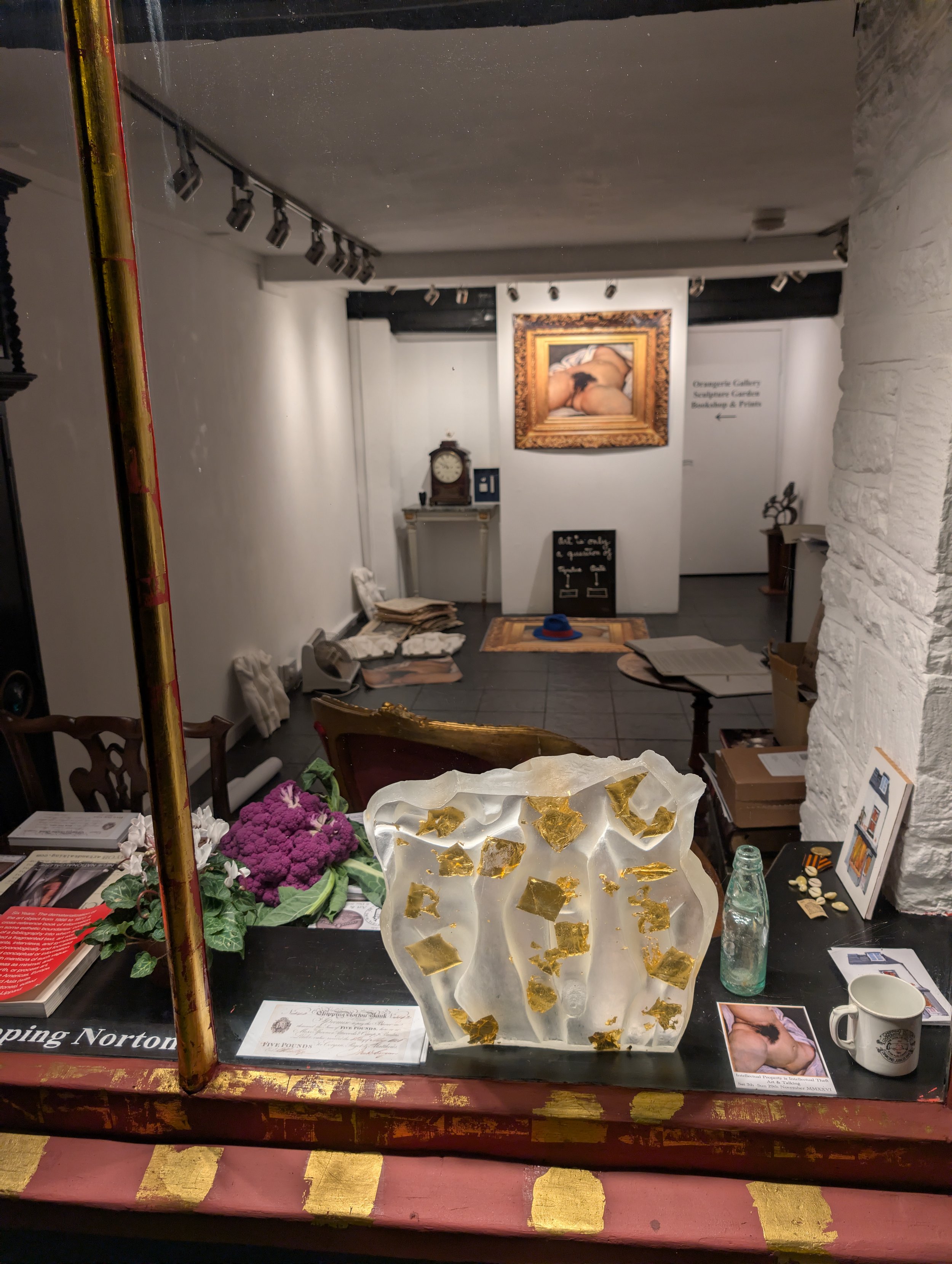
“Intellectual Property is Intellectual Theft”
Michael Bucknell MA & Gareth Williams.
Sat November 7th - Sun November 29th 2026
open daily 2-6PM from Saturday November 7th to Sunday November 15th, then Weds & Sats 11-1pm & 3-5pm & by calling +447949279462
An art exhibition challenging perceptions of authorship & originality through multiples and original copies.
A sexy and surprising exhibition that tests the boundaries of ownership, originality and self-expression This autumn, the Bayeux Tapestry went on display at the British Museum. Visitors were not allowed to take photographs, told that light will damage the fragile hand-woven textiles. However, this also keeps images of the artefact under museum control – one more example of the ways that institutions draw borders around our collective culture.
Intellectual Property is Intellectual Theft, the new exhibition at Art & Talking, challenges this idea. It shows how copying is not simply an act of theft, but also a form of creative engagement, by displaying reproductions and imaginative appropriations across a range of different mediums.
During the exhibition, artist Gareth Williams will be working on a replica of the Mona Lisa. The display will also include a copy of Gustave Courbet’s notorious L’Origine du Monde; Albrecht Dürer’s pioneering prints, and copies thereof (the artist was famously awarded the first-ever copyright); a facsimile of Kazimir Malevich’s Black Square, and sixty-nine plaster copies of the Louvre’s Three Graces, which was itself a Roman version of a Greek original, and 69 3D prints of the Ain Sakhri figurine.
Intellectual Property is Intellectual Theft confronts nudity taboos and the porous boundary between originality and imitation. In the process, it escapes institutional and legal attempts to place boundaries on creativity, and celebrates the fact that artist have always produced new work through sharing, copying, and reimagining their cultural inheritance.
Michael Bucknell, MA, founder of Art & Talking, explains: ‘In 1840, Proudhon said: Property is theft, intellectual property is intellectual theft. It’s an idea that has long fascinated me: I’ve owned the URL intellectualpropertyisintellectualtheft.com for almost two decades. In the age of AI, it’s a subject that many more people are talking about, and this exhibition will challenge their ideas of ownership and appropriation with a full-size replica of the BayeuxTapestry, the world record for the most plaster Graces to ever decorate a building, and the most famous painting of a cunt in history, newly painted.’
Michael Bucknell has a BA in Painting from Camberwell College of Arts, and a MA in Art History from the University of Edinburgh. He is the founding director of Art & Talking, and lives in Berlin. He is a member of the berufsverband bildender künstler*innen berlin, the Brandenburgischer Verband Bildender Künstler, the Deutscher Verband für Kunstgeschichte, and the Deutschen Vereins für Kunstwissenschaft. He has exhibited in London, Lagos, Berlin, Moscow, St Petersburg, Kotlas, Penza, Loforten and Venice.
He organised 6 5 day free “Luxury Goods London” festivals featuring hundreds of artists, performers, professors and poets from 42 countries describing the Cost, Value, Meaning, Role, Illusion, and finally Reality of art in exactly 50 words. He has travelled the world, with a particular focus on France, Russia, Italy & Greece, looking at original art and architecture having been taught at Edinburgh how the use of photographs had devalued art historical experience and knowledge.
Gareth Williams studied sculpture at St Martin’s College and Syracuse University. He has worked as a replicator and as a street artist in France, Holland, and Italy. He resides in Chipping Norton and assists at Art & Talking. He can realise paintings.
Thanks to Liam Binns at Kopyrite printers for realising the Bayeux Tapestry.
the use of Content (including images, editorial or descriptive text, footage or any other media) found on the V&A's Websites infringes my rights.
Fri 6 Nov 2026 00:29 (14 hours ago)
to hello, vaimages
Your contact details
Michael Bucknell, Art & Talking, Chipping Norton.
Nature of the complaint
I believe that the use of Content (including images, editorial or descriptive text, footage or any other media) found on the V&A's Websites infringes my rights, as you claim to own intellectual property rights in images which are not yours, but belong to everyone.
When I download the public domain images of the 1867 Convention for promoting universally Reproductions of Works of Art for the benefit of Museums of all countries, from your website to use in my exhibition Intellectual Property Is Intellectual Theft at Art & Talking Chipping Norton you claim to own rights in my property and pretend that I need your permission to exhibit my images in my exhibition. (https://www.artandtalking.com/intellectualpropertyisintellectualtheft), specifically you require that I agree that "the intellectual property rights in all 'Content' (including images, editorial or descriptive text, footage or any other media) featured within the 'Websites' (www.vam.ac.uk, and all sub-domains) and selected social media platforms, is owned by the 'V&A' (the Board of Trustees of the Victoria and Albert Museum) and other copyright owners as specified wherever possible." and that "These Terms of Use are governed by the laws of England and Wales and the courts of England and Wales shall have exclusive jurisdiction over any dispute arising from them."
V&A museum number (where applicable)
MSL/1921/1959
The full web address of where you found the material
Proof that you are the rights holder
I own every right in out of copyright images that I have downloaded from your website.
Case law is clear that "copyright can only subsist in subject matter that is original in the sense that it is the author’s own ‘intellectual creation’." https://www.gov.uk/government/publications/copyright-notice-digital-images-photographs-and-the-internet/copyright-notice-digital-images-photographs-and-the-internet
https://douglasmccarthy.com/2024/01/after-thj-v-sheridan/
Anthony Misquitta <a.misquitta@vam.ac.uk>
Fri 6 Nov 2026 11:14 (3 hours ago) V&A
Dear Mr Bucknall
Thank you for email which has been passed to me because of the legal nature of your claims.
When you downloaded the material in question you accepted contractual restrictions on your use of it and it is on the basis of that contract that the V&A would seek to prevent any unrestricted use of the work. Therefore, what you categorise as a copyright issue is actually a contract issue.
For what it’s worth, from a copyright perspective, we maintain that all of our specialist artifact imagery qualifies for copyright protection because it does embody the author’s own intellectual creation. However, as I mention above, it is through the contract route rather than the copyright route that we seek to protect our investment in the creation of high-quality images.
If you are interested in reading a counter-argument to that of Douglas McCarthy (whom I know, like and respect), please consider my own thoughts on THJ v. Sheridan that you can find here: Out of Copyright: Clarification of the Law – The Association For Cultural Enterprises
Regards
Anthony Misquitta| General Counsel
V&A South Kensington
Fri 6 Nov 2026 13:28 (1 hour ago)
to vaimages, Anthony, V&A
Dear Mr Misquitta,
My name is Bucknell.
Thank you very much for your prompt reply. Unfortunately I don't understand it. Please can you explain.
Are you seeking to prevent my "unrestricted use of the work"( a scan the 1867 Convention for promoting Universally Reproductions of Works of Art for the benefit of Museums of all countries ) in my exhibition Intellectual Property is Intellectual Theft based on the contract you claim I agreed to in order to download?
I have read the contract, it is confusing, but I don't understand how I can agree under English law that you own rights in or can restrict my use of an image that you don't own any rights in at all.
You write in your article "If you are seeking to determine if a photograph of an out of copyright work qualifies for copyright, you must ask if the photographer made any creative choices when creating the image." The image we are concerned with bears every appearance of being a simple low quality document scan of an 1867 document. https://collections.vam.ac.uk/item/O1345874/convention-for-promoting-universally-reproductions-printed-copy/
What rights do you claim that the V&A owns in this image, and how were they acquired?
I repeat my objection under section 8 of your terms and conditions that your use of Content (including images, editorial or descriptive text, footage or any other media) found on the V&A's Websites infringes my rights, and those of humanity in general by falsely claiming ownership of a public good.
I will exhibit the images in my exhibition which opens tomorrow, and I would be very pleased to welcome you to it,
and show you around.
in art,
Michael Bucknell, MA
Fri 6 Nov 2026 13:36 (1 hour ago) to VA, michael, V&A
Dear Mr Bucknell
I apologise for mis-spelling your name.
I can’t give you legal advice. I can remind you is that you did not have to accept the contractual restrictions that you are now questioning.
Regards
Anthony Misquitta| General Counsel
V&A South Kensington
Fri 6 Nov 2026 13:49 (49 minutes ago)
to Anthony, VA, V&A
Dear Mr Misquitta,
I am not requesting legal advice, I am responding to your email, inviting you to my exhibition, justifying my complaint under section 8 of the terms and conditions of your contract that the V&A infringes my rights by falsely claiming ownership of public goods that belong to me, and demanding that they stop doing so.
I am also clearly stating that I dispute any claim that you make to be able to restrict my use for any purpose whatsoever of any out of copyright image that I own, wherever and however acquired, and that I will exhibit for sale the images of the 1867 Convention for promoting Universally Reproductions of Works of Art for the benefit of Museums of all countries that I downloaded from your website in my exhibition Intellectual Property Is Intellectual Theft at Art & Talking, the Art Centre of Chipping Norton opening tomorrow.
in art,
Michael Bucknell
The Law of Copyright
Bookreader Item Preview
Search inside(243 results)
Bookmarks(0)
Downloadable files(2 formats)
Visual Adjustments
Share this book
Experiments
Search inside
(243 results)
Please enter text to search for
243 resultsSkip to last result
Page n0 — This is a digital copy of a book that was preserved for generations on Hbrary shelves before it was carefully scanned by Google as part of a project
Page n0 — It has survived long enough for the copyright to expire and the book to enter the public domain. A public domain book is one that was never subject
Page n0 — to copyright or whose legal copyright term has expired. Whether a book is in the public domain may vary country to country. Public domain books
Page n0 — are our gateways to the past, representing a wealth of history, culture and knowledge that's often difficult to discover.
Page n0 — Marks, notations and other maiginalia present in the original volume will appear in this file - a reminder of this book's long journey from the
Page n0 — publisher to a library and finally to you.
Page n0 — + Refrain fivm automated querying Do not send automated queries of any sort to Google's system: If you are conducting research on machine translation, optical character recognition or other areas where access to a large amount of text is helpful, please contact us. We encourage the use of public domain materials for these purposes and may be able to help.
Page n0 — + Keep it legal Whatever your use, remember that you are responsible for ensuring that what you are doing is legal. Do not assume that just because we believe a book is in the public domain for users in the United States, that the work is also in the public domain for users in other countries. Whether a book is still in copyright varies from country to country, and we can't offer guidance on whether any specific use of any specific book is allowed. Please do not assume that a book's appearance in Google Book Search means it can be used in any manner anywhere in the world. Copyright infringement liabili^ can be quite severe.
Page n8 — <A
Page n13 — W W. Stevens, Ltd. v. Cassell & Co., Ltd. (1913), Times, Feb. 7 7,13 Page 5, line 9, add : a card-index system for the purposes of the National Insurance Acts, consisting of a box containing cards of different colours and with different headings {LibrcLCO, Ltd, v. Shaw Walker, Ltd, (1913), 30 T.L.R. 22); a system of ' standardized tabular advertising ' (Moore v. Associated Newspapers, Ltd. (1915), Times, June 18).
Page n13 — Page 6, line 7. For a discussion whether a periodical recension was a new edition, see H. Blacklock db Co,, Ltd. V. C, Arthur Pearson, Ltd., [1915] 2 Ch. 376.
Page n13 — Page 9, un^ 16. In Incorporated Council of Law Reporting for England and Wales v. William Green d; Sons, [1912] W.N. 243, the plaintiffs moved for an injunction to restrain the defendants from infringing their copyright in the Law Reports. The defendants consented to give a perpetual undertaking in the terms of the motion and to pay the costs.
Page n13 — Page 11, note I. On the other hand the view stated in the text is supported by Broemel v. Meyer (1913), 29 T.L.R. 148 (Where there's a will there's a way). See also W. Stevens, Ltd. v. Cassell <Sc Co., Lid. (1913), Times, Feb. 7 (Magazine of Fiction).
Page n13 — Page 14, unb 7. In Byrne v. Statist Co., [1914] 1 K.B, 622 it was held that a summarized and edited translation of a speech reported in a foreign language was an ' original
Page n14 — Page 29, note (h), Byrne v. Statist Co,, [1914] 1 K.B. 623 supports the view expressed in the text. A summarized and edited translation was there held to be an ' original literary work '.
Page n14 — Page 39, line 17. A song composed in America by an American was published in New York on May 6, 1913. On the same day an English firm of publishers, who had received twelve copies from the American owners of the copyright, sent one copy to the British Museum, filed one copy at their office, and exposed six copies for sale on their counter in London. On May 6 they sent the other four copies to the agents for the Universities. After a fortnight they placed the six copies among their general stock. It was held that there had been a proper publication in London on May 6 and an issue of copies to the public (Francis, Day db Hunter v. Feldrmn ds Co., [1914] 2 Ch. 728).
Page n14 — Page 51, line 22. Where an artistic work had been assigned with all copyrights but not registered under the Fine Arts Copyright Act, 1862, at the time of the commencement of the Copyright Act, 1911, it was held that the owner had such a copyright as would entitle him to the substituted rights given by the Act of 1911 {E, W, Savory, Ltd, V. The WorU of Golf, Ltd,, [1914] 2 Ch. 666). See also Barker Motion Photography, Ltd, v. E, Hulton ds Co,, Ltd, (1912), 28 T.L.R. 496.
Page n15 — Page 62, line 26. This provision does not justify the making of a copy of the work for the purpose of subsequent mechanical reproduction, if the copyright is vested in an assignee {Gkappell dh Go,, Ltd, v. Columbia Graphophone Co,, [1914] 2 Ch. 745).
Page n15 — Page 63, une 4. Where a plaintiff in the early part of 1911 composed and published an original musical work, and before the commencement of the Copyright Act, 1911, the defendants manufactured abroad and imported into England gramophone records of the work, and after the commencement of the Act sold them without the plaintiff's consent and without payment of royalties, it was held that they had infringed his copyright (MonckUm v. Pathi Freres PatJ^phone, Ltd,, [1914] 1 K.B. 395).
Page n15 — Page 66, une 14. A prosecution for selling and distributing infringing copies of ordnance maps will be found in The Times, October 24, 1913, p. 4, col. 6.
Page n15 — Page 66, une 16. A new Minute which was issued by the Treasury on June 28, 1912, is printed in the Supplement, p. 69.
Page n15 — Page 80, une 19. For a case where a work was made by a person under a contract of service but was not made in the course of his employment and he was therefore held to be the owner of the copyright, see Byrne v. Statist Co., [1914] 1 K.B. 622.
Page n15 — Page 83, une 2. A director of a company that published a weekly periodical, who was also dress editress ', has been held to be a clerk or servant' of the company within s. 209 (1) (b) of the Companies (Consolidation) Act, 1908, but not persons who supplied for a fixed salary * fashion drawings ' and weekly articles respectively {In re Beeton <Se Co,, Ltd., [1913] 2 Ch. 279).
Page n15 — Page 85, unb 9. It has now been held that a curate is not under a contract of service with his incumbent or his bishop {In re National Insurance Act, 1911, In re Employment of Church of England Curates, [1912] 2 Ch. 563); neither are ministers of the United Methodist Church or ministers under probation of the Wesleyan Methodist Church appointed by the Conference of their Church employed under a contract of service (In re Employment of Ministers of the United Methodist Church, [1912] W.N, 206).
Page n16 — Page 96, line 3. The view expressed in the text is now supported by E. W. Savory, Ltd. v. The World of Oolf, Ltd., [1914] 2 Ch. 566. There the only memorandum of an assignment of copyright was a receipt for £2 6^. M. for * Five original art designs inclusive of all copyrights. Subjects : 4 golfing subjects, 1 Teddy Bear painting ', which was signed by the artist, duly stamped and handed to the plaintiffs. Parol evidence was admitted to identify the golfing subjects with those in question in the action, and it was held that the memorandum was sufficient within s. 3 of the Fine Arts Copyright Act, 1862.
Page n16 — Page 101, line 10. The making of a single copy without authority is an infringement of copyright (Chappell ds Co., Ltd. V. Columbia Graphophone Co., [1914] 2 Ch. 745).
Page n16 — Page 109, line 24. The making of a single copy of a song with pianoforte accompaniment without authority, for whatever purpose, is an infringement of the copyright (Chappell dh Co., Ltd. v. Columbia Graphophone Co., [1914] 2 Ch. 745).
Page n17 — Page 122, line 9. In Fenning Film Service, Ltd. v. Wolverhampton, Walsall ds District Cinemas, Ltd., [1914] 3 K.B. 1171, the plaintiffs had agreed to let a certain cinematograph film to the defendants for a certain period and for exhibition at certain places, and the defendants agreed not to exhibit it or suffer it to be exhibited elsewhere. They in fact broke their contract in this respect, and also advertised their intention of exhibiting it elsewhere. It was held that they were liable, in addition to damages for breach of contract, to damages for infringement of copyright, on the ground that by their advertisements they had authorized the performance of the work.
Page n17 — Page 125, note (d). Bees v. Bobbins (1914), Times, February 6, July 4, was a similar case. Both the melodramas in that case were held to have been written independently, though the defendant had seen the plaintiff's play. In Peskin v. Bay Brothers (1915), Times, Nov. 19, 20, a revite Splash Me and alleged infringing reviies Have a Dip and Som^ Splash were held to come for the most part from the ' common stock', but an injunction was granted in respect of one scene.
Page n17 — Page 129, note (r). In CoreUi v. Gray (1913), 30 T.L.R. 116, it was held that the copyright in a novel was infringed by a dramatic sketch which contained a series of stock incidents in combination taken from the novel, even though no sentence in the sketch was similar to any sentence in the novel.
Page n17 — Page 132, line 11. The fact that due notice has been given and royalties paid to the author does not, however, justify the infringement of an assignee's copyright by the making of a copy of the assigned work for the purpose of subsequent mechanical reproduction (Chappell d; Co,, Ltd. V. Columbia Graphophone Co., [1914] 2 Ch. 745).
Page n18 — Page 143, line 10. It has been held that, in order to sue for an infringement which occurred before the commencement of the Copjrright Act, 1911, there must have been registration, although registration is not required by that Act as a condition precedent to action (Evans v. Morris, [1913] W.N. 58). So Barker Motion PJiotography, Ltd, V. E. Hulton d: Co,, Ltd, (1912), 28 T.L.R. 496.
Page n18 — Page 145, line 25. It was held, however, in Rtibens v. PatM Frires Pathephone, Ltd, (1912), Times, December 20, that, in an action for the infringement of copyright in a song, the author of the music could sue alone for infringement of copyright in the music.
Page n18 — Page 146, line 12. In Scotland, where the trustees and executors of a deceased person had assigned certain of his copyrights before they had obtained confirmation, it was held that the assignee could sue for infringement, but that confirmation would have to be expede by the trustees before he could extract a decree for payment (Mackay v. Mackay, 1914, S.C. 200).
Page n18 — Page 148, line 22. The section provides no protection to a person who, fearing or suspecting that copyright exists, makes a mistake as to the owner of the copyright, and under that mistake obtains authority to publish from a person who is not in fact the owner (Byrne v. Statist Co,, [1914] 1 K.B. 622).
Page n18 — Page 149, line 6. In E, W, Savory, Ltd. v. The World of Golf, Ltd,, [1914] 2 Ch. 566, the infringement was innocent up to a certain point of time, but the Court held that the defendants did not do all that they ought to have done after discovering the infringement, and ordered the infringing copies to be delivered up.
Page n18 — Page 161, line 5. A plaintifi whose copyright is infringed has a right to an order restraining the infringement, and is not prevented from exercising his rights by an offer of the infringer before action that he will promise not to infringe again, and will pay agreed damages. If such an offer is repeated after writ issued, with the addition of an offer to submit to an order and pay costs to date, the plaintiff may be deprived of any subsequent costs (E. W, Savory, Ltd, v. The World of Golf, Ltd., [1914] 2 Ch. 566). Apparently, in the case of an infringement of copyright, as in that of a design, trade mark, or patent, although the defendant has consented to the order claimed, the plaintiff is entitled to the costs of moving in open court and not merely to the costs which would have been inciured on a summons in chambers, since it is desirable that some publicity should be given to the order {J. T. Smith d; J, E, Jones, Ltd. v. Service, Reeve ds Co., [1914] 2 Ch. 676).
Page n19 — Page 155, lines 19, 22. For a conviction for these offences, see The Times, October 24, 1913, p. 4, col. 6.
Page n19 — Page 155, line 26. For a conviction for this offence, see The Times, November 27, 1913, p. 4, col. 2.
Page n19 — Page 157, line 11. There was a conviction for this offence on November 26,1913 (see The Times, November 27, 1913, p. 4, col. 2).
Page n19 — Page 173, line 2. In Ridge v. English Illustrated Magazine, Ltd. (1913), 29 T.L.R. 592, the defendants published under the plaintiff's name a story not by him, which he alleged to be of inferior quality and detrimental to his reputation. The jury were directed that, if they came to the conclusion that a reader would think the plaintiff a mere commonplace scribbler, they could give him damages for libel, and that, on the claim for passingoff, if they thought that the facts were proved and that damage must certainly ensue, though it was not capable of present proof, they could find for the plaintiff with damages. They did so.
Page n19 — Page 173, line 10, add : and a cinematograph play (Menchen v. Elite Sales Agency, Ltd. (1912), Times, December 18, not decided), a magazine (W. Stevens, Ltd. V. CasseU ds Co., Ltd. (1913), Times, February 7, unsuccessful), and a revue {Peskin v. Ray Brothers (1915), Times, November 19, 20, imsuccessful).
Page n20 — Page 186, line 8. A new Order in Council relating to Austria-Hungary is printed in the Supplement, p. 61.
Page n20 — Page 189, note {x), line 11. In Cranz df Co, v. Sheard 6c Co, (1913), Le Droit d'Auteur, 1914, p. 69, an action in the High Court before Scrutton J., the defendants had printed 600 separate copies of the waltz ' Du und Du ' from Johann Strauss's Die Fledernums, and 100 copies of it as part of an album of dance music, before there was a copyright treaty between this country and AustriaHungary. After the treaty was made, they published 500 copies of the waltz, and the action was brought by the holders of the copyright. The defendants sought to argue that they had a subsisting and valuable interest in the work. It appeared that they had less than a hundred copies left in stock at the date of the Order in Council bringing into force the copyright treaty with AustriaHungary. It was held that they had a subsisting interest, but that the interest was of no value, and an injunction was granted against them with £5 damages.
Page n22 — (iv) Italy (a) as regards the exclusive right of translation, preserves Article 5 of the Berne Convention, 1886, as amended by the Additional Act of Paris, 1896 ; (6) as regards the right of public representation of translations of dramatic and dramatico-musical works, preserves Article 9, paragraph 2 of the Berne Convention, 1886.
Page n22 — (v) Japan, (a) as regards the exclusive right of translation, preserves Article 5 of the Berne Convention, 1886, as amended by the Additional Act of Paris, 1896 ; (6) as regards the public performance of musical works, preserves Article 9, paragraph 3 of the Berne Convention, 1886.
Page n22 — (vi) Norway, (a) as regards works of architecture, preserves Article 4 of the Berne Convention, 1886 ; (6) as regards articles in newspapers and magazines, preserves Article 7 of the Berne Convention, 1886; (c) as regards retroactivity, preserves Article 14 of the Berne Convention, 1886.
Page n22 — (vii) The Netherlands, (a) as regards the exclusive right of translation, preserves Article 5 of the Berne Convention, 1886, as amended by the Additional Act of Paris, 1896; (6) as regards articles in newspapers and * magazines, preserves Article 7 of the Berne Convention, 1886, as amended by the Additional Act of Paris, 1896 ; (c) as regards the right of public representation of translations of dramatic and dramatico-musical works, preserves Article 9, paragraph 2, of the Berne Convention, 1886.
Page n24 — It seems clear that, so far as the International Copyright arrangements are embodied in the law of this country, they remain in force unless and until they are altered by new legislation and subject to any suspension of rights imposed by the legislation relating to trading with the enemy or at common law. Neither probably are the International Conventions themselves, which, it must be remembered, apply to neutral as well as to belligerent powers, abrogated by the state of war. Several of the belligerent parties thereto have, in fact, proceeded with legislation and other arrangements for the carrying out of the Conventions since the outbreak of war, and thereby admitted their continual existence. There was a very interesting decision of the Imperial Court of Germany on October 26, 1914, in a cognate matter, namely the matter of the Convention of Paris, 1883, for the protection of industrial property. The claim in this case was made in respect of a French patent. The judgment declares that,^ inasmuch as the German Empire has acceded to the Convention and brought it into force by domestic legislation, the Convention has become part of the German law with regard to industrial property. It continues : ' It may be that the binding force of the Convention terminated, ipso f(wto, at the outbreak of war, as regards countries at war with Germany, but it does not follow from this that the provisions of the Convention, in so far as it forms part of our civil law, ceases to have effect as regards alien enemies. There is not necessarily an absolute correlation between the obligatory force of the Convention in international law and the application of the Convention in domestic law. Such a correlation only exists in the case of conventions, the application of which would contradict the object of the war. This cannot be the case, at least from the point of view of German law, when the question concerns a treaty which, like this Convention, is concerned may cause a smile, but its general principles appear to be sound.
Page n25 — solely with matters of civil law. Contrary to the practice of certain other countries, German international law does not adopt the point of view that war ought to be waged in such a way as to injure as far as possible the economic interests of alien enemies and to deprive them to a large extent of the benefits of ordinary private law. It is, on the contrary, founded on the principle that war is only made on the enemy state and on its armed force, and that alien enemies ought to be assimilated to our own nationals as regards civil law to the same extent as before the war, that is to say in every respect, except so far as may be otherwise enacted by law. This principle, it need not be said, does not prevent a special law from prescribing a different treatment to alien enemies, especially by the application of the law of retaliation, as has often been the case in the course of the present war. But no such law has hitherto been enacted as regards industrial property. So long as that has not taken place, a German judge ought to apply the provisions of the Convention as he did before. For, even if it be admitted that the belligerent states cease to be mutually bound by the Convention in international law, they all have the power of completely maintaining the existing state of things and of applying the provisions of the Convention in their own territory. It could not be supposed that the legislative bodies of Germany have jointly agreed to abolish the application of the provisions of the Convention with regard to alien enemies, and that is even less the case inasmuch as grave doubts may be felt if and how far it is beneficial to suppress them. It might be asked, for example, if such abolition ought to extend to the persons mentioned in Article 3, and if and how far it ought to be retroactive. It would be a very serious thing to hand over this question and other difficult questions to the opinion of the judge instead of settling them by means of a law ' (see Le Droit d'Auteur, 1916, p. 5). The statements in this judgment as to German practice in war
Page n26 — ' Provided that the Board of Trade may, on the appHcation of the Trustees of the British Museum, make regulations excepting from the provisions of this subsection publications wholly or mainly in the nature of trade advertisements, or such classes of such publications as may be specified in the regulations, and thereupon it shall not be necessary for the publisher of any publication so excepted so to deUver the pubUcation or for the trustees to give a receipt therefor, imless, as respects any particular publication, a written demand for the delivery thereof is made by the trustees. Every regulation under this proviso shall be laid before each House of Parliament as soon as may be after it is made, and if an address is presented to His Majesty by either House of Parliament within the next subsequent twenty-one days on which the House has sat, praying that any such regulation may be annulled^ His Majesty in Council may annul the regulation and it shall be thenceforth void, but without prejudice to the validity of anything previously done thereunder before the expiration of such period.'
Page n27 — [Note.—A regulation made under this section is printed in the Supplement, p 36.]
Page n27 — (a) The name and address of the person intending to reproduce the work ;
Page n27 — (6) the name of the work which it is intended to reproduce and (if necessary) a description sufficient to identify it;
Page n27 — the work; (c) the earliest date at which any of the copies will be delivered to a purchaser.
Page n28 — 8. The notice shall, not less than one month before any copies of the work are delivered to a purchaser, be sent by registered post or published by advertisement as follows :
Page n28 — (a) If the name and an address within the United Kingdom of the owner of the copyright, or his agent for the receipt of notice, are known or can with reasonable diligence be ascertained, the notice shall be sent to such owner or agent at such address ;
Page n28 — (6) if such name and address are not known and cannot with reasonable diligence be ascertained the notice shall be advertised in the London Gazette; the advertisement in the London Gazette shall give the particulars required by paragraphs (a) and (6) of Regulation 2, and shall also state an address from which a copy of the notice described in Regulation 2. may be obtained.
Page n28 — 4.—{a) Unless otherwise agreed royalties shall be payable by means of adhesive labels purchased from the owner of the copyright and af&xed to the copies of the work.
Page n28 — After the person reproducing the work has given the prescribed notice of his intention to reproduce the work the owner of the copyright shall by writing sent by registered post intimate to him some reasonably convenient place within the United Kingdom from which adhesive labels can be obtained and on demand in writing and tender of the price shall supply from such place adhesive labels of the required denominations at a price equal to the amount of royalty represented thereby.
Page n28 — Subject to these Regulations, no copy of the work shall be delivered to a purchaser until such label or labels denoting the amount of royalty have been affixed thereto.
Page n29 — (i) after the expiration of fourteen days from the date of the prescribed notice the owner of the copyright has not duly sent to the person reproducing the demand duly made, copies of the work may be delivered to purchasers without having labels af&xed thereto ; and the amount of royalties shall be a debt due from the person reproducing the work to the owner of the copyright, and the person reproducing the work shall keep an account of all such copies sold by him.
Page n29 — (e) The adhesive label suppUed as aforesaid shall be an adhesive paper label, square in shape, the design to be entirely enclosed within a circle, and the side of the label not to be greater than | inch in length. The label shall not bear the ef&gy of the Sovereign or any other person, nor any word, mark, or design such as to suggest that the label is issued by or under the authority of the Government for the purpose of denoting any duty payable to the
Page n30 — (a) The name and address of the person intending to
Page n30 — necessary) a description sufficient to identify the
Page n30 — will be delivered to a purchaser ; (/) whether any other work is to be reproduced on the same contrivance with the musical work specified in accordance with paragraph (6).
Page n31 — 3. The notice shall, not less than ten days before any contrivances on which the musical work is reproduced are (6) if such name and address are not known and cannot with reasonable diligence be ascertained, the notice shall be advertised in the London Gazette ; the advertisement in the London Gazette shall give the particulars required by paragraphs {a) and (6) of Regulation 2, and shall also state an address from which a copy of the notice described in Regulation 2 may be obtained. Any number of musical works may be included in the same advertisement.
Page n31 — delivered to a purchaser, be sent by registered post or published by advertisement as follows :
Page n31 — (a) If the name and an address within the United Kingdom of the owner of the copyright, or his agent for the receipt of notice, are known or can with reasonable diligence be ascertained, the notice shall be sent to such owner or agent at such address ;
Page n31 — 4.—(a) Unless otherwise agreed, royalties shall be payable by means of adhesive labels purchased from the owner of the copyright and affixed in the manner provided by these Regulations.
Page n31 — After the person making the contrivances has given the prescribed notice of his intention to make or sell the contrivances, the owner of the copyright shall by wTiting sent by registered post intimate to him some reasonably convenient place within the United Kingdom from which adhesive labels can be obtained and on demand in writing and tender of the price shall supply from such place adhesive labels of the required denominations at a price equal to the amount of royalty represented thereby.
Page n31 — Subject to these Regulations no contrivance shall be delivered to a purchaser until such label or labels denoting the amount of royalty have been affixed thereto, or in the case of cylinders, to which it is not reasonably practicable to affix the labels, until such label or labels have been affixed to a carton or box enclosing the cylinder.
Page n32 — contrivances may be delivered to purchasers without having labels affixed thereto or to the carton or box enclosing the same ; and the amount of royalties shall be a debt due from the person making the contrivances to the owner of the copjrright and the person making the contrivances shall keep an account of all such contrivances sold by him.
Page n33 — (/) The adhesive label supplied as aforesaid shall be an adhesive paper label, square in shape, the design to be entirely enclosed within a circle and the side of the label not to be greater than f inch in length. The label shall not bear the effigy of the Sovereign or any other person, nor any word, mark, or design such as to suggest that the label is issued by or under the authority of the Government for the purpose of denoting any duty payable to the Government.
Page n33 — (a) a statement of the name of the musical work in respect of which the inquiries are made and of the author (if known), and (if necessary) a description , sufficient to identify it;
Page n33 — (6) a statement of the name, address, and occupation of the person making the inquiries;
Page n33 — (c) an allegation that a contrivance has previously been made by means of which the musical work may be mechanically performed, with the trade name (if known) and a description of such contrivance ; (d) an inquiry whether the contrivance so described was made with the consent or acquiescence of the owner of the copyright.
Page n34 — (a) if an address within the United Kingdom of the OAvner of the copyright is known or can with reasonable diligence be ascertained the inquiries shall be sent to such address ; or
Page n34 — (a) in cases where the inquiries are required to be sent by registered post seven days after the date when the inquiries would in ordinary course of post be delivered ;
Page n35 — 3. For the purposes of these regulations the published edition of a book includes all copies of the same work published by the same publisher or his successor in business in a form substantially the same with respect to printing, illustrations and general condition.
Page n36 — 2. A design shall be deemed to be used as a model or pattern to be multiplied by any industrial process within the meaning of Section 22 of the Copyright Act, 1911—
Page n36 — (a) When the design is reproduced or is intended to be reproduced in more than 50 single copies, unless all the articles in which the design is reproduced or is intended to be reproduced together form only a single set, as defined by Rule 6 of the Designs Rules, 1908 ;
Page n37 — 2. Any notice in regard to any book or other printed work in which copyright subsisted on the 30th day of June 1912 which was given to and accepted by the said Commissioners on or before that day pursuant to Section 42 of the Customs Consolidation Act, 1876, or Section 1 of the Revenue Act, 1889, shall for a period of twelve months from the first day of July 1912 if the copjrright so long subsists be treated as a notice given under Section 14 of the Copyright Act, 1911, unless the notice is withdrawn or superseded or the said Commissioners require a further notice to be given.
Page n37 — 8. The notice in writing to be given to the said Commissioners under Section 14 of the Copyright Act, 1911, by the owner of the copyright in any work (other than a book or other printed work) in which copyright subsists under the said Act or his agent who is desirous that copies
Page n38 — thereof made out of the United Kingdom shall not be imported into the United Kingdom may be either a general notice in the Form No. 2 in the Schedule hereto or as near thereto as circumstances permit or a special notice in the Form No. 3 in the same Schedule relating to a particular importation.
Page n38 — 4. Every notice given in pursuance of these Regulations in the Form No. 1 or No. 2 in the Schedule hereto shall be accompanied by a statutory declaration in the Form No. 4 in the same Schedule,
Page n38 — 5. Before any article which appears, or is alleged, to be a copy of a work to which a notice applies is detained, or any further proceedings with a view to the forfeiture thereof under the law relating to the Customs are taken, the person who signed the notice whether as owner or agent shall, if required so to do, give to the said Commissioners in writing such further information and evidence, verified if so required by a statutory declaration, as they consider necessary to satisfy them that the article in question is liable to detention and forfeiture.
Page n38 — 6. In the case of any detention in consequence of a notice in the Form No, 3 given to the said Commissioners the person who signed the notice whether as owner or agent must if so required deposit with the Collector of Customs and Excise or other Chief Officer of Customs and Excise at the port or place of detention a sum of money sufficient in the opinion of that Officer to cover any expense which may be incurred in the examination required by reason of his notice of the goods detained, and if upon the examination of the goods the said Collector or other Chief Officer is satisfied that there is no ground for their detention, they will be delivered.
Page n39 — ?• If any goods are placed under detention in consequence of any notice given in pursuance of these Regulations, the said Commissioners may require the person who signed the notice to give an undertaking in writing to reimburse them all expenses and damages incurred in respect of the detention, and of any proceedings for forfeiture subsequently taken if such an undertaking has not already been given, and may also require him within four days after the detention to enter into a bond with two approved sureties in such form and for such amount as the said Commissioners may require.
Page n39 — * Book or other printed work' means every part or division of a book, pamphlet, sheet of letterpress, sheet of music, map, plan, chart, or table separately published.
Page n40 — Description of printed work, if not a book. FuU name of Author or Authors
Page n40 — may apply to a number of books or
Page n41 — If not a British subject name of country in which Authorwas resident, or domiciled at date of the making of the
Page n41 — Relating to a particular importation.
Page n41 — of the copyright in a certain original work as to which copyright for the owner*, now subsists under the Copyright Act, 1911, and that the under ihi oo^ mentioned goods, that is to say, (2) nuim>er of
Page n42 — A Commissioner for Oaths.
Page n42 — There shall be excepted from the provisions of Section 15 (1) of the Copyright Act, 1911, whereby the publisher of any book published in the United Eangdom is required within one month after the publication to deliver, at his own expense, a copy of the book to the Trustees of the British Museum, the following publications, viz.:
Page n42 — 0. S, Barnes, A Secretary to the Board of Trade.
Page n44 — Whereas on the 9th day of September 1886, a Convention with respect to the protection to be given by way of copyright to the authors of literary and artistic works (hereinafter called the Berne Convention) set out in the Second Schedule to this Order was concluded between Her late Majesty Queen Victoria and the foreign countries following, that is to say:—Belgium, France, Germany, Hayti, Italy, Spain, Switzerland, and Tunis, and on the 5th day of September 1887, the ratifications of the said Berne Convention were duly exchanged between Her late Majesty Queen Victoria and the aforesaid countries :
Page n45 — And whereas a Convention (hereinafter called the Berlin Convention) set out in the First Schedule to this Order was on the 13th day of November 1908, agreed upon between His late Majesty King Edward VII and the foreign countries following, namely: Belgium, Denmark, France, Germany, Italy, Japan, Liberia, Luxemburg, Monaco, Norway, Spain, Sweden, Switzerland, and Tunis, for the purpose of replacing the said Berne Convention and the said Additional Act:
Page n46 — (a) to works first published in a foreign country of the Copyright Union, in like manner as if they had a translation) in another newspaper with an indication of the source shall be conditional upon reproduction being forbidden by express declaration in some conspicuous part of the newspaper in which the article is published.
Page n47 — been first published within the parts of His Majesty's dominions to which the said Act extends : (5) to literary, dramatic, musical and artistic works, the authors whereof were at the time of the making of the works subjects or citizens of a foreign country of the Copyright Union, in like manner as if the authors had been British subjects : (c) in respect of residence in a foreign country of the Copyright Union, in like manner as if such residence had been residence in the parts of His Majesty's dominions to which the said Act extends. Provided that—
Page n47 — (i) Sections 1 (2) (d) and 19 of the Copyright Act, 1911, and such other part or parts thereof as confer upon the owner of the copyright in a literary, dramatic or musical work the exclusive right of making any record perforated roll cinematograph film or other contrivance by means of which the work may be mechanically performed and such other part or parts thereof as confer copyright in any record or perforated roll shall not apply in the case of any work of which the country of origin is Denmark, Italy, or Sweden, (ii) The term of copyright within the parts of His Majesty's dominions to which this Order applies shall not exceed that conferred by the law of the country of origin of the work, (iii) The enjoyment of the rights conferred by the Copyright Act, 1911, shall be subject to the accomplishment of the following conditions and formalities, that is to say :
Page n47 — {a) In the case of any newspaper article (not being a serial story or tale) of which the country of origin is one of the foreign countries following, namely, Belgium, France, Germany, and the German Protectorates, Hayti, Liberia, Luxemburg, Monaco, Portugal, Spain, Switzerland, and Timis, the right to prevent the reproduction of such article (either in the original language or in
Page n48 — (6) In the case of any newspaper or magazine article (not being a serial story or tale) of which the country of origin is Denmark, Italy, Norway, or Sweden, the right to prevent the reproduction of such article (either in the original language or in a translation) with an indication of the source shall be conditional upon reproduction being forbidden by express declaration in some conspicuous part of newspaper or magazine in which the article is published.
Page n48 — (c) In the case of any literary or dramatic work of which the country of origin is Denmark, Italy, Japan, or Sweden, the right after the expiration of ten years from the end of the year in which the work or in the case of a book published in numbers each number of the work was first published, to prevent the production, reproduction, performance in public or publication of any translation of the work shall be conditional upon the publication before the expiration of the above-mentioned period and within the parts of His Majesty's dominions to which this Order applies or within any foreign country of the Copyright Union of an authorized translation in the language for which protection is claimed of the work or of each number of the work.
Page n49 — 4. In this Order the expression, '^ the country of origin ', as applied to a work has the same meaning as in the third paragraph of Article 4 of the Berlin Convention.
Page n49 — 5.—(a) This Order shall apply to all His Majesty's dominions, colonies, and possessions, excepting to those hereinafter named, that is to say, except to—
Page n53 — taken any action whereby he has incurred any expenditure or liability in connexion with the reproduction or performance of any work at a time when such reproduction or performance would, but for the making of this Order, have been lawful, nothing in this Order shall diminish or prejudice any rights or interest arising from, or in connection with, such action which are subsisting or valuable at the said date unless the person who, by virtue of this Order, becomes entitled to restrain such reproduction or performance agrees to pay such compensation as, failing agreement, may be determined in accordance with the provisions of the Copyright Act, 1911.
Page n53 — 4. The provisions of Article (2), Proviso (iii) (a), of the
Page n54 — (a) The provisions of Article (2), Proviso (iii) (5), and of Article (2), Proviso (iii) (c) of the Principal Order shall apply as if the Netherlands were included amongst the foreign countries named in those provisions. (6) In the application to works of which the country of origin is the Netherlands of sections 1 (2) (d) and 19 of the Copyright Act, 1911, the date of thia Order shall be substituted for the commencement of the Act in sections 19 (7) and 19 (8) wherever that expression occurs, and the 1st November, 1912^ for the passing of the Act.
Page n56 — Viscount Allendale Mr. J. A. Pease.
Page n57 — 1. The Principal Order shall extend to the Netherlands East Indies and the Colony of Cura9ao as if they were amongst the foreign countries of the Copyright Union therein named, subject to the following modifications : (a) The provisions of Article (2), Proviso (iii) (6), and of Article (2), Proviso (iii) (c), of the Principal Order shall apply as if the Netherlands East Indies and the Colony of Cura9ao were included amongst the foreign countries named in those provisions.
Page n57 — Section 24 of the Copyright Act, 1911, the date of this Order shall be substituted for the commencement of the Act wherever that expression occurs in subsection (1) (a) and for the 26th July, 1910, in subsection (1) (6).
Page n59 — The Principal Order shall extend to the Colony of Surinam as if it were amongst the foreign countries of the Copyright Union therein named, subject to the following modifications: (a) The provisions of Article (2), Proviso (iii) (6), and of Article (2), Proviso (iii) (c) of the Principal Order shall apply as if the Colony of Surinam were included amongst the foreign countries named in those provisions.
Page n59 — of section 24 of the Copyright Act, 1911, the date of this Order shall be substituted for the commencement of the Act wherever that expression occurs in subsection (1) (a), and for the 26th July, 1910, in subsection (1) (6).
Page n60 — And whereas it is provided in Article (2), Proviso (i), of the Principal Order that sections 1 (2) (d) and 19 of the Copyright Act, 1911, and such other part or parts thereof as confer upon the owner of the copyright in a literary, dramatic, or musical work the exclusive right of making any record, perforated roll, cinematograph film, or other contrivance by means of which the work may be mechanically performed and such other part or parts thereof as confer copyright in any record or perforated roll shall not apply in the case of any work of which the country of origin is Italy :
Page n61 — taken any action whereby he has incurred any expenditure or liability in connection with the reproduction or performance of any work at a time when such reproduction or performance would, but for the making of this Order, have been lawful, nothing in this Order shall diminish or prejudice any rights or interest arising from, or in connection with, such action which are subsisting or valuable at the said date unless the person who, by virtue of this Order, becomes entitled to restrain such reproduction or performance agrees to pay such compensation as, failing agreement, may be determined in accordance with the provisions of the Copyright Act, 1911.
Page n63 — 1. The provisions of Article 2, Proviso (iii) (a), of the Principal Order shall apply as if Italy were included amongst the Foreign Countries named in those provisions.
Page n64 — 3. Where any person has, before the commencement of this Order, taken any action whereby he has incurred any expenditure or liability in connection with the reproduction or performance of any work in a manner which at the time was lawful, or for the purpose of, or with a view to the reproduction or performance of, a work at a time when such reproduction or performance would, but for the making of this Order, have been lawful, nothing in this Order shall diminish or prejudice any rights or interest arising from, or in connection with, such action which are subsisting or valuable at the said date unless the person who, by virtue of this Order, becomes entitled to restrain such reproduction or performance agrees to pay such compensation as, failing agreement, may be determined in accordance with the provisions of the Copyright Act, 1911.
Page n65 — Whereas by a Proclamation of the President of the United States of America, dated the 9th April 1910, the benefits of the United States Act of 1909, entitled * An Act to amend and consolidate the Acts respecting Copyright', were extended to the Subjects of Great Britain and her Possessions, but no provision was made therein for the protection of the musical works of British Subjects against reproduction by means of mechanical contrivances :
Page n66 — (a) to literary, dramatic, musical and artistic works the
Page n67 — Whebeas on the 24th day of April 1893, a Convention, set out in the First Schedule to this Order, with respect to the protection to be given by way of copyright to the authors of hterary and artistic works was concluded between Her late Majesty Queen Victoria and His Majesty the Emperor of Austria, King of Bohemia and Apostolic King of Hungary, and the ratifications of the said Convention were exchanged on the 14th day of April 1894, between Her late Majesty Queen Victoria and His Majesty the Emperor :
Page n68 — (a) To works first published in the Austro-Hungarian Monarchy in like manner as if they had been first published within the parts of His Majesty's dominions to which the said Act extends ;
Page n69 — (a) In the case of any literary or dramatic work the right after the expiration of 10 years from the end of the year in which the work or in the case of a book published in numbers each number of the work was first published to prevent the production reproduction performance in public or publication of any English translation of the work shall be conditional upon the publication before the expiration of the above-mentioned period of an authorized English translation of the work or of each number of the work;
Page n71 — The right of translation forming part of the copyright, the protection of the right of translation is assured under the conditions laid down by this convention. If ten years after the expiry of the year in which a work to be protected in Her Majesty's dominions on the basis of this convention has appeared, no translation in English has been published, the right of translating the work into English shall no longer within those dominions exclusively belong to the author.
Page n71 — In the case of a book published in numbers, the aforesaid period of ten years shall commence at the end of the year in which each number is published.
Page n71 — It is understood that in the case of a work for which the translating right has fallen into the public domain, the translator cannot oppose the translation of the same work by other writers.
Page n72 — Consequently, it shall not be necessary that a work which has obtained legal protection in one country should be registered, or copies thereof deposited in the other country, in order that the remedies against infringement may be obtained which are granted in the other country to works first published there.
Page n73 — (a) In the Austro-Hungary («c) Monarchy—
Page n73 — In the same manner, appliances for the reproduction of works, such as stereotypes, wood-blocks, and engraved plates of every description, such as lithographers' stones, if their production has not hitherto been prohibited, may continue to be used during a period of four years from the coming into force of the present convention.
Page n73 — The distribution of such copies, and the use of the said appliances is, however, only permitted if an inventory of the said copies and appliances is taken by the government in question, in consequence of an application of the interested party, within three months from the coming into force of the present convention, and if these copies and appliances are marked with a special stamp.
Page n75 — * Without prejudice to any rights or privileges of the Crown, where any work has, whether before or after the commencement of this Act, been prepared or published by or under the direction or control of His Majesty or any Government department, the copyright in the work shall, subject to any agreement with the author, belong to His Majesty, and in such case shall continue for a period of fifty years from the date of the first publication of the work.'
Page n76 — A considerable and increasing number of Government works fall into the three last classes above set forth, and My Lords see no reason why such works—often produced at considerable cost—should be reproduced by private enterprise for the benefit of individual publishers. For the future, publications which fall within this description will bear an indication on the title-page that the Crown Copyright is reserved. The Controller of the Stationery Office will act on a notification by the Department responsible for the production of the work that it is desired that Crown Copyright should be expressly reserved, subject to reference to Their Lordships in case of doubt. Any infringement of copyright in these cases should be brought to the notice of the Controller of the Stationery Office by the Heads of Departments, so far as works prepared or published by or under their direction are concerned.
Page n76 — The publications which fall into the first four classes are issued for the use and information of the public, and it is desirable that the knowledge of their contents should be diffused as widely as possible. In the case of these publications no steps will ordinarily be taken to enforce the rights of the Crown in respect of copyright. The rights of the Crown will not, however, lapse, and should exceptional circumstances appear to justify such a course it will be possible to assert them. In such a case, the Department concerned should acquaint the Controller of the Stationery Office as early as possible of the special circumstances which render it desirable to depart from the general rule permitting full and free reproduction of works in these categories, and the Controller will, subject to the direction of Their Lordships, take such measures as may seem appropriate to enforce the right of the Crown. Acts of Parliament must not, except when published under the authority of the Government, purport on the face of them to be published by authority.
Page n78 — 1. When a country not belonging to the Union does not protect in a sufficient manner the works of authors belonging to one of the countries of the Union, the provisions of the convention of November 13, 1908, cannot prejudice, in any way, the right which belongs to the contracting countries to restrict the protection of works the authors of which are, at the time of the first publication of such works, subjects or citizens of the said country which does not belong to the Union, and are not actually domiciled in one of the countries of the Union.
Page n79 — 3. Aucune restriction etablie en vertu du no. 1 ci-dessus ne devra porter prejudice aux droits qu'un auteur aura acquis sur une oeuvre publiee dans un pays de rUnion avant la mise a execution de cette restriction.
Page n79 — 4. Les Etats qui, en vertu du present Protocole, restreindront la protection des droits des auteurs, le notifieront au Gouvemement de la Confederation Suisse par une declaration 6crite oiJi seront indiqu6s les pays visa-vis desquels la protection est restreinte, de meme que les restrictions auxquelles les droits des auteurs ressortissant k ces pays sont soumis. Le Gouvemement de la Confederation Suisse communiquera aussitot le fait a tous les autres Etats de rUnion.
Page n79 — 5. Le present Protocole sera ratifie, et les ratifications seront depos6es a Berne dans un d^lai maximum de douze mois comptds a partir de sa date. II entrera en vigueur un mois apres I'expiration de ce delai, et aura meme force et dur6e que la Convention a laquelle il se rapporte.
Page n79 — 3. No restriction established by virtue of No. I above shall prejudice the rights which an author has acquired in a work published in one of the countries of the Union before the putting into force of this restriction.
Page n79 — 4. The countries which, by virtue of the present Protocol, shall limit the protection of the rights of authors, shall notify the fact to the Government of the Swiss Confederation by a written declaration indicating the countries in respect of which the protection is restricted, and also the restrictions to which the rights of authors within the jurisdiction of those countries are subject. The Government of the Swiss Confederation will at once communicate the fact to all the other States of the Union.
Page n79 — 5. The present Protocol shall be ratified, and the ratifications shall be deposited at Berne within a maximum period of twelve months from its date. It shall come into force one month after the expiration of this period, and shall have the same force and duration as the Convention to which it relates.
Page n80 — bers of the Union have signed the present Protocol, of which a certified copy shall be transmitted to each of the Governments of the Union.
Page n80 — Done at Berne, the 20th day of March, 1914, in a single copy, deposited in the Archives of the Swiss (Confederation.
Page n80 — Lbs P16nipotentiaires soussign6s, k ce diiment autoris^s, se sont reunis ce jour a Teffet de proc6der k la signature du Protocole additionnel k la Convention de Berne revisee pour la protection des oeuvres litteraires et artistiques, du 13 novembre 1908, et ils ont pris connaissance de la Declaration suivante, lue par M. le Plenipotentiaire de la SuMe :
Page n81 — Fait a Berne, le vingtieme jour du mois de mars de Pan mil neuf cent quatorze.
Page n82 — Sec. 3. That in the construction of this Act the words * engraving, cut, and print' shall be applied only to pictorial illustrations or works connected with the fine arts, and no prints or labels designed to be used for any other articles of manufacture shall be entered under the Copyright Law, but may be registered in the Patent Office. And the Commissioner of Patents is hereby charged with the supervision and control of the entry or registry of such prints or labels, in conformity with the regulations provided by law as to copyright of prints, except that there shall be paid for recording the title of any print or label, not a trade-mark, six dollars, which shall cover the expense of furnishing a copy of the record, under the seal of the Commissioner of Patents, to the party entering the same.]
Page n82 — Page 289, note (a), add the Table of Residential ProSec, 11. That copyright may also be had of the works Copyof an author, of which copies are not reproduced for sale, f^^^ P^^l by the deposit, with claim of copyright, of one complete unpubcopy of such work if it be a lecture or similar production ^^^^. or a dramatic, musical, or dramatico-musical composition ; lectures, of a title and description, with one print taken from each ^^*^*\« scene or act, if the work be a motion-picture photoplay ; of a photographic print if the work be a photograph; of a title and description, with not less than two prints taken from different sections of a complete motion picture, if the work be a motion picture other than a photoplay; or of a photograph or other identifying reproduction thereof, if it be a work of art or a plastic work or drawing. But the privilege of registration of copjrright secured Deposit hereunder shall not exempt the copyright proprietor from of copies the deposit of copies, under sections twelve and thirteen of publicathis Act, where the work is later reproduced in copies *^°^- for sale.
Page n83 — Page 290, unb 19, add (Act of March 28, 1914) after * published ' : or if the work is by an author who is a citizen or subject of a foreign state or nation and has been published in a foreign country, one complete copy of the best edition then published in such foreign country; and after ' copies ' : or copy.
Page n83 — Page 293, line 9. The Act of June 18, 1874, provides that the notice of copyright to be inscribed on each copy of a copyrighted work shall consist of the following words :
Page n83 — , by A. B., in the office of the Librarian of Congress,
Page n83 — at Washington ' ; or, , . . the word ' Copyright', together with the year the copyright was entered, and the name of the party by whom it was taken out, thus : ' Copyright, 18—, by A. B.'
Page n84 — Section 25, down to * shall not be regarded as a penalty', the following (Act of August 24, 1912) : Infringe Sec. 25. That if any person shall infringe the copyright mentof ^ ^^y ^ork protected under the copyright laws of the
Page n84 — Injunc(a) To an injunction restraining such infringement;
Page n84 — News case of a newspaper reproduction of a copyrighted photo-
Page n84 — eniph • ^^^ ^^ ^® ^^®® ^^ ^® infringement of an undramatized or recovery, non-dramatic work by means of motion pictures, where $50-$2O0. ^j^^ infringer shall show that he was not aware that he Infringe^as infringing, and that such infringement could not have motion been reasonably foreseen, such damages shall not exceed pictures, the sum of one hundred dollars ; and in the case of an tized infringement of a copyrighted dramatic or dramaticoornonmusical work by a maker of motion pictures and his work, agencies for distribution thereof to exhibitors, where such maximum infringer shows that he was not aware that he was infrinc-
Page n84 — $100. ing a copyrighted work, and that such infringements could Dramatic not reasonably have been foreseen, the entire sum of such ^^^^' damages recoverable by the copyright proprietor from damages, such infringing maker and his agencies for the distribution $5,000. ^Q exhibitors of such infringing motion picture shall not Maximum exceed the sum of five thousand dollars nor be less than ^5 000?^' two hundred and fifty dollars, and such damages shall in Minimum ^o other case exceed the sum of five thousand dollars nor recovery, be less than the sum of two hundred and fifty dollars, and shall not be regarded as a penalty. But the foregoing exceptions shall not deprive the copyright proprietor of any other remedy given him mider this law, nor shall the limitation as to the amomit of recovery apply to infringements occurring after the actual notice to a defendant, either by service of process in a suit or other written notice served upon him.
Page n85 — Sec. 55. That in the case of each entry the person Certificate recorded as the claimant of the copyright shall be entitled J>^ Jfg^^" to a certificate of registration under seal of the copyright office, to contain the name and address of said claimant, the name of the country of which the author of the work Nationis a citizen or subject, and when an alien author domiciled ^J7 °^ in the United States at the time of said registration, then a statement of that fact, including his place of domicile, the name of the author (when the records of the copjrright office shall show the same), the title of the work which is registered for which copyright is claimed, the date of the deposit of the copies of such work, the date of publication if the work has been reproduced in copies for sale, or publicly distributed, and such marks as to class designation and entry number as shall fully identify the entry. In the Certificate case of a book, the certificate shall also state the receipt for book of the affidavit, as provided by section sixteen of this Act, receipt of and the date of the completion of the printing, or the affidavit, date of the publication of the book, as stated in the said affidavit. The register of copyrights shall prepare a printed form for the said certificate, to be filled out in each case as above provided for in the case of all registrations made after this Act goes into effect, and in the case of all previous registrations so far as the copyright office record books shall show such facts, which certificate, sealed with the Certificate seal of the copyright office, shall, upon payment of the u^ayl® prescribed fee, be given to any person making application |ny for the same. Said certificate shall be admitted in any person.
Page n86 — court as prima facie evidence of the facts stated therein. Receipt In addition to such certificate the register of copyrights deposFted. s^Lall furnish, upon request, without additional fee, a receipt
Page n86 — Be it enacted by the Senate and Hovse of Representatives of the United States of America in Congress assembled, That all articles that shall be imported from foreign countries for the purpose of exhibition, and articles and material imported solely for use in constructing, installing, and maintaining foreign buildings and exhibits at the PanamaPacific International Exposition upon which there shall be a tariff or customs duty shall be admitted free of the payment of duty, customs fees, or charges, under such regulations as the Secretary of the Treasury shall prescribe ; but it shall be lawful at any time during the exposition to sell for delivery at the discretion of the exposition company any goods or property imported for and actually on exhibition in the exposition buildings or groimds, subject to such regulations for the security of the revenue and for the collection of import duties as the Secretary of the Treasury may prescribe; Provided, That all such articles when sold or withdrawn for consumption or use in the United States shall be subject to the duty, if any, imposed upon such articles by the revenue laws in force at the date of withdrawal; and on such articles as shall have suffered diminution or deterioration from incidental handling and necessary exposure the duty, if paid, shall be assessed according to the appraised value at the time of withdrawal for consumption or use, and the penalties prescribed by law shall be enforced against any person guilty of illegal sale, use, or withdrawal.
Page n87 — Sec. 2. That the Librarian of Congress and the Com^^^^^ missioner of Patents are hereby authorized and directed registrato establish a branch office under the direction of the tioi^of
Page n87 — at the Panama-Pacific International Exposition, in suit^^^ able quarters to be furnished free of charge by the PanamaPacific International Exposition Company, said office to be established not later than July 1st, nineteen hundred and fourteen, and maintained until the close of said exposition ; and the proprietor of any certificate of registration, copyright, trade-mark, or patent issued by any foreign Government protecting any pattern, model, design, copyright, trade-mark, or manufactured article imported for exhibition and exhibited at said Panama-Pacific International Exposition may, upon presentation of satisfactory proof of such proprietorship, obtain without charge a certificate from said branch office, which shall Ctertifioate be legal evidence of such proprietorship ; and said branch trati^' office shall keep a register of all certificates of registration, trade-mark, or patent, and a register of all certificates of copjrright issued, which shall be open to public inspection.
Page n88 — Panama-Pacific International Exposition, and there exhibited ; and any person who shall infringe the rights protected under this Act shall be liable— Injunc(a) To an injunction restraining such infringement;
Page n88 — Penalty Sbc. 4. That any person who willfully and for profit for willful shall infringe any right protected under this Act, or who inent. shall knowingly and willfully aid or abet such infringement shall be deemed guilty of a misdemeanor, and upon conviction thereof shall be punished by imprisonment for not exceeding one year or by a fine of not less than $100 nor more than $1,000, or both, in the discretion of the court. Sees. 26 Sec. 6. That sections 25, 26, 27, 34, 35, 36, 37, 38,
Page n88 — Act of 3^> ^^^ ^ o^ ^® Copyright Act approved March 4, 1909, 1909, are hereby made applicable to civil actions authorized to tionin ^® brought under the provisions of this Act. copyright Sbc. 6. That the rights protected under the provisions Diirati n ^^ *^® ^^^ shall begin on the date of the arrival of the of pro pattern, model, design, copyrighted article, trade-mark, tection. Qj, manufactured article so imported for exhibition within the grounds of the Panama-Pacific International Exposition at San Francisco, and shall continue for a period of three years from the date of the closing of said exposition.
Page n91 — A PROCLAMATION.
Page n91 — * so far as they secure copyright controlling the parts of instruments serving to reproduce mechanically the musical Sec. 1 (e), work, shall include only compositions published and copymechani^ righted after this Act goes into effect, and shall not include cal musical the works of a foreign author or composer unless the J?^^ ^°' foreign state or nation of which such author or composer
Page n91 — is a citizen or subject grants, either by treaty, convention, agreement, or law, to citizens of the United States similar rights':
Page n91 — secured by the Act shall extend to the work of an author a^^^^
Page n91 — or proprietor who is a citizen or subject of a foreign stare who may
Page n91 — (a) When an alien author or proprietor shall be domiciled Alien within the United States at the time of the first publication domiciled of his work ; or in U. S.
Page n91 — author or proprietor is a citizen or subject grants, either g^-pting
Page n91 — the United States the benefit of copyright on substantially the same basis as to its own citizens, or copyright protection substantially equal to the protection secured to such foreign author under this Act or by treaty ; or when such foreign state or nation is a party to an international Interagreement which provides for reciprocity in the granting ^^^ee^ of copyright, by the terms of which agreement the United ment. States may, at its pleasure, become a party thereto :
Page n92 — And whereas satisfactory official assurance has been given that, by virtue of the authority conferred by the British Copyright Act, 1911, a British Order in Council has been issued of even date with this Proclamation directing:—
Page n92 — (a) to literary, dramatic, musical and artistic works the
Page n93 — (Copyright Ofl&ce Bulletin No. 15, edition of 1914 (a).
Page n93 — (a) Some additions have been made to the notes with regard to matters subsequent to the publication of these rules and regulations.—G. S. B.
Page n94 — printing and publishing a copyrightable work with a notice of claim in the form prescribed by the statute. Registration can be made after such publication^ but the statute expressly provides, in certain cases, for registration of manuscript works.
Page n94 — (a) A citizen of the United States, or
Page n94 — the time of the first publication of his work, or (c) A citizen or subject of any country which grants either by treaty, convention, agreement, or law, to citizens of the United States the benefit of copyright on substantially the same basis as to its own citizens. The existence of reciprocal copyright conditions is determined by presidential proclamation (c).
Page n94 — (2) The jprcypriebor of a work. The word * proprietor' is here used to indicate a person who derives his title to the work from the author. K the author of the work should be a person who could not himself claim the benefit of the Copyright Act, the proprietor cannot claim it.
Page n95 — A certificate of registration is issued to the applicant and duplicates thereof may be obtained on payment of the statutory fee of 50 cents.
Page n95 — (a) Books.—^This term includes all printed literary works {except dramatic compositions) whether published in the ordinary shape of a book or pamphlet, or printed as a leaflet, card, or single page. The term * book ' as used in the law includes tabulated forms of information, frequently called charts ; tables of figures showing the results of mathematical computations, such as logarithmic tables ; interest, cost, and wage tables, &c., single poems, and the words of a song when printed and published without music ; librettos; descriptions of motion pictures or spectacles; encyclopaedias; catalogues; directories; gazetteers and similar compilations; circulars or folders containing information in the form of reading matter other than mere lists of articles, names and addresses, and literary contributions to periodicals or newspapers.
Page n96 — oftener than once a year; bulletins or proceedings of
Page n96 — than a year ; and, generally, periodical publications which
Page n96 — ate^ pub^^^ stage in a dramatic manner, or separately published lished. songs from operas and operettas, should be registered as musical compositions, not dramatico-musical compositions. Musical ^Q^ ^g^ Musical compositions, including other vocal and positions, all instrumental compositions, with or without words.
Page n96 — But when the text is printed alone it should be registered as a ' book ', not as a ' musical composition '.
Page n97 — works, such as terrestrial maps, plats, marine charts, star maps, but not diagrams, astrological charts, landscapes, or drawings of imaginary regions which do not have a real existence..
Page n97 — 14. (i) Dratuings or plastic works of a scientific or technical Dra.wings character,—^This term includes diagrams or models illus^q^^*^^ trating scientific or technical works, architects' plans, designs for engineering work, &c.
Page n97 — Postal cards cannot be copyrighted as such. The pictures thereon may be registered as ' prints or pictorial illustrations' or as * photographs'. Text matter on a postal card may be of such a character that it may be registered as a ' book '.
Page n98 — Unpublished works are such as have not at the time of registration been printed or reproduced in copies for sale or been publicly distributed. They include : (a) Lectures, sermons, addresses, or similar productions for oral delivery ; (6) dramatic and musical compositions ; (c) photographic prints; {d) works of art (paintings, drawings, and sculptures) ; (e) plastic works ; (/) motion-picture photoplays ; and ig) motion pictures other than photoplays. Ke£^- Li order to secure copyright in such unpublished works,
Page n98 — The entire work in each case should be deposited. It is not sufficient to deposit a mere outline or epitome, or, in the case of a play, a mere scenario, or a scenario with the synopsis of the dialogue. Un21. (2) In the case of photographs, deposit one copy of
Page n98 — woi^ for works of art, or drawings or plastic works of a scientific of art. or technical character, deposit a photograph or other
Page n99 — (5) In the case of motion pictures other than photoplays, deposit a title and description, with not less than two prints taken from difiPerent sections of the complete motion picture.
Page n99 — In each case the deposited article should be accompanied by an application for registration and a money order for the amount of the statutory fee.
Page n99 — 23. Any work which has been registered under section 11, Reproif reproduced in copies for sale or distribution, must be o^^?^ deposited a second time (two copies, accompanied by an published application for registration and the statutory fee) in the ^^^ same manner as is required in the case of works published
Page n99 — 24. After publication of the work with the copyright Deposit notice inscribed, two camphte copies of the best edition o^ copies, of the work (a) must be sent to the Copyright Office, with
Page n99 — a proper application for registration correctly filled out and a money order for the amount of the legal fee.
Page n99 — (a) By virtue of the Act of March 28,1914 (see p. 77, ante), one complete copy only is required if the work is by an author who is a citizen or subject of a foreign state or nation, and has been published in a foreign country.
Page n100 — right, 19— (the year of publication), by A. B. (the name of the claimant).' The name of the claimant printed in the notice should be the real name of a living person, or his trade name if he always uses one (but not a pseudonym or pen name), or the name of the firm or corporation claiming to own the copyright. The copyright notice should not be printed in the name of one person for the benefit of another. The beneficiary's name should be printed in such cases.
Page n100 — 27. In the case of maps, photographs, reproductions of works of art, prints or pictorial illustrations, works of art, models or designs for works of art, and plastic works of a scientific or technical character, the notice may consist of the letter C, enclosed within a circle, thus ©, accompanied with the initials, monogram, mark, or symbol of the copyright proprietor. But in such cases the name itself of the copyright proprietor must appear on some accessible portion of the work, or on the mount of the picture or map, or on the margin, back, or permanent base or pedestal of the work.
Page n100 — m United ^^^^^^ States in order to secure copyright: States. (a) All * books ' in the English language and books in
Page n100 — any language by a citizen or domiciled resident of the United States must be printed from type set within the limits of the United States, either by hand or by the aid of any kind of typesetting machine, or from plates made within the limits of the United States from type set therein, or, if the text of such books be produced by lithographic process or photo-engraving process, then by a process wholly performed within the limits of the United States ; and the printing of the text and binding of the book must be performed within the limits of the United States.
Page n101 — (6) All illtistrationa within a book produced by lithographic process or photo-engraving process and all separate lithographs or photo-engramngs must be produced by lithographic or photo-engraving process wholly performed within the limits of the United States, except when the subjects represented in such illustrations in a book or such separate lithographs or photo-engravings 'are located in a foreign country and illustrate a scientific work or reproduce a work of art'.
Page n101 — (2) The name of the country of which the author of the work is a citizen or subject.
Page n102 — ever, the work is published anonymously or under a pseudonym and it is not desired to place on record the real name of the author, this may be omitted. In the case of works made for hire, the employer may be given as the author. By the nationality of the author is meant citizenship, not race ; a person naturalized in the United States should be described as a citizen. An author, a citizen of a foreign country having no copyright relations with the United States, may secure copyright in this country, if at the time of publication of his work he is domiciled in the United States. The fact of such domicile in the United States should be expressly stated in the application, including a statement of this place of domicile. Care . should be taken that the title of the work, the name of the author, and the name of the copyright claimant should be correctly stated in the application, and that they should agree exactly with the same statements made in the work itself.
Page n102 — A6. Contribution to a newspaper or periodical.
Page n103 — G. Work of art (painting, drawing, or sculpture); or model or design for a work of art.
Page n103 — 11. Published drawing or plastic work of a scientific or technical character.
Page n103 — 12. Unpublished drawing or plastic work of a scientific or technical character.
Page n103 — Ml. Motion picture, not a photoplay, reproduced for sale.
Page n103 — M2. Motion picture, not a photoplay, not reproduced for sale.
Page n103 — Rl. Renewal of a copyright for 28 years.
Page n103 — R2. Extension of a renewal copyright for 14 years.
Page n104 — (4) That the completion of the printing of said book was on a stated day, or that the book was published on a given date.
Page n104 — Reciting a corporation or partnership as affiant. Oaths can be taken only by individuals.
Page n104 — Failure to state in what capacity the affiant takes the oath, whether as claimant, agent of the claimant, or printer. Where a corporation or firm is the claimant, the affiant should swear as agent.
Page n105 — 87. In the case of a foreign author applying for a book Book in in a language other than English, no affidavit is required, J^^^^ge as such books are not subject to the manufacturing clause.
Page n105 — In the case of a foreign author applying for a book in the English language, the same affidavit must be made as in that of an American author, except where a book is deposited for ad interim protection under section 21. In such cases the affidavit must be filed when the ad interim copyright is sought to be extended to the full term.
Page n105 — Separate registration is necessary for each number of the periodical published with a notice of copyright, and can only be made after publication. It is not possible to register the title of the periodical in advance of publication.
Page n105 — 89. K special registration is requested for any conContriba* tribution to a periodical, one copy of the number of the ^rio*° periodical in which the contribution appears should be dicals. deposited promptly after publication.
Page n105 — The entire copy should be sent; sending a mere clipping or page containing the contribution does not comply with the statute.
Page n106 — The date of publication of a periodical is not necessarily the date stated on the title-page. The application should state the day on which the issue is ' first placed on sale, sold, or publicly distributed', which may be earlier or later than the date printed on the title-page.
Page n106 — M 40. Where a book in the English language has been
Page n106 — pyright. printed abroad, an ad interim copyxight may be secured by depositing in the Copyright Of&ce one complete copy of the foreign edition, with an application containing a request for the reservation and a money order for $1. Such applications should state : (1) Name and nationality of the author ; (2) Name, nationality, and address of the copyright claimant; (3) Exact date of original publication abroad.
Page n106 — Copjnight matter designed for deposit in the Copyright Office will be transmitted by the postmaster free of charge when requested. The postmaster will also, when requested, give a receipt for matter so delivered to him for transmission.
Page n107 — Publishers may for their own convenience deposit in the Copyright Office a sum of money in advance against which each registration will be charged.
Page n107 — 48. When a copyright has been assigned the instrument Assign* in writing signed by the proprietor of the copyright may ^^Jbe filed in this office for record within six calendar months right, after its execution without the limits of the United States or three calendar months within the United States.
Page n107 — After having been recorded the original assignment will be returned to the sender with a sealed certificate of record attached. The assignment will be returned by registered mail, if the post-office registration fee (10 cents) is sent for that purpose.
Page n107 — office upon request, at a cost of 10 cents for each work assigned.
Page n107 — 46. Whenever the owner of the copyright in a musical Notice of
Page n107 — permits anyone else to do so, he must send a notice of Office to be recorded (6). Notice in 47. Whenever any person in the absence of a license absence of Ij^^^q^ to use a copyrighted musical composition upon the parts of instruments serving to reproduce the same mechanically, the act requires that he shall serve notice of such intention upon the copjnight proprietor and must also send a duplicate of such notice to the Copjnright Office.
Page n108 — 48. Application for the renewal or extension of a subsisting copjrright (except copyright of a composite work) may be filed \^ithin one year prior to the expiration of the existing term by :
Page n108 — 40. If the work be a composite work upon which copyright was originally secured by the proprietor thereof, then such proprietor is entitled to the privilege of renewal and extension.
Page n109 — A copy of the alleged infringement of copyright, if actually made, and a copy of the work alleged to be infringed, should accompany the petition, or its absence be explained; except in cases of alleged infringement by the public performance of dramatic and dramatico-musical compositions, the delivery of lectures, sermons, addresses, and so forth, the infringement of copyright upon sculptures and other similar works and in any case where it is not feasible.
Page n110 — Upon the institution of any action, suit, or proceeding, or at any time thereafter, and before the entry of final judgment or decree therein, the plaintiff or complainant, or his authorized agent or attorney, may file with the clerk of any court given jurisdiction under section 34 of the Act of March 4, 1909, an affidavit stating, upon the best of his knowledge, information, and belief, the number and location, as near as may be, of the alleged infringing copies, records, plates, moulds, matrices, &c., or other means for making the copies alleged to infringe the copyright, and the value of the same, and with such affidavit shall file with the clerk a bond executed by at least two sureties and approved by the court or a commissioner thereof.
Page n110 — Such bond shall bind the sureties in a specified sum, to be fixed by the court, but not less than twice the reasonable value of such infringing copies, plates, records, moulds, matrices, or other means for making such infringing copies, and be conditioned for the prompt prosecution of the action, suit or proceeding; for the return of said articles to the defendant, if they or any of them are adjudged not to be infringements, or if the action abates, or is discontinued before they are returned to the defendant; and for the payment to the defendant of any damages which the court may award to him against the plaintiff or complainant. Upon the filing of said affidavit and bond, and the approval of said bond, the clerk shall issue a writ directed to the marshal of the district where the said infringing copies, plates, records, moulds, matrices, &c., or other means of making such infringing copies shall be stated in said affidavit to be located, and generally to any marshal of the United States, directing the said marshal to forthwith seize and hold the same subject to the order of the court issuing said writ, or of the court of the district in which the seizure shall be made.
Page n111 — The marshal shall thereupon seize said articles or any smaller or larger part thereof he may then or thereafter find, using such force as may be reasonably necessary in the premises, and serve on the defendant a copy of the affidavit, writ, and bond by delivering the same to him personally, if he can be found within the district or if he cannot be found, to his agent, if any, or to the person from whose possession the articles are taken, or if the owner, agent, or such person cannot be found within the district by leaving said copy at the usual place of abode of such owner or agent, with a person of suitable age and discretion, or at the place where said articles are found, and shall make immediate return of such seizure, or attempted seizure, to the court. He shall also attach to said articles a tag or label stating the fact of such seizure and warning all persons from in any manner interfering therewith.
Page n111 — A marshal who has seized aUeged infringing articles, shall retain them in his possession, keeping them in a secure place, subject to the order of the court.
Page n111 — Within three days after the articles are seized, and a copy of the affidavit, writ and bond are served as hereinbefore provided, the defendant shall serve upon the clerk a notice that he excepts to the amount of the penalty of the bond, or to the sureties of the plaintiff or complainant, or both, otherwise he shall be deemed to have waived all objection to the amount of the penalty of the bond and the sufficiency of the sureties thereon. If the court sustain the exceptions it may order a new bond to be executed by the plaintiff or complainant, or in default thereof within a time to be named by the court, the property to be returned to the defendant.
Page n112 — ^^ tli^ fi<iU(k*il ;ff ^jt eir>»:'p2iMntiwt %iuJJ ««rTe upon ti>e nWif^iKJaiirrtr tii^n^A M tlMf time tfaersin stated.
Page n112 — filing by the defendant of a bond executed by at least
Page n112 — two sureties, binding them in a specified sum to be fixed
British Order in Council issued.
British copyright act, 1911.
Subject matter of copyright.
Residence.
Term of copyright.
Formalities and conditions.
Existing works.
Selfgoverning dominions not included in this Order.
be determined by the President of the United States, by proclamation made from time to time as the purposes of this Act may require ' :
And whereas satisfactory official assurance has been given that, by virtue of the authority conferred by the British Copyright Act, 1911, a British Order in Council has been issued of even date with this Proclamation directing : —
1. That *the Copyright Act, 1911, including the provisions as to existing works, shall, subject to the provisions of the said Act and of this Order, apply —
(a) to literary, dramatic, musical and artistic works the
authors whereof were at the time of the making of the works citizens of the United States of America, in like manner as if the authors had been British subjects :
(b) in respect of residence in the United States of America,
in like manner as if such residence had been residence in the parts of His Majesty's dominions to which the said Act extends.
Provided that —
(i) the term of copyright within the parts of His Majesty's dominions to which this Order applies shall not exceed that conferred by the law of the United States of America :
(ii) the enjoyment of the rights conferred by this Order shall be subject to the accomplishment of the conditions and formalities prescribed by the law of the United States of America :
(iii) in the application to existing works of the provisions of Section 24 of the Copyright Act, 1911, the commencement of this Order shall be substituted for the 26th July, 1910, in subsection 1 (b).'
2. That ' this Order shall apply to all His Majesty's dominions, colonies and possessions with the exception of those hereinafter named, that is to say : — The Dominion of Canada, The Commonwealth of Australia, The Dominion of New Zealand, The Union of South Africa, Newfoundland.'
3. That ' this Order shall come into operation on the Date of first day of January 1915, which day is in this Order ^^^' referred to as the commencement of this Order. 1915.
And the Lords Commissioners of His Majesty's Treasury are to give the necessary Orders accordingly.'
Now, therefore, I, Woodrow Wilson, President of the ProclaUnited States of America, do declare and proclaim that one ™* ^^ of the alternative conditions specified in section 8 (b) of the Act of March 4, 1909, now exists and is fulfilled in respect to the subjects of Great Britain and the British dominions, colonies and possessions, with the exception of Canada, Australia, New Zealand, South Africa, and Newfoundland, and that such subjects shall be entitled to all the benefits of section 1 (e) of the said Act, on and after January 1, 1915.
In testimony whereof, I have hereunto set my hand Exeouand caused the seal of the United States to be afl&xed. *ion.
Done at the City of Washington this first day of January, Date of in the year of our Lord one thousand nine hundred P^^dania* (Seal) and fifteen, and of the Independence of the United States of America the one hundred and thirtyninth.
WOODROW WILSON.
By the President :
W. J. Bryan, Secretary of State.
RULES AND REGULATIONS FOR THE REGISTRATION OF CLAIMS TO COPYRIGHT
(Copyright Ofl&ce Bulletin No. 15, edition of 1914 (a).
1. Copyright under the Act of Congress entitled : ' An CopyAct to amend and consolidate the Acts respecting copy- ^J^rAct right', approved March 4, 1909 (6), is ordinarily secured by
(a) Some additions have been made to the notes with regard to matters subsequent to the publication of these rules and regulations. — G. S. B.
(6) Amendatory Acts were approved August 24, 1912 (providing for the registration of motion pictures), March 2, 1913 (amending sec. 55, with regard to the certificate of registration), and March 28, 1914 (amending sec. 12, to provide for deposit of only one copy in case of works of foreign authors published abroad in foreign languages).
Results
174 / 243
Page — (92/119)
The Law of Copyright
by
Publication date
Publisher
Clarendon Press
Collection
Book from the collections of
University of California
Language
Item Size
24.1M
Book digitized by Google from the library of the University of California and uploaded to the Internet Archive by user tpb.
Notes
"The law ... is stated as on the dates on which the Copyright act, 1911 ... comes into operation." --Pref.
Addeddate
2008-03-17 13:48:15
Copyright-region
US
Identifier
lawcopyright00robegoog
Identifier-ark
ark:/13960/t8v985c97
Lccn
12024700
Openlibrary_edition
Openlibrary_work
Pages
120
Possible copyright status
NOT_IN_COPYRIGHT
Scandate
20070829000000
Scanner
Source
http://books.google.com/books?id=hhU-AAAAIAAJ&oe=UTF-8
Show More
plus-circle Add ReviewReviews
There are no reviews yet. Be the first one to .
393 Views
DOWNLOAD OPTIONS
DAISY
For users with print-disabilities
EPUB

SINGLE PAGE PROCESSED TIFF ZIP download
download 13 Files
download 6 Original
IN COLLECTIONS
Uploaded byUnknownon March 17, 2008
SIMILAR ITEMS (based on metadata)
by thomas edward scrutton
texts
eye567
favorite0
comment0
by wordsworth, william, 1770-1850
texts
eye582
favorite2
comment1
by thomas edward scrutton
texts
eye559
favorite0
comment0
The law of copyright [electronic resource]
by robertson, george stuart, b. 1872
texts
eye1,876
favorite1
comment0
by henry albert hinkson
texts
eye423
favorite1
comment0
The Law of Musical and Dramatic Copyright
by edward cutler , thomas eustace smith , frederic edward weatherly
texts
eye287
favorite0
comment0
The law of musical and dramatic copyright
by cutler, edward, b. 1831
texts
eye788
favorite2
comment0
by j.p. eddy, esq. and e. roydhouse, esq,. ll.b.
texts
eye15
favorite1
comment0
by robertson, george stuart
texts
eye64
favorite0
comment0
What is Property? Proudhon 1840
Chapter II.
Property considered as a Natural Right. — Occupation and Civil Law as Efficient Bases of Property. Definitions.
The Roman law defined property as the right to use and abuse one’s own within the limits of the law — jus utendi et abutendi re suâ, guatenus juris ratio patitur. A justification of the word abuse has been attempted, on the ground that it signifies, not senseless and immoral abuse, but only absolute domain. Vain distinction! invented as an excuse for property, and powerless against the frenzy of possession, which it neither prevents nor represses. The proprietor may, if he chooses, allow his crops to rot under foot; sow his field with salt; milk his cows on the sand; change his vineyard into a desert, and use his vegetable-garden as a park: do these things constitute abuse, or not? In the matter of property, use and abuse are necessarily indistinguishable.
According to the Declaration of Rights, published as a preface to the Constitution of ‘93, property is “the right to enjoy and dispose at will of one’s goods, one’s income, and the fruit of one’s labor and industry.”
Code Napoléon, article 544: “Property is the right to enjoy and dispose of things in the most absolute manner, provided we do not overstep the limits prescribed by the laws and regulations.”
These two definitions do not differ from that of the Roman law: all give the proprietor an absolute right over a thing; and as for the restriction imposed by the code, — provided we do not overstep the limits prescribed by the laws and regulations, — its object is not to limit property, but to prevent the domain of one proprietor from interfering with that of another. That is a confirmation of the principle, not a limitation of it.
There are different kinds of property: 1. Property pure and simple, the dominant and seigniorial power over a thing; or, as they term it, naked property. 2. Possession. “Possession,” says Duranton, “is a matter of fact, not of right.” Toullier: “Property is a right, a legal power; possession is a fact.” The tenant, the farmer, the commandité, the usufructuary, are possessors; the owner who lets and lends for use, the heir who is to come into possession on the death of a usufructuary, are proprietors. If I may venture the comparison: a lover is a possessor, a husband is a proprietor.
This double definition of property — domain and possession — is of the highest importance; and it must be clearly understood, in order to comprehend what is to follow.
From the distinction between possession and property arise two sorts of rights: the jus in re, the right in a thing, the right by which I may reclaim the property which I have acquired, in whatever hands I find it; and the jus ad rem, the right to a thing, which gives me a claim to become a proprietor. Thus the right of the partners to a marriage over each other’s person is the jus in re; that of two who are betrothed is only the jus ad rem. In the first, possession and property are united; the second includes only naked property. With me who, as a laborer, have a right to the possession of the products of Nature and my own industry, — and who, as a proletaire, enjoy none of them, — it is by virtue of the jus ad rem that I demand admittance to the jus in re.
This distinction between the jus in re and the jus ad rem is the basis of the famous distinction between possessoire and petitoire, — actual categories of jurisprudence, the whole of which is included within their vast boundaries. Petitoire refers to every thing relating to property; possessoire to that relating to possession. In writing this memoir against property, I bring against universal society an action petitoire: I prove that those who do not possess to-day are proprietors by the same title as those who do possess; but, instead of inferring therefrom that property should be shared by all, I demand, in the name of general security, its entire abolition. If I fail to win my case, there is nothing left for us (the proletarian class and myself) but to cut our throats: we can ask nothing more from the justice of nations; for, as the code of procedure (art 26) tells us in its energetic style, the plaintiff who has been non-suited in an action petitoire, is debarred thereby from bringing an action possessoire. If, on the contrary, I gain the case, we must then commence an action possessoire, that we may be reinstated in the enjoyment of the wealth of which we are deprived by property. I hope that we shall not be forced to that extremity; but these two actions cannot be prosecuted at once, such a course being prohibited by the same code of procedure.
Before going to the heart of the question, it will not be useless to offer a few preliminary remarks.
§ 1. — Property as a Natural Right.
The Declaration of Rights has placed property in its list of the natural and inalienable rights of man, four in all: liberty, equality, property, security. What rule did the legislators of '93 follow in compiling this list? None. They laid down principles, just as they discussed sovereignty and the laws; from a general point of view, and according to their own opinion. They did every thing in their own blind way.
If we can believe Toullier: “The absolute rights can be reduced to three: security, liberty, property.” Equality is eliminated by the Rennes professor; why? Is it because liberty implies it, or because property prohibits it? On this point the author of “Droit Civil Expliqué” is silent: it has not even occurred to him that the matter is under discussion.
Nevertheless, if we compare these three or four rights with each other, we find that property bears no resemblance whatever to the others; that for the majority of citizens it exists only potentially, and as a dormant faculty without exercise; that for the others, who do enjoy it, it is susceptible of certain transactions and modifications which do not harmonize with the idea of a natural right; that, in practice, governments, tribunals, and laws do not respect it; and finally that everybody, spontaneously and with one voice, regards it as chimerical.
Liberty is inviolable. I can neither sell nor alienate my liberty; every contract, every condition of a contract, which has in view the alienation or suspension of liberty, is null: the slave, when he plants his foot upon the soil of liberty, at that moment becomes a free man. When society seizes a malefactor and deprives him of his liberty, it is a case of legitimate defence: whoever violates the social compact by the commission of a crime declares himself a public enemy; in attacking the liberty of others, he compels them to take away his own. Liberty is the original condition of man; to renounce liberty is to renounce the nature of man: after that, how could we perform the acts of man?
Likewise, equality before the law suffers neither restriction nor exception. All Frenchmen are equally eligible to office: consequently, in the presence of this equality, condition and family have, in many cases, no influence upon choice. The poorest citizen can obtain judgment in the courts against one occupying the most exalted station. Let the millionaire, Ahab, build a château upon the vineyard of Naboth: the court will have the power, according to the circumstances, to order the destruction of the château, though it has cost millions; and to force the trespasser to restore the vineyard to its original state, and pay the damages. The law wishes all property, that has been legitimately acquired, to be kept inviolate without regard to value, and without respect for persons.
The charter demands, it is true, for the exercise of certain political rights, certain conditions of fortune and capacity; but all publicists know that the legislator’s intention was not to establish a privilege, but to take security. Provided the conditions fixed by law are complied with, every citizen may be an elector, and every elector eligible. The right, once acquired, is the same for all; the law compares neither persons nor votes. I do not ask now whether this system is the best; it is enough that, in the opinion of the charter and in the eyes of every one, equality before the law is absolute, and, like liberty, admits of no compromise.
It is the same with the right of security. Society promises its members no half-way protection, no sham defence; it binds itself to them as they bind themselves to it. It does not say to them, “I will shield you, provided it costs me nothing; I will protect you, if I run no risks thereby.” It says, “I will defend you against everybody; I will save and avenge you, or perish myself.” The whole strength of the State is at the service of each citizen; the obligation which binds them together is absolute.
How different with property! Worshipped by all, it is acknowledged by none: laws, morals, customs, public and private conscience, all plot its death and ruin.
To meet the expenses of government, which has armies to support, tasks to perform, and officers to pay, taxes are needed. Let all contribute to these expenses: nothing more just. But why should the rich pay more than the poor? That is just, they say, because they possess more. I confess that such justice is beyond my comprehension.
Why are taxes paid? To protect all in the exercise of their natural rights — liberty, equality, security, and property; to maintain order in the State; to furnish the public with useful and pleasant conveniences.
Now, does it cost more to defend the rich man’s life and liberty than the poor man’s? Who, in time of invasion, famine, or plague, causes more trouble, — the large proprietor who escapes the evil without the assistance of the State, or the laborer who sits in his cottage unprotected from danger?
Is public order endangered more by the worthy citizen, or by the artisan and journeyman? Why, the police have more to fear from a few hundred laborers, out of work, than from two hundred thousand electors!
Does the man of large income appreciate more keenly than the poor man national festivities, clean streets, and beautiful monuments? Why, he prefers his country-seat to all the popular pleasures; and when he wants to enjoy himself, he does not wait for the greased pole!
One of two things is true: either the proportional tax affords greater security to the larger tax-payers, or else it is a wrong. Because, if property is a natural right, as the Declaration of ‘93 declares, all that belongs to me by virtue of this right is as sacred as my person; it is my blood, my life, myself: whoever touches it offends the apple of my eye. My income of one hundred thousand francs is as inviolable as the grisette’s daily wage of seventy-five centimes; her attic is no more sacred than my suite of apartments. The tax is not levied in proportion to strength, size, or skill: no more should it be levied in proportion to property.
If, then, the State takes more from me, let it give me more in return, or cease to talk of equality of rights; for otherwise, society is established, not to defend property, but to destroy it. The State, through the proportional tax, becomes the chief of robbers; the State sets the example of systematic pillage: the State should be brought to the bar of justice at the head of those hideous brigands, that execrable mob which it now kills from motives of professional jealousy.
But, they say, the courts and the police force are established to restrain this mob; government is a company, not exactly for insurance, for it does not insure, but for vengeance and repression. The premium which this company exacts, the tax, is divided in proportion to property; that is, in proportion to the trouble which each piece of property occasions the avengers and repressers paid by the government.
This is any thing but the absolute and inalienable right of property. Under this system the poor and the rich distrust, and make war upon, each other. But what is the object of the war? Property. So that property is necessarily accompanied by war upon property. The liberty and security of the rich do not suffer from the liberty and security of the poor; far from that, they mutually strengthen and sustain each other. The rich man’s right of property, on the contrary, has to be continually defended against the poor man’s desire for property. What a contradiction! In England they have a poor-rate: they wish me to pay this tax. But what relation exists between my natural and inalienable right of property and the hunger from which ten million wretched people are suffering? When religion commands us to assist our fellows, it speaks in the name of charity, not in the name of law. The obligation of benevolence, imposed upon me by Christian morality, cannot be imposed upon me as a political tax for the benefit of any person or poor-house. I will give alms when I see fit to do so, when the sufferings of others excite in me that sympathy of which philosophers talk, and in which I do not believe: I will not be forced to bestow them. No one is obliged to do more than comply with this injunction: In the exercise of your own rights do not encroach upon the rights of another; an injunction which is the exact definition of liberty. Now, my possessions are my own; no one has a claim upon them: I object to the placing of the third theological virtue in the order of the day.
Everybody, in France, demands the conversion of the five per cent. bonds; they demand thereby the complete sacrifice of one species of property. They have the right to do it, if public necessity requires it; but where is the just indemnity promised by the charter? Not only does none exist, but this indemnity is not even possible; for, if the indemnity were equal to the property sacrificed, the conversion would be useless.
The State occupies the same position to-day toward the bondholders that the city of Calais did, when besieged by Edward III., toward its notables. The English conqueror consented to spare its inhabitants, provided it would surrender to him its most distinguished citizens to do with as he pleased. Eustache and several others offered themselves; it was noble in them, and our ministers should recommend their example to the bondholders. But had the city the right to surrender them? Assuredly not. The right to security is absolute; the country can require no one to sacrifice himself. The soldier standing guard within the enemy’s range is no exception to this rule. Wherever a citizen stands guard, the country stands guard with him: to-day it is the turn of the one, to-morrow of the other. When danger and devotion are common, flight is parricide. No one has the right to flee from danger; no one can serve as a scapegoat. The maxim of Caiaphas — it is right that a man should die for his nation — is that of the populace and of tyrants; the two extremes of social degradation.
It is said that all perpetual annuities are essentially redeemable. This maxim of civil law, applied to the State, is good for those who wish to return to the natural equality of labor and wealth; but, from the point of view of the proprietor, and in the mouth of conversionists, it is the language of bankrupts. The State is not only a borrower, it is an insurer and guardian of property; granting the best of security, it assures the most inviolable possession. How, then, can it force open the hands of its creditors, who have confidence in it, and then talk to them of public order and security of property? The State, in such an operation, is not a debtor who discharges his debt; it is a stock-company which allures its stockholders into a trap, and there, contrary to its authentic promise, exacts from them twenty, thirty, or forty per cent. of the interest on their capital.
That is not all. The State is a university of citizens joined together under a common law by an act of society. This act secures all in the possession of their property; guarantees to one his field, to another his vineyard, to a third his rents, and to the bondholder, who might have bought real estate but who preferred to come to the assistance of the treasury, his bonds. The State cannot demand, without offering an equivalent, the sacrifice of an acre of the field or a corner of the vineyard; still less can it lower rents: why should it have the right to diminish the interest on bonds? This right could not justly exist, unless the bondholder could invest his funds elsewhere to equal advantage; but being confined to the State, where can he find a place to invest them, since the cause of conversion, that is, the power to borrow to better advantage, lies in the State? That is why a government, based on the principle of property, cannot redeem its annuities without the consent of their holders. The money deposited with the republic is property which it has no right to touch while other kinds of property are respected; to force their redemption is to violate the social contract, and outlaw the bondholders.
The whole controversy as to the conversion of bonds finally reduces itself to this: —
Question. Is it just to reduce to misery forty-five thousand families who derive an income from their bonds of one hundred francs or less?
Answer. Is it just to compel seven or eight millions of tax-payers to pay a tax of five francs, when they should pay only three? It is clear, in the first place, that the reply is in reality no reply; but, to make the wrong more apparent, let us change it thus: Is it just to endanger the lives of one hundred thousand men, when we can save them by surrendering one hundred heads to the enemy? Reader, decide!
All this is clearly understood by the defenders of the present system. Yet, nevertheless, sooner or later, the conversion will be effected and property be violated, because no other course is possible; because property, regarded as a right, and not being a right, must of right perish; because the force of events, the laws of conscience, and physical and mathematical necessity must, in the end, destroy this illusion of our minds.
To sum up: liberty is an absolute right, because it is to man what impenetrability is to matter, — a sine qua non of existence; equality is an absolute right, because without equality there is no society; security is an absolute right, because in the eyes of every man his own liberty and life are as precious as another’s. These three rights are absolute; that is, susceptible of neither increase nor diminution; because in society each associate receives as much as he gives, — liberty for liberty, equality for equality, security for security, body for body, soul for soul, in life and in death.
But property, in its derivative sense, and by the definitions of law, is a right outside of society; for it is clear that, if the wealth of each was social wealth, the conditions would be equal for all, and it would be a contradiction to say: Property is a man’s right to dispose at will of social property. Then if we are associated for the sake of liberty, equality, and security, we are not associated for the sake of property; then if property is a natural right, this natural right is not social, but anti-social. Property and society are utterly irreconcilable institutions. It is as impossible to associate two proprietors as to join two magnets by their opposite poles. Either society must perish, or it must destroy property.
If property is a natural, absolute, imprescriptible, and inalienable right, why, in all ages, has there been so much speculation as to its origin? — for this is one of its distinguishing characteristics. The origin of a natural right! Good God! who ever inquired into the origin of the rights of liberty, security, or equality? They exist by the same right that we exist; they are born with us, they live and die with us. With property it is very different, indeed. By law, property can exist without a proprietor, like a quality without a subject. It exists for the human being who as yet is not, and for the octogenarian who is no more. And yet, in spite of these wonderful prerogatives which savor of the eternal and the infinite, they have never found the origin of property; the doctors still disagree. On one point only are they in harmony: namely, that the validity of the right of property depends upon the authenticity of its origin. But this harmony is their condemnation. Why have they acknowledged the right before settling the question of origin?
Certain classes do not relish investigation into the pretended titles to property, and its fabulous and perhaps scandalous history. They wish to hold to this proposition: that property is a fact; that it always has been, and always will be. With that proposition the savant Proudhon[1] commenced his “Treatise on the Right of Usufruct,” regarding the origin of property as a useless question. Perhaps I would subscribe to this doctrine, believing it inspired by a commendable love of peace, were all my fellow-citizens in comfortable circumstances; but, no! I will not subscribe to it.
§ 2. — Occupation, as the Title to Property.
The titles on which they pretend to base the right of property are two in number: occupation and labor. I shall examine them successively, under all their aspects and in detail; and I remind the reader that, to whatever authority we appeal, I shall prove beyond a doubt that property, to be just and possible, must necessarily have equality for its condition.
It is remarkable that, at those meetings of the State Council at which the Code was discussed, no controversy arose as to the origin and principle of property. All the articles of Vol. II., Book 2, concerning property and the right of accession, were passed without opposition or amendment. Bonaparte, who on other questions had given his legists so much trouble, had nothing to say about property. Be not surprised at it: in the eyes of that man, the most selfish and wilful person that ever lived, property was the first of rights, just as submission to authority was the most holy of duties.
The right of occupation, or of the first occupant, is that which results from the actual, physical, real possession of a thing. I occupy a piece of land; the presumption is, that I am the proprietor, until the contrary is proved. We know that originally such a right cannot be legitimate unless it is reciprocal; the jurists say as much.
Cicero compares the earth to a vast theatre: Quemadmodum theatrum cum commune sit, recte tamen dici potest ejus esse eum locum quem quisque occuparit.
This passage is all that ancient philosophy has to say about the origin of property.
The theatre, says Cicero, is common to all; nevertheless, the place that each one occupies is called his own; that is, it is a place possessed, not a place appropriated. This comparison annihilates property; moreover, it implies equality. Can I, in a theatre, occupy at the same time one place in the pit, another in the boxes, and a third in the gallery? Not unless I have three bodies, like Geryon, or can exist in different places at the same time, as is related of the magician Apollonius.
According to Cicero, no one has a right to more than he needs: such is the true interpretation of his famous axiom — suum quidque cujusque sit, to each one that which belongs to him — an axiom that has been strangely applied. That which belongs to each is not that which each may possess, but that which each has a right to possess. Now, what have we a right to possess? That which is required for our labor and consumption; Cicero’s comparison of the earth to a theatre proves it. According to that, each one may take what place he will, may beautify and adorn it, if he can; it is allowable: but he must never allow himself to overstep the limit which separates him from another. The doctrine of Cicero leads directly to equality; for, occupation being pure toleration, if the toleration is mutual (and it cannot be otherwise) the possessions are equal.
Grotius rushes into history; but what kind of reasoning is that which seeks the origin of a right, said to be natural, elsewhere than in Nature? This is the method of the ancients: the fact exists, then it is necessary, then it is just, then its antecedents are just also. Nevertheless, let us look into it.
“Originally, all things were common and undivided; they were the property of all.” Let us go no farther. Grotius tells us how this original communism came to an end through ambition and cupidity; how the age of gold was followed by the age of iron, &c. So that property rested first on war and conquest, then on treaties and agreements. But either these treaties and agreements distributed wealth equally, as did the original communism (the only method of distribution with which the barbarians were acquainted, and the only form of justice of which they could conceive; and then the question of origin assumes this form: how did equality afterwards disappear?) — or else these treaties and agreements were forced by the strong upon the weak, and in that case they are null; the tacit consent of posterity does not make them valid, and we live in a permanent condition of iniquity and fraud.
We never can conceive how the equality of conditions, having once existed, could afterwards have passed away. What was the cause of such degeneration? The instincts of the animals are unchangeable, as well as the differences of species; to suppose original equality in human society is to admit by implication that the present inequality is a degeneration from the nature of this society, — a thing which the defenders of property cannot explain. But I infer therefrom that, if Providence placed the first human beings in a condition of equality, it was an indication of its desires, a model that it wished them to realize in other forms; just as the religious sentiment, which it planted in their hearts, has developed and manifested itself in various ways. Man has but one nature, constant and unalterable: he pursues it through instinct, he wanders from it through reflection, he returns to it through judgment; who shall say that we are not returning now? According to Grotius, man has abandoned equality; according to me, he will yet return to it. How came he to abandon it? Why will he return to it? These are questions for future consideration.
Reid writes as follows: —
“The right of property is not innate, but acquired. It is not grounded upon the constitution of man, but upon his actions. Writers on jurisprudence have explained its origin in a manner that may satisfy every man of common understanding.
“The earth is given to men in common for the purposes of life, by the bounty of Heaven. But to divide it, and appropriate one part of its produce to one, another part to another, must be the work of men who have power and understanding given them, by which every man may accommodate himself, without hurt to any other.
“This common right of every man to what the earth produces, before it be occupied and appropriated by others, was, by ancient moralists, very properly compared to the right which every citizen had to the public theatre, where every man that came might occupy an empty seat, and thereby acquire a right to it while the entertainment lasted; but no man had a right to dispossess another.
“The earth is a great theatre, furnished by the Almighty, with perfect wisdom and goodness, for the entertainment and employment of all mankind. Here every man has a right to accommodate himself as a spectator, and to perform his part as an actor; but without hurt to others.”
Consequences of Reid’s doctrine.
1. That the portion which each one appropriates may wrong no one, it must be equal to the quotient of the total amount of property to be shared, divided by the number of those who are to share it;
2. The number of places being of necessity equal at all times to that of the spectators, no spectator can occupy two places, nor can any actor play several parts;
3. Whenever a spectator comes in or goes out, the places of all contract or enlarge correspondingly: for, says Reid, “the right of property is not innate, but acquired;” consequently, it is not absolute; consequently, the occupancy on which it is based, being a conditional fact, cannot endow this right with a stability which it does not possess itself. This seems to have been the thought of the Edinburgh professor when he added: —
“A right to life implies a right to the necessary means of life; and that justice, which forbids the taking away the life of an innocent man, forbids no less the taking from him the necessary means of life. He has the same right to defend the one as the other. To hinder another man’s innocent labor, or to deprive him of the fruit of it, is an injustice of the same kind, and has the same effect as to put him in fetters or in prison, and is equally a just object of resentment.”
Thus the chief of the Scotch school, without considering at all the inequality of skill or labor, posits a priori the equality of the means of labor, abandoning thereafter to each laborer the care of his own person, after the eternal axiom: Whoso does well, shall fare well.
The philosopher Reid is lacking, not in knowledge of the principle, but in courage to pursue it to its ultimate. If the right of life is equal, the right of labor is equal, and so is the right of occupancy. Would it not be criminal, were some islanders to repulse, in the name of property, the unfortunate victims of a shipwreck struggling to reach the shore? The very idea of such cruelty sickens the imagination. The proprietor, like Robinson Crusoe on his island, wards off with pike and musket the proletaire washed overboard by the wave of civilization, and seeking to gain a foothold upon the rocks of property. “Give me work!” cries he with all his might to the proprietor: “don’t drive me away, I will work for you at any price.” “I do not need your services,” replies the proprietor, showing the end of his pike or the barrel of his gun. “Lower my rent at least.” “I need my income to live upon.” “How can I pay you, when I can get no work?” “That is your business.” Then the unfortunate proletaire abandons himself to the waves; or, if he attempts to land upon the shore of property, the proprietor takes aim, and kills him.
We have just listened to a spiritualist; we will now question a materialist, then an eclectic: and having completed the circle of philosophy, we will turn next to law.
According to Destutt de Tracy, property is a necessity of our nature. That this necessity involves unpleasant consequences, it would be folly to deny. But these consequences are necessary evils which do not invalidate the principle; so that it as unreasonable to rebel against property on account of the abuses which it generates, as to complain of life because it is sure to end in death. This brutal and pitiless philosophy promises at least frank and close reasoning. Let us see if it keeps its promise.
“We talk very gravely about the conditions of property, . . . as if it was our province to decide what constitutes property. . . . It would seem, to hear certain philosophers and legislators, that at a certain moment, spontaneously and without cause, people began to use the words thine and mine; and that they might have, or ought to have, dispensed with them. But thine and mine were never invented.”
A philosopher yourself, you are too realistic. Thine and mine do not necessarily refer to self, as they do when I say your philosophy, and my equality; for your philosophy is you philosophizing, and my equality is I professing equality. Thine and mine oftener indicate a relation, — your country, your parish, your tailor, your milkmaid; my chamber, my seat at the theatre, my company and my battalion in the National Guard. In the former sense, we may sometimes say my labor, my skill, my virtue; never my grandeur nor my majesty: in the latter sense only, my field, my house, my vineyard, my capital, — precisely as the banker’s clerk says my cash-box. In short, thine and mine are signs and expressions of personal, but equal, rights; applied to things outside of us, they indicate possession, function, use, not property.
It does not seem possible, but, nevertheless, I shall prove, by quotations, that the whole theory of our author is based upon this paltry equivocation.
“Prior to all covenants, men are, not exactly, as Hobbes says, in a state of hostility, but of estrangement. In this state, justice and injustice are unknown; the rights of one bear no relation to the rights of another. All have as many rights as needs, and all feel it their duty to satisfy those needs by any means at their command.”
Grant it; whether true or false, it matters not. Destutt de Tracy cannot escape equality. On this theory, men, while in a state of estrangement, are under no obligations to each other; they all have the right to satisfy their needs without regard to the needs of others, and consequently the right to exercise their power over Nature, each according to his strength and ability. That involves the greatest inequality of wealth. Inequality of conditions, then, is the characteristic feature of estrangement or barbarism: the exact opposite of Rousseau’s idea. But let us look farther: —
“Restrictions of these rights and this duty commence at the time when covenants, either implied or expressed, are agreed upon. Then appears for the first time justice and injustice; that is, the balance between the rights of one and the rights of another, which up to that time were necessarily equal.”
Listen: rights were equal; that means that each individual had the right to satisfy his needs without reference to the needs of others. In other words, that all had the right to injure each other; that there was no right save force and cunning. They injured each other, not only by war and pillage, but also by usurpation and appropriation. Now, in order to abolish this equal right to use force and stratagem, — this equal right to do evil, the sole source of the inequality of benefits and injuries, — they commenced to make covenants either implied or expressed, and established a balance. Then these agreements and this balance were intended to secure to all equal comfort; then, by the law of contradictions, if isolation is the principle of inequality, society must produce equality. The social balance is the equalization of the strong and the weak; for, while they are not equals, they are strangers; they can form no associations, — they live as enemies. Then, if inequality of conditions is a necessary evil, so is isolation, for society and inequality are incompatible with each other. Then, if society is the true condition of man’s existence, so is equality also. This conclusion cannot be avoided.
This being so, how is it that, ever since the establishment of this balance, inequality has been on the increase? How is it that justice and isolation always accompany each other? Destutt de Tracy shall reply: —
“Needs and means, rights and duties, are products of the will. If man willed nothing, these would not exist. But to have needs and means, rights and duties, is to have, to possess, something. They are so many kinds of property, using the word in its most general sense: they are things which belong to us.”
Shameful equivocation, not justified by the necessity for generalization! The word property has two meanings: 1. It designates the quality which makes a thing what it is; the attribute which is peculiar to it, and especially distinguishes it. We use it in this sense when we say the properties of the triangle or of numbers; the property of the magnet, &c. 2. It expresses the right of absolute control over a thing by a free and intelligent being. It is used in this sense by writers on jurisprudence. Thus, in the phrase, iron acquires the property of a magnet, the word property does not convey the same idea that it does in this one: I have acquired this magnet as my property. To tell a poor man that he HAS property because he HAS arms and legs, — that the hunger from which he suffers, and his power to sleep in the open air are his property, — is to play upon words, and to add insult to injury.
“The sole basis of the idea of property is the idea of personality. As soon as property is born at all, it is born, of necessity, in all its fulness. As soon as an individual knows himself, — his moral personality, his capacities of enjoyment, suffering, and action, — he necessarily sees also that this self is exclusive proprietor of the body in which it dwells, its organs, their powers, faculties, &c. ... Inasmuch as artificial and conventional property exists, there must be natural property also; for nothing can exist in art without its counterpart in Nature.”
We ought to admire the honesty and judgment of philosophers! Man has properties; that is, in the first acceptation of the term, faculties. He has property; that is, in its second acceptation, the right of domain. He has, then, the property of the property of being proprietor. How ashamed I should be to notice such foolishness, were I here considering only the authority of Destutt de Tracy! But the entire human race, since the origination of society and language, when metaphysics and dialectics were first born, has been guilty of this puerile confusion of thought. All which man could call his own was identified in his mind with his person. He considered it as his property, his wealth; a part of himself, a member of his body, a faculty of his mind. The possession of things was likened to property in the powers of the body and mind; and on this false analogy was based the right of property, — the imitation of Nature by art, as Destutt de Tracy so elegantly puts it.
But why did not this ideologist perceive that man is not proprietor even of his own faculties? Man has powers, attributes, capacities; they are given him by Nature that he may live, learn, and love: he does not own them, but has only the use of them; and he can make no use of them that does not harmonize with Nature’s laws. If he had absolute mastery over his faculties, he could avoid hunger and cold; he could eat unstintedly, and walk through fire; he could move mountains, walk a hundred leagues in a minute, cure without medicines and by the sole force of his will, and could make himself immortal. He could say, “I wish to produce,” and his tasks would be finished with the words; he could say. “I wish to know,” and he would know; “I love,” and he would enjoy. What then? Man is not master of himself, but may be of his surroundings. Let him use the wealth of Nature, since he can live only by its use; but let him abandon his pretensions to the title of proprietor, and remember that he is called so only metaphorically.
To sum up: Destutt de Tracy classes together the external productions of Nature and art, and the powers or faculties of man, making both of them species of property; and upon this equivocation he hopes to establish, so firmly that it can never be disturbed, the right of property. But of these different kinds of property some are innate, as memory, imagination, strength, and beauty; while others are acquired, as land, water, and forests. In the state of Nature or isolation, the strongest and most skilful (that is, those best provided with innate property) stand the best chance of obtaining acquired property. Now, it is to prevent this encroachment and the war which results therefrom, that a balance (justice) has been employed, and covenants (implied or expressed) agreed upon: it is to correct, as far as possible, inequality of innate property by equality of acquired property. As long as the division remains unequal, so long the partners remain enemies; and it is the purpose of the covenants to reform this state of things. Thus we have, on the one hand, isolation, inequality, enmity, war, robbery, murder; on the other, society, equality, fraternity, peace, and love. Choose between them!
M. Joseph Dutens — a physician, engineer, and geometrician, but a very poor legist, and no philosopher at all — is the author of a “Philosophy of Political Economy,” in which he felt it his duty to break lances in behalf of property. His reasoning seems to be borrowed from Destutt de Tracy. He commences with this definition of property, worthy of Sganarelle: “Property is the right by which a thing is one’s own.” Literally translated: Property is the right of property.
After getting entangled a few times on the subjects of will, liberty, and personality; after having distinguished between immaterial-natural property, and material-natural property, a distinction similar to Destutt de Tracy’s of innate and acquired property, — M. Joseph Dutens concludes with these two general propositions: 1. Property is a natural and inalienable right of every man; 2. Inequality of property is a necessary result of Nature, — which propositions are convertible into a simpler one: All men have an equal right of unequal property.
He rebukes M. de Sismondi for having taught that landed property has no other basis than law and conventionality; and he says himself, speaking of the respect which people feel for property, that “their good sense reveals to them the nature of the original contract made between society and proprietors.”
He confounds property with possession, communism with equality, the just with the natural, and the natural with the possible. Now he takes these different ideas to be equivalents; now he seems to distinguish between them, so much so that it would be infinitely easier to refute him than to understand him. Attracted first by the title of the work, “Philosophy of Political Economy,” I have found, among the author’s obscurities, only the most ordinary ideas. For that reason I will not speak of him.
M. Cousin, in his “Moral Philosophy,” page 15, teaches that all morality, all laws, all rights are given to man with this injunction: “Free being, remain free.” Bravo! master; I wish to remain free if I can. He continues: —
“Our principle is true; it is good, it is social. Do not fear to push it to its ultimate.
“1. If the human person is sacred, its whole nature is sacred; and particularly its interior actions, its feelings, its thoughts, its voluntary decisions. This accounts for the respect due to philosophy, religion, the arts industry, commerce, and to all the results of liberty. I say respect, not simply toleration; for we do not tolerate a right, we respect it.”
I bow my head before this philosophy.
“2. My liberty, which is sacred, needs for its objective action an instrument which we call the body: the body participates then in the sacredness of liberty; it is then inviolable. This is the basis of the principle of individual liberty.
“3. My liberty needs, for its objective action, material to work upon; in other words, property or a thing. This thing or property naturally participates then in the inviolability of my person. For instance, I take possession of an object which has become necessary and useful in the outward manifestation of my liberty. I say, ‘This object is mine since it belongs to no one else; consequently, I possess it legitimately.’ So the legitimacy of possession rests on two conditions. First, I possess only as a free being. Suppress free activity, you destroy my power to labor. Now it is only by labor that I can use this property or thing, and it is only by using it that I possess it. Free activity is then the principle of the right of property. But that alone does not legitimate possession. All men are free; all can use property by labor. Does that mean that all men have a right to all property? Not at all. To possess legitimately, I must not only labor and produce in my capacity of a free being, but I must also be the first to occupy the property. In short, if labor and production are the principle of the right of property, the fact of first occupancy is its indispensable condition.
“4. I possess legitimately: then I have the right to use my property as I see fit. I have also the right to give it away. I have also the right to bequeath it; for if I decide to make a donation, my decision is as valid after my death as during my life.”
In fact, to become a proprietor, in M. Cousin’s opinion, one must take possession by occupation and labor. I maintain that the element of time must be considered also; for if the first occupants have occupied every thing, what are the new comers to do? What will become of them, having an instrument with which to work, but no material to work upon? Must they devour each other? A terrible extremity, unforeseen by philosophical prudence; for the reason that great geniuses neglect little things.
Notice also that M. Cousin says that neither occupation nor labor, taken separately, can legitimate the right of property; and that it is born only from the union of the two. This is one of M. Cousin’s eclectic turns, which he, more than any one else, should take pains to avoid. Instead of proceeding by the method of analysis, comparison, elimination, and reduction (the only means of discovering the truth amid the various forms of thought and whimsical opinions), he jumbles all systems together, and then, declaring each both right and wrong, exclaims: “There you have the truth.”
But, adhering to my promise, I will not refute him. I will only prove, by all the arguments with which he justifies the right of property, the principle of equality which kills it. As I have already said, my sole intent is this: to show at the bottom of all these positions that inevitable major, equality; hoping hereafter to show that the principle of property vitiates the very elements of economical, moral, and governmental science, thus leading it in the wrong direction.
Well, is it not true, from M. Cousin’s point of view, that, if the liberty of man is sacred, it is equally sacred in all individuals; that, if it needs property for its objective action, that is, for its life, the appropriation of material is equally necessary for all; that, if I wish to be respected in my right of appropriation, I must respect others in theirs; and, consequently, that though, in the sphere of the infinite, a person’s power of appropriation is limited only by himself, in the sphere of the finite this same power is limited by the mathematical relation between the number of persons and the space which they occupy? Does it not follow that if one individual cannot prevent another — his fellow-man — from appropriating an amount of material equal to his own, no more can he prevent individuals yet to come; because, while individuality passes away, universality persists, and eternal laws cannot be determined by a partial view of their manifestations? Must we not conclude, therefore, that whenever a person is born, the others must crowd closer together; and, by reciprocity of obligation, that if the new comer is afterwards to become an heir, the right of succession does not give him the right of accumulation, but only the right of choice?
I have followed M. Cousin so far as to imitate his style, and I am ashamed of it. Do we need such high-sounding terms, such sonorous phrases, to say such simple things? Man needs to labor in order to live; consequently, he needs tools to work with and materials to work upon. His need to produce constitutes his right to produce. Now, this right is guaranteed him by his fellows, with whom he makes an agreement to that effect. One hundred thousand men settle in a large country like France with no inhabitants: each man has a right to 1/100,000 of the land. If the number of possessors increases, each one’s portion diminishes in consequence; so that, if the number of inhabitants rises to thirty-four millions, each one will have a right only to 1/34,000,000. Now, so regulate the police system and the government, labor, exchange, inheritance, &c., that the means of labor shall be shared by all equally, and that each individual shall be free; and then society will be perfect.
Of all the defenders of property, M. Cousin has gone the farthest. He has maintained against the economists that labor does not establish the right of property unless preceded by occupation, and against the jurists that the civil law can determine and apply a natural right, but cannot create it. In fact, it is not sufficient to say, “The right of property is demonstrated by the existence of property; the function of the civil law is purely declaratory.” To say that, is to confess that there is no reply to those who question the legitimacy of the fact itself. Every right must be justifiable in itself, or by some antecedent right; property is no exception. For this reason, M. Cousin has sought to base it upon the sanctity of the human personality, and the act by which the will assimilates a thing. “Once touched by man,” says one of M. Cousin’s disciples, “things receive from him a character which transforms and humanizes them.” I confess, for my part, that I have no faith in this magic, and that I know of nothing less holy than the will of man. But this theory, fragile as it seems to psychology as well as jurisprudence, is nevertheless more philosophical and profound than those theories which are based upon labor or the authority of the law. Now, we have just seen to what this theory of which we are speaking leads, — to the equality implied in the terms of its statement.
But perhaps philosophy views things from too lofty a standpoint, and is not sufficiently practical; perhaps from the exalted summit of speculation men seem so small to the metaphysician that he cannot distinguish between them; perhaps, indeed, the equality of conditions is one of those principles which are very true and sublime as generalities, but which it would be ridiculous and even dangerous to attempt to rigorously apply to the customs of life and to social transactions. Undoubtedly, this is a case which calls for imitation of the wise reserve of moralists and jurists, who warn us against carrying things to extremes, and who advise us to suspect every definition; because there is not one, they say, which cannot be utterly destroyed by developing its disastrous results — Omnis definitio in jure civili periculosa est: parum est enim ut non subverti possit. Equality of conditions, — a terrible dogma in the ears of the proprietor, a consoling truth at the poor-man’s sick-bed, a frightful reality under the knife of the anatomist, — equality of conditions, established in the political, civil, and industrial spheres, is only an alluring impossibility, an inviting bait, a satanic delusion.
It is never my intention to surprise my reader. I detest, as I do death, the man who employs subterfuge in his words and conduct. From the first page of this book, I have expressed myself so plainly and decidedly that all can see the tendency of my thought and hopes; and they will do me the justice to say, that it would be difficult to exhibit more frankness and more boldness at the same time. I do not hesitate to declare that the time is not far distant when this reserve, now so much admired in philosophers — this happy medium so strongly recommended by professors of moral and political science — will be regarded as the disgraceful feature of a science without principle, and as the seal of its reprobation. In legislation and morals, as well as in geometry, axioms are absolute, definitions are certain; and all the results of a principle are to be accepted, provided they are logically deduced. Deplorable pride! We know nothing of our nature, and we charge our blunders to it; and, in a fit of unaffected ignorance, cry out, “The truth is in doubt, the best definition defines nothing!” We shall know some time whether this distressing uncertainty of jurisprudence arises from the nature of its investigations, or from our prejudices; whether, to explain social phenomena, it is not enough to change our hypothesis, as did Copernicus when he reversed the system of Ptolemy.
But what will be said when I show, as I soon shall, that this same jurisprudence continually tries to base property upon equality? What reply can be made?
§ 3. — Civil Law as the Foundation and Sanction of Property.
Pothier seems to think that property, like royalty, exists by divine right. He traces back its origin to God himself — ab Jove principium. He begins in this way: —
“God is the absolute ruler of the universe and all that it contains: Domini est terra et plenitudo ejus, orbis et universi qui habitant in eo. For the human race he has created the earth and all its creatures, and has given it a control over them subordinate only to his own. ‘Thou madest him to have dominion over the works of thy hands; thou hast put all things under his feet,’ says the Psalmist. God accompanied this gift with these words, addressed to our first parents after the creation: ‘Be fruitful, and multiply and replenish the earth,’ ” &c.
After this magnificent introduction, who would refuse to believe the human race to be an immense family living in brotherly union, and under the protection of a venerable father? But, heavens! are brothers enemies? Are fathers unnatural, and children prodigal?
God gave the earth to the human race: why then have I received none? He has put all things under my feet, — and I have not where to lay my head! Multiply, he tells us through his interpreter, Pothier. Ah, learned Pothier! that is as easy to do as to say; but you must give moss to the bird for its nest.
“The human race having multiplied, men divided among themselves the earth and most of the things upon it; that which fell to each, from that time exclusively belonged to him. That was the origin of the right of property.”
Say, rather, the right of possession. Men lived in a state of communism; whether positive or negative it matters little. Then there was no property, not even private possession. The genesis and growth of possession gradually forcing people to labor for their support, they agreed either formally or tacitly, — it makes no difference which, — that the laborer should be sole proprietor of the fruit of his labor; that is, they simply declared the fact that thereafter none could live without working. It necessarily followed that, to obtain equality of products, there must be equality of labor; and that, to obtain equality of labor, there must be equality of facilities for labor. Whoever without labor got possession, by force or by strategy, of another’s means of subsistence, destroyed equality, and placed himself above or outside of the law. Whoever monopolized the means of production on the ground of greater industry, also destroyed equality. Equality being then the expression of right, whoever violated it was unjust.
Thus, labor gives birth to private possession; the right in a thing — jus in re. But in what thing? Evidently in the product, not in the soil. So the Arabs have always understood it; and so, according to Cæsar and Tacitus, the Germans formerly held. “The Arabs,” says M. de Sismondi, “who admit a man’s property in the flocks which he has raised, do not refuse the crop to him who planted the seed; but they do not see why another, his equal, should not have a right to plant in his turn. The inequality which results from the pretended right of the first occupant seems to them to be based on no principle of justice; and when all the land falls into the hands of a certain number of inhabitants, there results a monopoly in their favor against the rest of the nation, to which they do not wish to submit.”
Well, they have shared the land. I admit that therefrom results a more powerful organization of labor; and that this method of distribution, fixed and durable, is advantageous to production: but how could this division give to each a transferable right of property in a thing to which all had an inalienable right of possession? In the terms of jurisprudence, this metamorphosis from possessor to proprietor is legally impossible; it implies in the jurisdiction of the courts the union of possessoire and petitoire; and the mutual concessions of those who share the land are nothing less than traffic in natural rights. The original cultivators of the land, who were also the original makers of the law, were not as learned as our legislators, I admit; and had they been, they could not have done worse: they did not foresee the consequences of the transformation of the right of private possession into the right of absolute property. But why have not those, who in later times have established the distinction between jus in re and jus ad rem, applied it to the principle of property itself?
Let me call the attention of the writers on jurisprudence to their own maxims.
The right of property, provided it can have a cause, can have but one — Dominium non potest nisi ex una causa contingere. I can possess by several titles; I can become proprietor by only one — Non ut ex pluribus causis idem nobis deberi potest, ita ex pluribus causis idem potest nostrum esse. The field which I have cleared, which I cultivate, on which I have built my house, which supports myself, my family, and my livestock, I can possess: 1st. As the original occupant; 2d. As a laborer; 3d. By virtue of the social contract which assigns it to me as my share. But none of these titles confer upon me the right of property. For, if I attempt to base it upon occupancy, society can reply, “I am the original occupant.” If I appeal to my labor, it will say, “It is only on that condition that you possess.” If I speak of agreements, it will respond, “These agreements establish only your right of use.” Such, however, are the only titles which proprietors advance. They never have been able to discover any others. Indeed, every right — it is Pothier who says it — supposes a producing cause in the person who enjoys it; but in man who lives and dies, in this son of earth who passes away like a shadow, there exists, with respect to external things, only titles of possession, not one title of property. Why, then, has society recognized a right injurious to itself, where there is no producing cause? Why, in according possession, has it also conceded property? Why has the law sanctioned this abuse of power?
The German Ancillon replies thus: —
“Some philosophers pretend that man, in employing his forces upon a natural object, — say a field or a tree, — acquires a right only to the improvements which he makes, to the form which he gives to the object, not to the object itself. Useless distinction! If the form could be separated from the object, perhaps there would be room for question; but as this is almost always impossible, the application of man’s strength to the different parts of the visible world is the foundation of the right of property, the primary origin of riches.”
Vain pretext! If the form cannot be separated from the object, nor property from possession, possession must be shared; in any case, society reserves the right to fix the conditions of property. Let us suppose that an appropriated farm yields a gross income of ten thousand francs; and, as very seldom happens, that this farm cannot be divided. Let us suppose farther that, by economical calculation, the annual expenses of a family are three thousand francs: the possessor of this farm should be obliged to guard his reputation as a good father of a family, by paying to society ten thousand francs, — less the total costs of cultivation, and the three thousand francs required for the maintenance of his family. This payment is not rent, it is an indemnity.
What sort of justice is it, then, which makes such laws as this: —
“Whereas, since labor so changes the form of a thing that the form and substance cannot be separated without destroying the thing itself, either society must be disinherited, or the laborer must lose the fruit of his labor; and
“Whereas, in every other case, property in raw material would give a title to added improvements, minus their cost; and whereas, in this instance, property in improvements ought to give a title to the principal;
“Therefore, the right of appropriation by labor shall never be admitted against individuals, but only against society.”
In such a way do legislators always reason in regard to property. The law is intended to protect men’s mutual rights, — that is, the rights of each against each, and each against all; and, as if a proportion could exist with less than four terms, the law-makers always disregard the latter. As long as man is opposed to man, property offsets property, and the two forces balance each other; as soon as man is isolated, that is, opposed to the society which he himself represents, jurisprudence is at fault: Themis has lost one scale of her balance.
Listen to the professor of Rennes, the learned Toullier: —
“How could this claim, made valid by occupation, become stable and permanent property, which might continue to stand, and which might be reclaimed after the first occupant had relinquished possession?
“Agriculture was a natural consequence of the multiplication of the human race, and agriculture, in its turn, favors population, and necessitates the establishment of permanent property; for who would take the trouble to plough and sow, if he were not certain that he would reap?”
To satisfy the husbandman, it was sufficient to guarantee him possession of his crop; admit even that he should have been protected in his right of occupation of land, as long as he remained its cultivator. That was all that he had a right to expect; that was all that the advance of civilization demanded. But property, property! the right of escheat over lands which one neither occupies nor cultivates, — who had authority to grant it? who pretended to have it?
“Agriculture alone was not sufficient to establish permanent property; positive laws were needed, and magistrates to execute them; in a word, the civil State was needed.
“The multiplication of the human race had rendered agriculture necessary; the need of securing to the cultivator the fruit of his labor made permanent property necessary, and also laws for its protection. So we are indebted to property for the creation of the civil State.”
Yes, of our civil State, as you have made it; a State which, at first, was despotism, then monarchy, then aristocracy, today democracy, and always tyranny.
“Without the ties of property it never would have been possible to subordinate men to the wholesome yoke of the law; and without permanent property the earth would have remained a vast forest. Let us admit, then, with the most careful writers, that if transient property, or the right of preference resulting from occupation, existed prior to the establishment of civil society, permanent property, as we know it to-day, is the work of civil law. It is the civil law which holds that, when once acquired, property can be lost only by the action of the proprietor, and that it exists even after the proprietor has relinquished possession of the thing, and it has fallen into the hands of a third party.
“Thus property and possession, which originally were confounded, became through the civil law two distinct and independent things; two things which, in the language of the law, have nothing whatever in common. In this we see what a wonderful change has been effected in property, and to what an extent Nature has been altered by the civil laws.”
Thus the law, in establishing property, has not been the expression of a psychological fact, the development of a natural law, the application of a moral principle. It has literally created a right outside of its own province. It has realized an abstraction, a metaphor, a fiction; and that without deigning to look at the consequences, without considering the disadvantages, without inquiring whether it was right or wrong.
It has sanctioned selfishness; it has endorsed monstrous pretensions; it has received with favor impious vows, as if it were able to fill up a bottomless pit, and to satiate hell! Blind law; the law of the ignorant man; a law which is not a law; the voice of discord, deceit, and blood! This it is which, continually revived, reinstated, rejuvenated, restored, re-enforced — as the palladium of society — has troubled the consciences of the people, has obscured the minds of the masters, and has induced all the catastrophes which have befallen nations. This it is which Christianity has condemned, but which its ignorant ministers deify; who have as little desire to study Nature and man, as ability to read their Scriptures.
But, indeed, what guide did the law follow in creating the domain of property? What principle directed it? What was its standard?
Would you believe it? It was equality.
Agriculture was the foundation of territorial possession, and the original cause of property. It was of no use to secure to the farmer the fruit of his labor, unless the means of production were at the same time secured to him. To fortify the weak against the invasion of the strong, to suppress spoliation and fraud, the necessity was felt of establishing between possessors permanent lines of division, insuperable obstacles. Every year saw the people multiply, and the cupidity of the husbandman increase: it was thought best to put a bridle on ambition by setting boundaries which ambition would in vain attempt to overstep. Thus the soil came to be appropriated through need of the equality which is essential to public security and peaceable possession. Undoubtedly the division was never geographically equal; a multitude of rights, some founded in Nature, but wrongly interpreted and still more wrongly applied, inheritance, gift, and exchange; others, like the privileges of birth and position, the illegitimate creations of ignorance and brute force, — all operated to prevent absolute equality. But, nevertheless, the principle remained the same: equality had sanctioned possession; equality sanctioned property.
The husbandman needed each year a field to sow; what more convenient and simple arrangement for the barbarians, — instead of indulging in annual quarrels and fights, instead of continually moving their houses, furniture, and families from spot to spot, — than to assign to each individual a fixed and inalienable estate?
It was not right that the soldier, on returning from an expedition, should find himself dispossessed on account of the services which he had just rendered to his country; his estate ought to be restored to him. It became, therefore, customary to retain property by intent alone — nudo animo; it could be sacrificed only with the consent and by the action of the proprietor.
It was necessary that the equality in the division should be kept up from one generation to another, without a new distribution of the land upon the death of each family; it appeared therefore natural and just that children and parents, according to the degree of relationship which they bore to the deceased, should be the heirs of their ancestors. Thence came, in the first place, the feudal and patriarchal custom of recognizing only one heir; then, by a quite contrary application of the principle of equality, the admission of all the children to a share in their father’s estate, and, very recently also among us, the definitive abolition of the right of primogeniture.
But what is there in common between these rude outlines of instinctive organization and the true social science? How could these men, who never had the faintest idea of statistics, valuation, or political economy, furnish us with principles of legislation?
“The law,” says a modern writer on jurisprudence, “is the expression of a social want, the declaration of a fact: the legislator does not make it, he declares it. ‘This definition is not exact. The law is a method by which social wants must be satisfied; the people do not vote it, the legislator does not express it: the savant discovers and formulates it. But in fact, the law, according to M. Ch. Comte, who has devoted half a volume to its definition, was in the beginning only the expression of a want, and the indication of the means of supplying it; and up to this time it has been nothing else. The legists — with mechanical fidelity, full of obstinacy, enemies of philosophy, buried in literalities — have always mistaken for the last word of science that which was only the inconsiderate aspiration of men who, to be sure, were well-meaning, but wanting in foresight.
They did not foresee, these old founders of the domain of property, that the perpetual and absolute right to retain one’s estate, — a right which seemed to them equitable, because it was common, — involves the right to transfer, sell, give, gain, and lose it; that it tends, consequently, to nothing less than the destruction of that equality which they established it to maintain. And though they should have foreseen it, they disregarded it; the present want occupied their whole attention, and, as ordinarily happens in such cases, the disadvantages were at first scarcely perceptible, and they passed unnoticed.
They did not foresee, these ingenuous legislators, that if property is retainable by intent alone — nudo animo — it carries with it the right to let, to lease, to loan at interest, to profit by exchange, to settle annuities, and to levy a tax on a field which intent reserves, while the body is busy elsewhere.
They did not foresee, these fathers of our jurisprudence, that, if the right of inheritance is any thing other than Nature’s method of preserving equality of wealth, families will soon become victims of the most disastrous exclusions; and society, pierced to the heart by one of its most sacred principles, will come to its death through opulence and misery.[2]
They did not foresee. ... But why need I go farther?
James, dying, leaves two sons, Peter and John, heirs of his fortune: James’s property is divided equally between them. But Peter has only one daughter, while John, his brother, leaves six sons. It is clear that, to be true to the principle of equality, and at the same time to that of heredity, the two estates must be divided in seven equal portions among the children of Peter and John; for otherwise a stranger might marry Peter’s daughter, and by this alliance half of the property of James, the grandfather, would be transferred to another family, which is contrary to the principle of heredity. Furthermore, John’s children would be poor on account of their number, while their cousin, being an only child, would be rich, which is contrary to the principle of equality. If we extend this combined application of two principles apparently opposed to each other, we shall become convinced that the right of succession, which is assailed with so little wisdom in our day, is no obstacle to the maintenance of equality.
Under whatever form of government we live, it can always be said that le mort saisit le vif; that is, that inheritance and succession will last for ever, whoever may be the recognized heir. But the St. Simonians wish the heir to be designated by the magistrate; others wish him to be chosen by the deceased, or assumed by the law to be so chosen: the essential point is that Nature’s wish be satisfied, so far as the law of equality allows. To-day the real controller of inheritance is chance or caprice; now, in matters of legislation, chance and caprice cannot be accepted as guides. It is for the purpose of avoiding the manifold disturbances which follow in the wake of chance that Nature, after having created us equal, suggests to us the principle of heredity; which serves as a voice by which society asks us to choose, from among all our brothers, him whom we judge best fitted to complete our unfinished work. The consequences are plain enough, and this is not the time to criticise the whole Code.
The history of property among the ancient nations is, then, simply a matter of research and curiosity. It is a rule of jurisprudence that the fact does not substantiate the right. Now, property is no exception to this rule: then the universal recognition of the right of property does not legitimate the right of property. Man is mistaken as to the constitution of society, the nature of right, and the application of justice; just as he was mistaken regarding the cause of meteors and the movement of the heavenly bodies. His old opinions cannot be taken for articles of faith. Of what consequence is it to us that the Indian race was divided into four classes; that, on the banks of the Nile and the Ganges, blood and position formerly determined the distribution of the land; that the Greeks and Romans placed property under the protection of the gods; that they accompanied with religious ceremonies the work of partitioning the land and appraising their goods? The variety of the forms of privilege does not sanction injustice. The faith of Jupiter, the proprietor,[3] proves no more against the equality of citizens, than do the mysteries of Venus, the wanton, against conjugal chastity.
The authority of the human race is of no effect as evidence in favor of the right of property, because this right, resting of necessity upon equality, contradicts its principle; the decision of the religions which have sanctioned it is of no effect, because in all ages the priest has submitted to the prince, and the gods have always spoken as the politicians desired; the social advantages, attributed to property, cannot be cited in its behalf, because they all spring from the principle of equality of possession.
What means, then, this dithyramb upon property?
“The right of property is the most important of human institutions.” . . .
Yes; as monarchy is the most glorious.
“The original cause of man’s prosperity upon earth.”
Because justice was supposed to be its principle.
“Property became the legitimate end of his ambition, the hope of his existence, the shelter of his family; in a word, the corner-stone of the domestic dwelling, of communities, and of the political State.”
Possession alone produced all that.
“Eternal principle, — “
Property is eternal, like every negation, —
“Of all social and civil institutions.”
For that reason, every institution and every law based on property will perish.
“It is a boon as precious as liberty.”
For the rich proprietor.
“In fact, the cause of the cultivation of the habitable earth.”
If the cultivator ceased to be a tenant, would the land be worse cared for?
“The guarantee and the morality of labor.”
Under the regime of property, labor is not a condition, but a privilege.
“The application of justice.”
What is justice without equality of fortunes? A balance with false weights.
“All morality, — “
A famished stomach knows no morality, —
“All public order, — “
Certainly, the preservation of property, —
“Rest on the right of property."[4]
Corner-stone of all which is, stumbling-block of all which ought to be, — such is property.
To sum up and conclude: —
Not only does occupation lead to equality, it prevents property. For, since every man, from the fact of his existence, has the right of occupation, and, in order to live, must have material for cultivation on which he may labor; and since, on the other hand, the number of occupants varies continually with the births and deaths, — it follows that the quantity of material which each laborer may claim varies with the number of occupants; consequently, that occupation is always subordinate to population. Finally, that, inasmuch as possession, in right, can never remain fixed, it is impossible, in fact, that it can ever become property.
Every occupant is, then, necessarily a possessor or usufructuary, — a function which excludes proprietorship. Now, this is the right of the usufructuary: he is responsible for the thing entrusted to him; he must use it in conformity with general utility, with a view to its preservation and development; he has no power to transform it, to diminish it, or to change its nature; he cannot so divide the usufruct that another shall perform the labor while he receives the product. In a word, the usufructuary is under the supervision of society, submitted to the condition of labor and the law of equality.
Thus is annihilated the Roman definition of property — the right of use and abuse — an immorality born of violence, the most monstrous pretension that the civil laws ever sanctioned. Man receives his usufruct from the hands of society, which alone is the permanent possessor. The individual passes away, society is deathless.
What a profound disgust fills my soul while discussing such simple truths ! Do we doubt these things to-day? Will it be necessary to again take arms for their triumph? And can force, in default of reason, alone introduce them into our laws?
All have an equal right of occupancy.
The amount occupied being measured, not by the will, but by the variable conditions of space and number, property cannot exist.
This no code has ever expressed; this no constitution can admit! These are axioms which the civil law and the law of nations deny! ...
But I hear the exclamations of the partisans of another system: “Labor, labor! that is the basis of property!”
Reader, do not be deceived. This new basis of property is worse than the first, and I shall soon have to ask your pardon for having demonstrated things clearer, and refuted pretensions more unjust, than any which we have yet considered.
Footnotes
1. The Proudhon here referred to is J. B. V. Proudhon; a distinguished French jurist, and distant relative of the Translator.
2. Here, especially, the simplicity of our ancestors appears in all its rudeness. After having made first cousins heirs, where there were no legitimate children, they could not so divide the property between two different branches as to prevent the simultaneous existence of extreme wealth and extreme poverty in the same family. For example: —
James dying, leaves two sons, Peter and John, heirs of his fortune: James’s property is divided equally between them. But Peter has only one daughter, while John, his brother, leaves six sons. It is clear that, to be true of the principle of equality, and at the same time to that of heredity, the two estates must be divided in seven equal portions among the children of Peter and John; for otherwise a stranger might marry Peter’s daughter, and by this alliance half of the property of James, the grandfather, would be transferred to another family, which is contrary to the principle of heredity. Furthermore, John’s children would be poor on account of their number, while their cousins, being an only child, would be rich, which is contrary to the principle of equality. If we extend this combined application of two principles apparently opposed to each other, we shall become convinced that the right of succession, which is assailed with so little wisdom in our day, is no obstacle to the maintenance of equality.
Under whatever form of government we live, it can always be said that le mort saisit le vif; that is, that inheritance and succession will last for ever, who ever may be recognized the heir. But the St. Simonians wish the heir to be designated by the magistrate; others wish him to be chosen by the deceased, or assumed by the law to be so chosen; the essential point is that Nature’s wish be satisfied, so far as the law of equality allows. To-day the real controller of inheritance is chance or caprice; now, in matters of legislation, chance and caprice cannot be accepted as guides. It is for the purpose of avoiding the manifold disturbances which follow in the wake of chance that Nature, after having created us equal, suggests to us the principle of heredity; which serves as a voice by which society asks us to choose, from among all our brothers, him whom we judge best fitted to complete our unfinished work.
3. Zeus klésios.
4. Giraud, “Investigations into the Right of Property among the Romans.”