Matter and Light - Alison Dalwood and Stephan Hausmeister
Saturday 2nd May - Sunday 31st 2026
Opening Saturday May 2nd 2-8pm, 6-8pm Vermouth reception
open daily 2-6PM from Saturday May 2nd to Saturday May 9th
For ArtWeek open daily from 11-6pm from Sunday May 10th to Sunday May 17th, 11-8pm on Thursday14th
Short texts- full texts at the end.
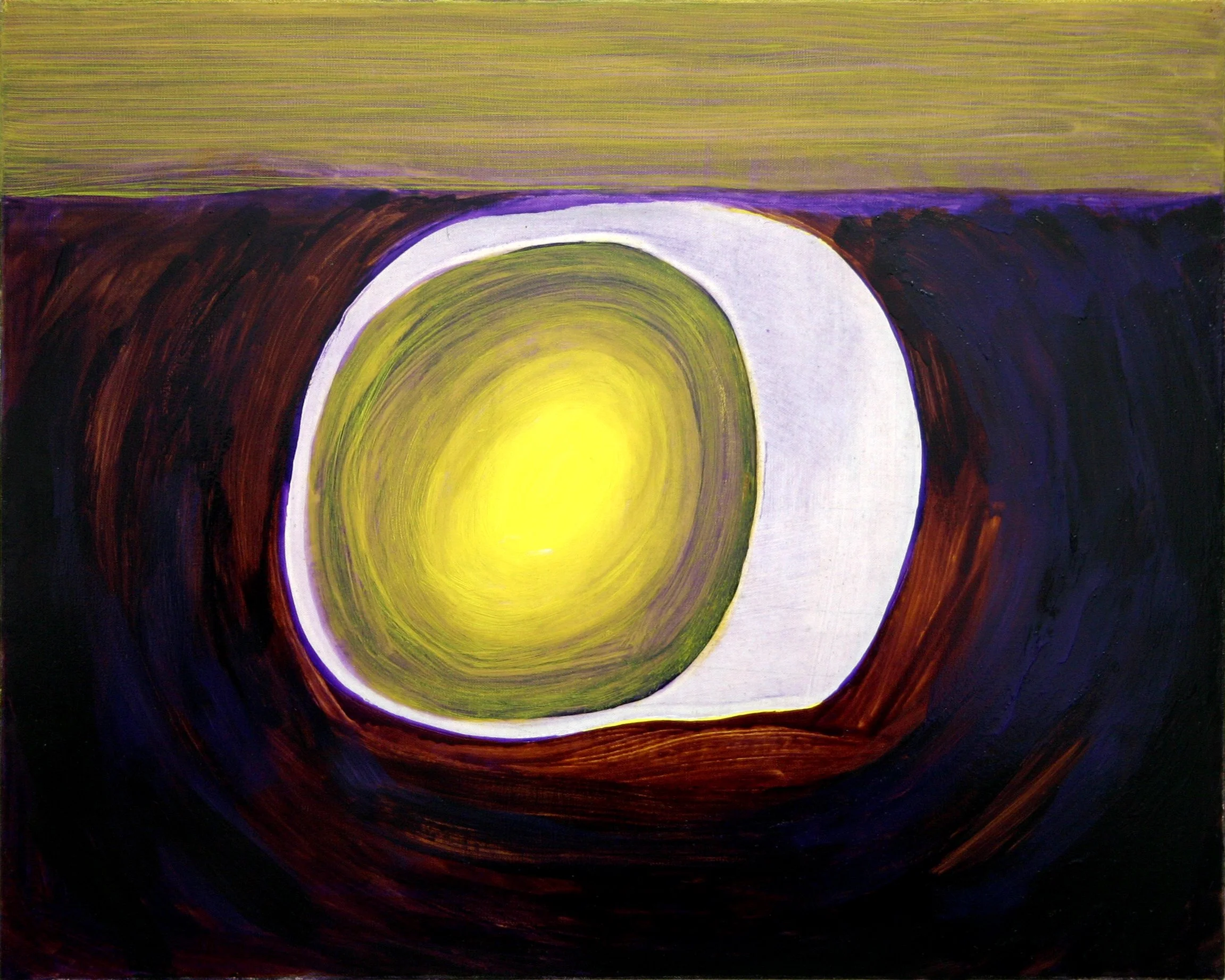
Matter and Light brings together two artists whose practices explore the shifting relationship between perception, material, and image. While their approaches diverge in medium and intent, both engage with the instability of representation - how meaning is formed, dissolved, or held in suspension between what is seen and what is felt.
Through painting, Alison Dalwood explores mutable terrain, where colour, mass, and luminosity unfold as phenomena of transformation. Stephan Hausmeister, through woodcut print and mediated image, examines how pictures circulate within collective consciousness - how symbols acquire gravity and how context alters perception.
What unites these practices is an attention to thresholds: between darkness and illumination, object and image, matter and thought. In each, light acts as both subject and catalyst, drawing form out of obscurity and returning it to flux. The exhibition proposes a shared inquiry into how the visible world, whether painted or reproduced - continually remakes itself in the act of being seen.
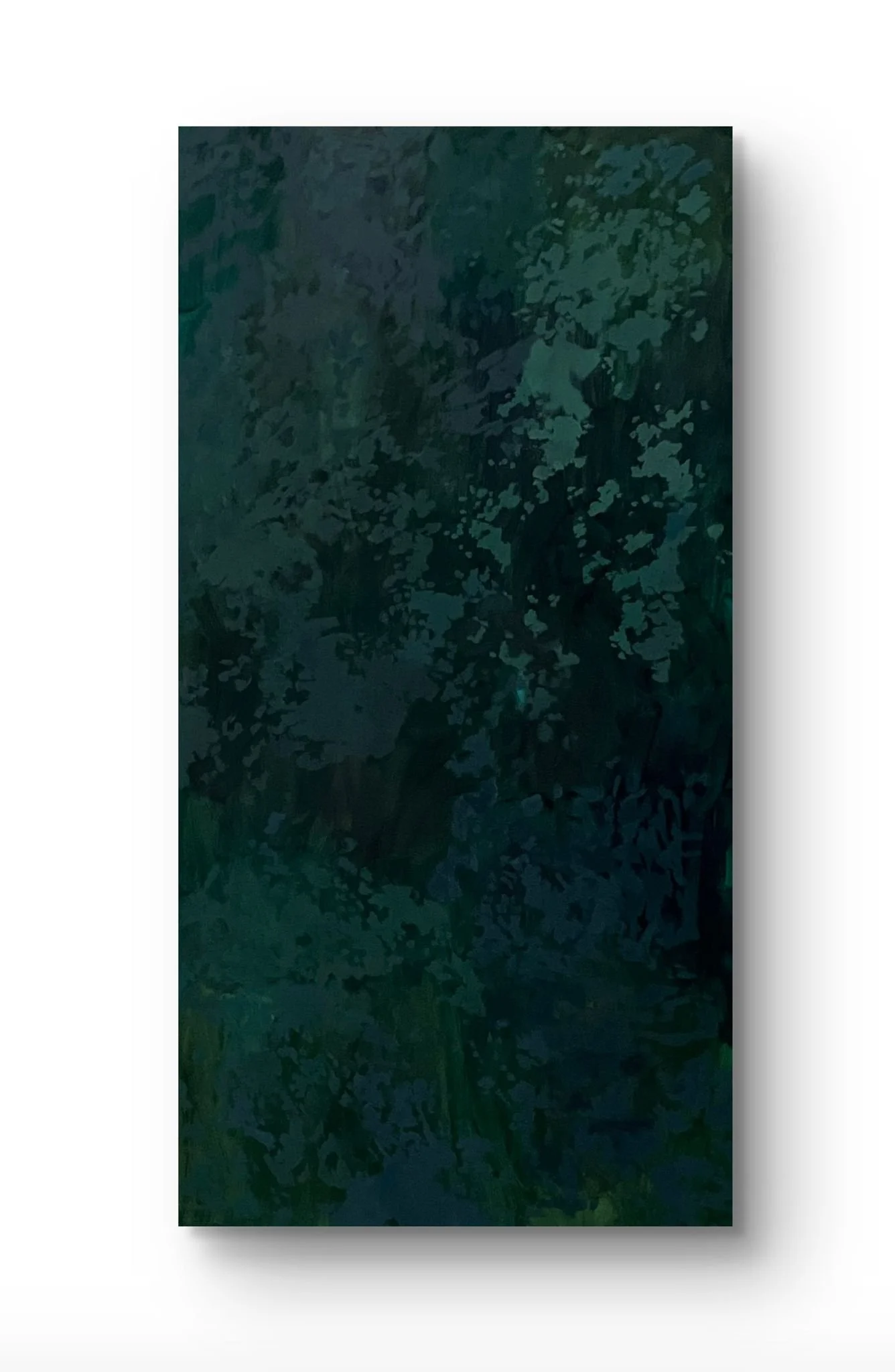
Alison Dalwood’s paintings transform mass and space into perceptual events. Each work traces how substance shifts, memory settles, and forms emerge and dissolve. Rather than depicting the world, they propose a process: an elemental field in constant flux, mutable and unresolved, where matter and perception converge and interact.
Stephan Hausmeister examines how images shape collective perception. Through woodcuts, paintings, and public interventions, he disrupts the circulation of mass-media imagery, exposing its instability. Iconic figures, suspended moments, and solitary forms are distilled into charged visual encounters that question meaning, memory, and the fragile systems that construct what we see.
Stephan Hausmeister
Matter and Light
Stephan Hausmeister’s practice explores the politics, logics, and mechanics of images; why certain pictures enter the collective field of vision while others remain unseen. His work intervenes in the circulation of visual material, interrupting the flow of mass-media content through public and performative gestures, including temporary site-specific billboards and interventions across newspapers, magazines, and online platforms.
Hausmeister re-edits and republishes material sourced from mass media, displacing original contexts and sequences to disrupt habitual readings. By manipulating framing and distribution, he exposes the instability of visual hierarchies, revealing how meaning is continually reshaped through systems of reproduction and transmission. These actions often fold back into the very networks they critique: documentation of his interventions circulates widely through the same outlets from which the source material was drawn. This recursive movement underscores a central concern: not to assert a political position or alternative truth, but to foreground the subjectivity of mass imagery and the transient systems that sustain it.
In the Immigrant Inconnu series of unique woodcuts (60 × 60 cm), Hausmeister turns to iconic pictures that define collective memory of recent history. Rather than reproducing specific photographs, he translates them into a reduced visual language shaped by carving and grain. Each version is printed onto an individually painted canvas, making every work unique. Through this process, detail is both lost and reconfigured. What remains are traces: silhouettes, gestures, and structures that exist between documentation and recollection. The series reflects on how such forms persist not as fixed records, but as images continually reinterpreted through material, memory, and time.
Selected for their global familiarity, these source pictures emerge from the constant flux of contemporary visual culture. They depict moments of intense human presence set against overwhelming forces: a figure suspended above a void, a lone individual confronting an army. Their pathos is distilled through the physicality of woodcut—the act of carving, the resistance of grain, the pressure of printing. By fixing these transient moments in a tactile medium, Hausmeister heightens the tension between permanence and ephemerality, resistance and disappearance.
In this exhibition, the woodcuts are arranged to suggest a loose narrative progression. The Significant Objects series extends this enquiry through painting. Each presents a single, weighty form against a pared-back ground. These objects assert volume and cast shadows, yet remain ambiguous, hovering between recognition and abstraction. In their stillness, they invite reflection on how visual forms acquire emotional and symbolic charge once stripped of narrative context.
Hausmeister’s visual language bears traces of German Expressionism, evident in bold contrasts, structural clarity, and an engagement with the emotional and ethical weight of representation. His work combines critical attention to media systems with a painterly sensitivity to form, tone, and surface.
Biography
Stephan Hausmeister is a German-born, UK-based artist whose practice spans painting, printmaking, installation, performance, and curatorial work, critically engaging with the circulation and politics of images. He participated in Joseph Beuys’ Free International University at Documeta 6 and went on to study at the Berlin University of the Arts (1980–87). Early support from the Berlin Senate of Cultural Affairs enabled extended periods of work in Morocco, followed by further grants and, in 1991, the prestigious DAAD Artists-in-Berlin Program, which brought him to London.
In 1995 he founded Artistsprinting, one of the UK’s first large-format digital print workshops for artists. Hausmeister has exhibited and produced projects across Europe, the United States, Asia, and South America, with presentations at major institutions and events including the Martin-Gropius-Bau and 2360CUFT at the Kaohsiung Container Arts Festival, Kaohsiung Museum of Fine Arts, Taiwan.
Selected exhibitions and projects include Walking Billboards at Documenta 11 (2002); Gefährliche Benutzeroberflächen (Hazardous User Interfaces) at Kunstverein Grafschaft Bentheim (2003); Field of Vision: New York at The Lab Gallery, New York (2004); Field of Vision: Beijing at Beijing New Art Projects (2006); The Utopia of 20 Minutes Embrace at the Brandenburg Gate and Akademie der Künste, Berlin (2007); Break on Through to the Other Side at the East Side Gallery, Berlin (2009); Science & Fiction – A Laboratory of Drawing at Katz Contemporary, Zurich (2012); and Bridge over Trouble at Yizhao Space, 798 Art Zone, Beijing (2012).
His long-term engagement with cross-cultural exchange has led to collaborations with leading artists, including work as artistic director of large-scale performances and public interventions. From 2003 to 2014 he developed and curated projects and exchange programmes between European and Chinese artists, such as Field of Vision, building on earlier initiatives including Unwahr Gallery in Berlin. Alongside his artistic practice, Hausmeister has held visiting lectureships at Columbia University New York, the University of Illinois at Urbana-Champaign, and the University of Hertfordshire.
Alison Dalwood
Matter and Light
You don’t need background or explanation when looking at these paintings. Some things are left open. What matters is the encounter: scale, surface, the way paint sits and carries light. It is not only visual. When a painting brings together immediacy and complexity and comes into a kind of balance, that tension is what matters.
The paintings emerge from attention to light, clouds, reflections, and the way things shift and dissolve. Paint is moved, layered, thinned, built up, and left to behave. The surface matters: how it receives light, how it absorbs or releases it, how it changes as perception shifts in and out of focus.
Forms appear and dissolve with a slightly destabilising effect that makes sustained focus difficult. They may register as something distant or close, a fragment of landscape, a trace of movement, but they do not settle. This instability carries a rhythm of emergence and disappearance, shifting with proximity and duration.
A diptych in the exhibition sets two conditions side by side: a pale blue painting where paint disperses into something like air or vapour, and a deep green work where light is broken across a denser surface. They do not describe anything directly, but sit in relation - two ways of working with light.
What remains is the act of perception itself, something forming, then slipping away, and the sense that there is always more present than can be fully grasped.
Biography
Alison Dalwood studied Fine Art at Newcastle University and holds an MFA from the University of Reading. Her practice spans painting and installation, and has developed alongside a sustained interest in perception, time, and the conditions of looking. Alongside her artistic practice, she has held academic roles as fine art lecturer at the University of Hertfordshire and has contributed to teaching in various art colleges as a visiting lecturer.
Dalwood has exhibited widely in solo shows across Europe and the UK, including Nothing from Something at the Globe Gallery, Newcastle upon Tyne (2013); Unattended Moment at Casa Matei Gallery, Cluj-Napoca (2011); Multiple Spaces at Academia Gallery, Sofia (2007); Time and Light at the Institute for New Media, Frankfurt (2005); Location Matters at I Space,Chicago (2000); Recente Schilderijen at Agni Fine Art, The Hague (2000); Neue Arbeiten at Galerie Unwahr, Berlin (1999); and an early solo exhibition at the Hatton Gallery, Newcastle. These exhibitions trace a long-standing engagement with spatial and temporal enquiry across varied international contexts.
Her work has also been shown in group exhibitions, including Are You Seeing What I’m Seeing (University of Hertfordshire, 2022), Recpice Finem (Schloss Bothmer, Germany, 2020), Fully Awake (Edinburgh Art Festival, 2019), Auftakt Rhythm Section, (European House of Art Upper Bavaria, 2017) and The Open West (The Wilson Gallery, Cheltenham, 2015), as well as projects in Beijing, New York, Chicago, Santiago, and across Germany and Switzerland. She has undertaken residencies at the Institute for New Media, Frankfurt (2005) and the University of Oxford’s Harcourt Arboretum (2009), and received Arts Council England Individual Artist Grants (2005, 2007) alongside the University of Hertfordshire Vice Chancellor’s Award (2007). Her essay in the publication Wonder in Contemporary Artistic Practice (Routledge, 2017) extends these concerns into writing, while her work is held in public and private collections, including a permanent commissioned installation at the University of Ulster.